
Indonesia Walk for Peace Promotes Religious Tolerance and National Unity
..Indonesia’s greatest challenge lies in adopting this spirit a part of everyday culture.Surabaya, East Java (ANTARA) -
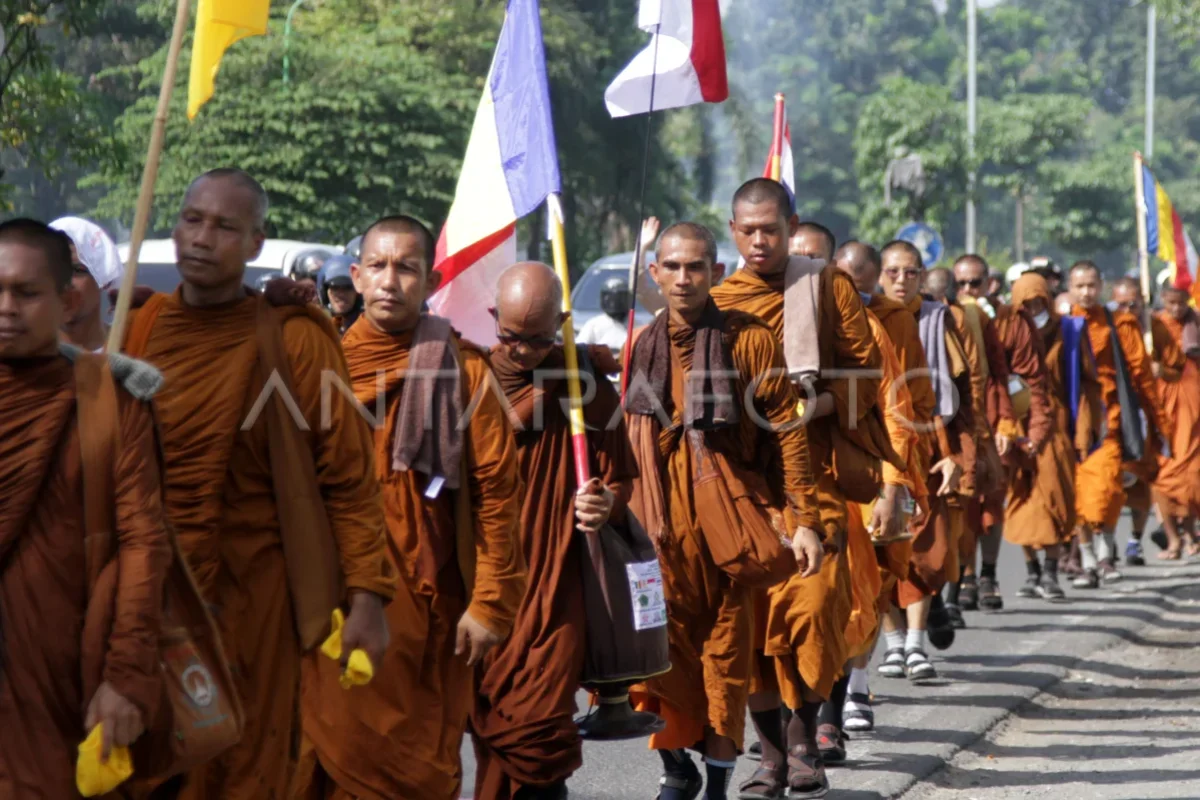
The waves of heat rising from the asphalt of Jalan Ahmad Yani in Surabaya did little to slow the steady steps of the monks in their brown robes.
Moving at an unhurried pace, heads gently bowed and simple bags in hand, they navigated their way with a calmness that contrasted sharply with the pace of the modern city.
On the sidewalk, residents stopped for them. Drivers slowed, small vendors waved, children took photos with their phones, and people of various faiths offered drinks.
In a world increasingly troubled by social polarization, identity conflicts, and political tensions, the monks’ journey on the 2026 Indonesia Walk for Peace (IWFP) felt like a timely reminder.
The IWFP was more than a spiritual journey to Borobudur Temple to celebrate Vesak. It also stood as a reflection of Indonesia as a diverse nation, united in its shared path forward.
A total of 57 monks from Thailand, Malaysia, Laos, and Indonesia walked more than 600 kilometers from Bali to Borobudur. They traveled through cities across East Java, stopping at monasteries, Chinese temples, and even mosques, carrying messages of peace and compassion.
In Banyuwangi, they were welcomed by an interfaith community at the Tik Liong Tian Rogojampi temple. In Surabaya, the group stopped at the Al Akbar National Mosque before continuing their journey to the temple. In Bali, local governments and village communities accompanied them on their journey.
The warm welcome came not only from Buddhists, but also from Muslims, Christians, Hindus, and the wider public also supported their journey. In a digital space often filled with clashes over identity, such scenes felt increasingly rare and reassuring.
Related news: Vesak celebration in Singkawang promotes tolerance, nationalism
Steps for tolerance
Indonesia has often been praised as a diverse nation capable of maintaining harmony. However, in recent years, challenges to tolerance have become more evident.
Social media makes differences more easily subject to debate and dispute. Identity politics emerges at almost every political moment. Even public spaces are often filled with suspicion towards different groups.
Therefore, the Indonesia Walk for Peace is compelling not only because of its spiritual journey, but it also brings tolerance in a concrete and visible form.
Tolerance has too often become a slogan, appearing in speeches, seminars, or banners commemorating national holidays. But on the road, the monks demonstrated that true tolerance lives on through direct human encounters.
When the group stopped at the Al Akbar Mosque in Surabaya, the message conveyed was not merely symbolic. It symbolized a deeper meaning: places of worship are no longer viewed as exclusive spaces belonging to one group, but rather as points of human encounter.
There, religious identities are not erased, but instead embraced in reverence.
Indonesia, in fact, has a long-standing tradition of this practice. In many regions, people are accustomed to living side by side without overly stressing differences in belief.
Villages in Java, Bali, Maluku, and even Sulawesi have historical experiences of interfaith mutual cooperation. However, urban modernization and the rapid flow of digital politics are slowly eroding these spaces for encounter.
People now meet more often through screens than on the streets. As a result, empathy is easily diminished as social relationships become algorithmic. Differences are no longer understood as a normal social reality, but rather as a threat to be confronted.
At this point, the monks’ journeys have great symbolic power. They walk slowly among the community, opening up space for direct interaction, and reminding us that peace is not born from lengthy lectures, but from a willingness to be present together.
The Indonesia Walk for Peace demonstrates that peace diplomacy is more powerful in simplicity, conducted on foot through villages, greeting ordinary people, and building emotional connections between nations in simple ways.
Related news: VP Gibran urges unity, tolerance amid global tensions
Silent walk
The IWFP resonates with present-day Indonesia as it offers a space of silence within an increasingly noisy cultural landscape. Meanwhile, modern life continues to accelerate, with people racing for productivity, popularity, and attention.
In such a situation, the monks’ journey feels like a silent critique of the modern world. They walk dozens of kilometers each day without luxury, large processions, and the demands of popularity.
Even when the four monks become exhausted on their way to Surabaya, the group continues their journey at a simple pace. In this context, spirituality becomes most concretely expressed in resilience, patience, and discipline.
Indonesia is actually facing a deeper social problem than mere intolerance. Society is increasingly divided due to the lack of space for reflection. Public conversation is overly filled with anger, while the space for listening is slowly disappearing.
The IWFP offers a different approach. It does not come with propaganda or a large-scale campaign. It delivers peace from the simple act of walking.
In many Asian traditions, spiritual journeys are closely linked to a contemplative meaning. Traveling means realizing that life does not always have to be rushed.
Values such as patience and self-control are even more important in the modern era.
Therefore, the public’s enthusiasm for the IWFP is not merely a tribute to Buddhist rituals. It is a broader social longing: a longing for peace, for warmer human relationships, and for a public life free from strife.
Indonesia may still encounter issues of intolerance. However, the public’s response to monks demonstrates that the nation’s social foundations remain strong.
At the grassroots level, people are often more prepared to live in harmony than elite debates in digital spaces.
R