
Indonesia Urges Global Collaboration to Tackle Sustainable Development Challenges
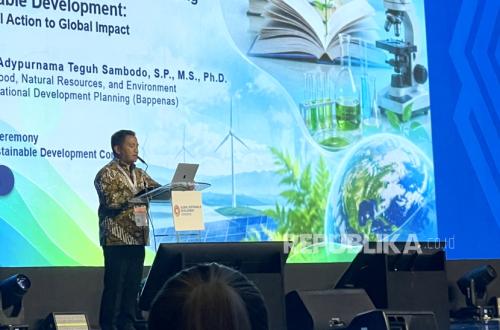
Indonesia is pushing for strengthened global collaboration to face increasingly complex sustainable development challenges, ranging from the climate crisis and food security to the slowing progress of the Sustainable Development Goals (SDGs). Cross-border cooperation between the business sector, academia, and international institutions is considered key to accelerating solutions for interconnected development issues.
This message was delivered during the opening of the Global Sustainable Development Congress (GSDC) 2026 in BSD, Tangerang, on Monday (22/06/2026). The global forum, which brings together over 1,000 world leaders from governments, universities, industry, and international organisations, serves as a platform to accelerate SDG achievement amidst rising global challenges.
Leonardo A.A. Teguh Sambodo, Deputy for Food, Natural Resources, and the Environment at the Ministry of National Development Planning/Bappenas, stated that the world is currently facing increasing pressure due to climate change, environmental degradation, and various crises that directly impact economic and social development.
According to Leonardo, these challenges can no longer be viewed merely as environmental issues, but have evolved into systemic risks affecting food security, water availability, public health, and economic stability.
“The climate crisis is no longer a standalone environmental issue. Its impact has affected economic development, social structures, and the welfare of society at large,” said Leonardo.
Leonardo shared recent data showing that most of the world’s SDG targets are facing delays. In the Asia-Pacific region, approximately 88 per cent of SDG targets are not on track to meet the 2030 deadline.
He noted that this condition requires a more integrated development approach by linking economic, social, and environmental agendas within a single, mutually supporting policy framework.
For Indonesia, Leonardo continued, the SDGs have become part of the national development agenda, integrated with the Indonesia Emas 2045 vision and the target to achieve net-zero emissions by 2060.
According to Leonardo, Indonesia’s progress continues to show positive development. Based on the Indonesia SDGs 2025 report, approximately 62.7 per cent of national indicators have reached their targets or show appropriate trends.
Nevertheless, Leonardo assessed that acceleration is still required, given that development challenges are becoming more complex and require support from various parties.
He emphasised that universities hold a strategic position in accelerating SDG achievement through research, innovation, and the development of solutions that can be directly applied within society.
“Sustainable development requires the active contribution of all stakeholders, and universities are at the centre of those efforts,” said Leonardo.
Leonardo mentioned that Indonesia currently has 75 SDGs Centres spread across 26 provinces. The existence of these study centres is expected to strengthen collaboration between universities, local governments, the community, and the business world in addressing various development challenges.
Meanwhile, the British Ambassador to Indonesia, Dominic Jermey, stated that sustainable development represents one of the greatest challenges and opportunities for current and future generations.
According to Dominic, the transition to a green economy has the potential to create new jobs and drive more sustainable economic growth. However, the success of this transformation depends heavily on the quality of education and human resource development.
“Education is the foundation for building the skills, knowledge, and innovation required in the economy of the future,” said Dominic.
Dominic stated that the United Kingdom continues to strengthen cooperation with Indonesia in the fields of education, research, climate change, and technological development. This collaboration is expected to accelerate the emergence of various innovative solutions to address global development challenges.
He added that sustainable development cannot be achieved by governments, businesses, or academics acting in isolation. Therefore, collaboration is the primary factor in accelerating the achievement of global development targets.
“The transition to a sustainable future can only be achieved through collaboration. All parties have an important role to play in shaping a better future,” said Dominic.
The Global Sustainable Development Congress 2026 will run for several days, featuring discussions on various strategic issues, ranging from climate change and educational transformation to technological innovation and the strengthening of global partnerships to accelerate the achievement of the SDGs.