
Indonesia, Türkiye, Pakistan and Qatar Sign Defence Cooperation Pact Named After the Battle of Badr
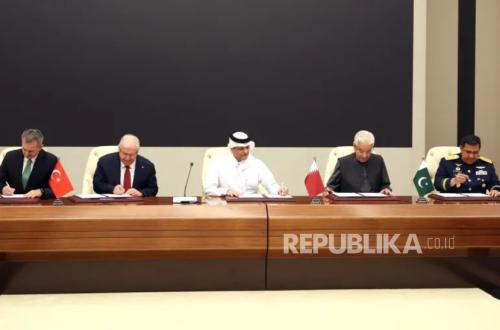
DOHA — Indonesia, Türkiye, Pakistan and Qatar have signed a defence cooperation agreement to strengthen their military capabilities and develop their respective defence industries. The agreement opens up opportunities for joint weapons production, technology development and military research.
Türkiye’s Ministry of National Defence announced that the agreement, titled the Badr Memorandum of Understanding, was signed in Doha, Qatar, on Wednesday (21 October 2026).
There has been no official explanation for the choice of the name Badr. In Islamic history, however, it is known as the first battle fought by the Prophet Muhammad against the Quraysh. The battle, between 300 Muslims and 1,000 Quraysh troops, was also the first victory for the Muslim community.
Reuters reported on Wednesday that the memorandum aims to deepen the four countries’ strategic partnership through cooperation in military production, defence capability-building, technical training, and research and development.
Indonesia was represented at the signing by Deputy Defence Minister Yusuf Jauhari. Türkiye was represented by Defence Minister Yaşar Güler; Qatar by Deputy Prime Minister and Minister of State for Defence Affairs Sheikh Saud bin Abdulrahman bin Hasan Al Thani; and Pakistan by Defence Minister Khawaja Muhammad Asif.
Türkiye’s Ministry of National Defence said the agreement was economically significant because it would enable each country to draw on the strengths of its own defence industry.
The cooperation is expected to strengthen production capacity, integrate the countries’ defence-industry capabilities and create opportunities to meet the defence needs of friendly countries and partners.
Haluk Gorgun, head of Türkiye’s Defence Industry Agency, said the agreement would provide a foundation for joint production and technology development.
He said technology exchange, joint development and stronger domestic production capabilities were essential to building a sustainable defence industry.
Gorgun said he hoped the complementary capabilities of Türkiye, Qatar, Pakistan and Indonesia could be turned into concrete projects.
The four-country agreement comes as governments seek to strengthen their domestic defence capabilities and expand security partnerships amid geopolitical uncertainty.
Al Jazeera reported on Thursday (22 October 2026) that the agreement came as efforts by the United States and Iran to reach a concrete peace deal had yet to produce results. This has encouraged countries in the region to diversify their defence partnerships and reduce excessive dependence on Washington.
Diversification does not necessarily mean abandoning longstanding alliances. Instead, these countries are seeking greater control over their own security while maintaining existing partnerships.
Arda Mevlutoglu, a defence-industry analyst and managing director of Mergen Analytical Strategies, said the development could give rise to a wider network of defence cooperation.
“We may be witnessing the emergence of an interconnected network of defence and security arrangements stretching from the Gulf to South Asia and South-east Asia, rather than a single formal alliance,” Mevlutoglu told Al Jazeera.
Qatar’s Ministry of Defence said the Badr memorandum aims to promote defence manufacturing cooperation, improve the four countries’ defence capabilities, and expand technical training, research and development.
Under the agreement, each country is expected to contribute its strengths to building a complementary defence-industrial ecosystem.
Türkiye has technological expertise, systems-integration capabilities and a relatively mature defence industry. Pakistan and Indonesia offer manufacturing capacity, a skilled workforce and large domestic markets. Qatar, meanwhile, has investment potential and demand for defence equipment.
Mevlutoglu said combining these capabilities could enable the four countries to build an integrated supply chain to jointly develop, produce and maintain defence systems.
Albert Vidal, a researcher at the International Institute for Strategic Studies, said Pakistan and Indonesia were also interested in buying Turkish weapons while locating some of the production process in their own countries.
Such arrangements could lower costs for Turkish defence companies while creating jobs and strengthening industrial capacity in Indonesia and Pakistan. Qatar could contribute through financing and investment.
The cooperation, therefore, is not limited to weapons purchases; it also offers opportunities to acquire technology and develop production capabilities in buyer countries.
The Badr agreement builds on existing defence-industry ties among the participating countries.
Türkiye has previously pursued separate military-production cooperation with Qatar, Pakistan and Indonesia. Qatar and Türkiye, for example, signed a bilateral memorandum of understanding on the defence industry in October 2025.
Qatar has also invested in Türkiye’s defence industry for more than a decade. Their relationship extends beyond industry to security: during Qatar’s 2017 diplomatic crisis, Türkiye deployed troops to Doha.
Pakistan and Türkiye, meanwhile, are developing a warship project. Of the four ships planned, two are being built in Istanbul and two at Karachi Shipyard in Pakistan.
Indonesia also has a joint tank-development project with Türkiye.
Burcu Ozcelik, a senior researcher at the Royal United Services Institute, said the new agreement could bring together previously separate defence-export and joint-production projects in a more structured and resilient network.
In other words, Badr could provide a framework for integrating existing projects while creating new opportunities for collaboration among the four countries.
US-Israeli attacks on Iran and Houthi attacks on Saudi Arabia have heightened security concerns in the region. At the same time, reports of limits on US weapons stocks have encouraged countries to build their own arms-production capacity and cooperate with other partners.
Mevlutoglu said diversification was one of the main drivers of the cooperation. Recent conflicts have exposed vulnerabilities arising from dependence on foreign suppliers, restrictions on access to technology and supply-chain disruptions.
He cautioned, however, against interpreting the Badr agreement as an effort to sever ties with Washington.
Qatar is unlikely, he said, to abandon its strategic relationship with the United States. Türkiye is also seeking greater independence in defence technology within the framework of its NATO membership, rather than seeking to leave the alliance.
Bader Mousa Al-Saif, an associate researcher in the Middle East and North Africa programme at Chatham House and a lecturer at Kuwait University, said the initiative reflected a growing tendency among Gulf countries to look to the Global South and fellow Muslim-majority countries as partners.
The Badr cooperation is taking place alongside other efforts to strengthen regional security ties.
In August 2026, Saudi Arabia, Pakistan and Türkiye signed the Makkah Joint Defence Agreement, which includes mutual defence commitments. Türkiye subsequently submitted the agreement to parliament for ratification on Wednesday (21 October 2026).
Although complementary, the two agreements have different aims. The Makkah agreement focuses on deterring threats and collective military cooperation, while the Badr memorandum centres on the defence industry and technology.
Mevlutoglu said industrial cooperation in Doha could provide a technological and production foundation for a broader security partnership.
For Indonesia, the agreement offers an opportunity to strengthen its national defence industry through joint production, technology transfer, workforce skills development and supply-chain development. Whether those benefits materialise will depend on concrete projects, the division of industrial roles and the extent to which the cooperation results in domestic mastery of technology.
Source: jawawa.id (https://jawawa.id/newsitem/indonesia-turkiye-pakistan-and-qatar-sign-defence-cooperation-pact-named-after-the-battle-of-badr-1792608638)
Originally published by Republika (https://news.republika.co.id/berita/tn9r4i393/indonesia-turki-pakistan-qatar-jalin-kerja-sama-pertahanan-ambil-nama-dari-perang-badar), translated from Indonesian