
Indonesia to Trial New B50 Fuel for Trains Next Week
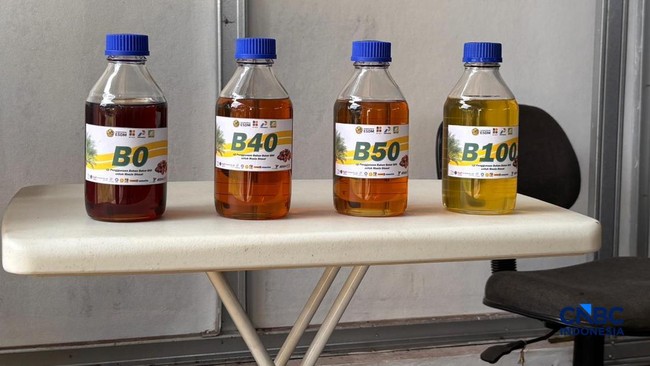
Lembang, CNBC Indonesia - The Ministry of Energy and Mineral Resources (ESDM) has scheduled trials for the use of 50% biodiesel (B50) fuel in the railway sector starting next week. This will be followed by the target for commercial implementation of B50 in July 2026.
Director General of New, Renewable Energy, and Energy Conservation (EBTKE) at the Ministry of ESDM, Eniya Listiani Dewi, explained that the testing on trains was delayed pending the end of the Eid al-Fitr holiday period. She stated that the testing will be conducted on long-distance routes on Java island to assess the durability of locomotive engines.
“The trains next week, we will run them using the route from Yogyakarta to Pasar Senen, from Lempuyangan Station to Pasar Senen, continuously. Another locomotive from Gambir to Pasar Turi. That is what we have already done, and the trains will start now because we were waiting for Eid to finish,” said Eniya when met at the B50 Road Test Fuel Blending and Filling Station, Lembang, on Tuesday (21/4/2026).
The trials in the railway sector align with the series of tests already underway in the automotive, mining, and maritime sectors. The government projects that testing in these three main sectors will be completed by July to support the simultaneous implementation of B50 across Indonesia.
“Our prediction is that the three sectors will be finished by July. Insyaallah, in line with the directives, it can be 1 July,” Eniya continued.
The government is also tightening specifications for vegetable fuel (FAME) used in the B50 mixture to ensure engine performance. Quality parameters such as water content and monoglyceride in the FAME specifications used in the B50 mixture are being lowered compared to B40 standards to prevent deposits or technical issues in diesel engines.
“So these are requirements for the vegetable fuel business entities, we stipulate them like that so that the performance is good. Definitely improved because we are testing the performance, that’s why we set the B100 specifications to be much better,” Eniya concluded.
Based on data from the Ministry of ESDM, the implementation of the B50 programme targeted for July 2026 is projected to save state foreign exchange up to Rp 157.28 trillion. In addition to economic aspects, the policy is also expected to add national employment with a target absorption of more than 2.2 million workers.
From an environmental perspective, the use of B50 is targeted to reduce greenhouse gas emissions by 46.72 million tons of CO2 in 2026. As of mid-April 2026, the national biodiesel distribution realisation has reached 3.90 million kilolitres, or about 24.9% of the initial annual allocation of 15.65 million kilolitres.
Technically, the B50 specifications are enhanced to maintain engine performance, including reducing water content to a maximum of 300 ppm and monoglyceride to a maximum of 0.47% by mass. Oxidation stability is also strengthened to a minimum of 900 minutes to ensure fuel quality remains prime during storage and distribution across various regions.
The government targets the completion of all trial series in the automotive sector by June 2026, while other strategic sectors such as heavy equipment and railways will be finalised gradually until the end of the year. With interim test results showing reliable and safe performance, B50 is ready to strengthen national energy independence.