
Indonesia to Become First Country to Use 3 kg CNG for Cooking
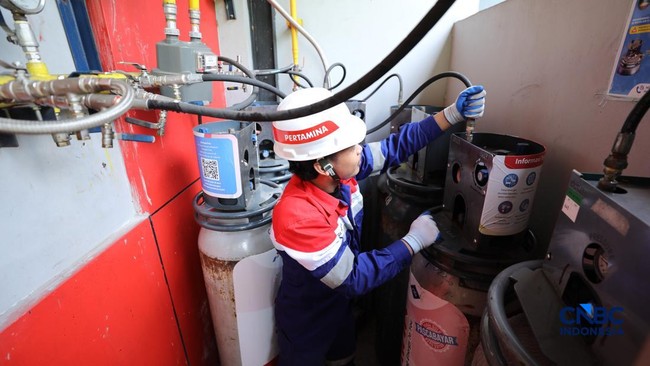
Indonesia will become the first country to implement the use of 3 kg CNG (Compressed Natural Gas) for cooking fuel as an alternative to replace Liquefied Petroleum Gas (LPG). The Ministry of Energy and Mineral Resources (ESDM) is currently finalising plans for its use. A roadmap for the transition from 3 kg LPG to 3 kg CNG is being prepared. Director General of Oil and Gas Laode Sulaeman explained that the roadmap is expected to make the switch safe and efficient. “(3 kg CNG) is the first in the world. Indeed, there are many challenges, as the Minister said earlier, but we will never succeed if we never face those challenges,” he said in the ESDM Ministry’s Bukan Abuleke Podcast in Jakarta, quoted on Friday (29/5/2026). The 3 kg CNG will utilise Type 4 cylinder technology made from fibre composite material. The use of this cylinder offers light weight and strength to withstand high gas pressure. The same technology is already used globally, but only for sizes equivalent to 12 kg LPG and above. “So, this Type 4 cylinder we are making does not yet exist in the world to replace the equivalent of 3 kg LPG. The ones that exist are equivalent to 12 kg LPG, which are already in use now and above,” Laode said. The transition from LPG to CNG is also projected to reduce the subsidy burden by 30–40%. This is because CNG uses domestic natural gas components, unlike LPG, which is still imported at a volume of 7 million tonnes per year. “After calculations, the Minister conveyed that subsidies are still needed, but they can be reduced by 30 to 40% because of the efficiency process. This CNG is our own, compared to having to import,” he added. The government also stated that the public does not need to make major modifications. The valve system of the CNG cylinder is specially designed to be compatible with existing household cooking equipment. “The initial idea was that it must be the same as the 3 kg LPG; it must not be different, otherwise housewives will object. The public does not need to replace their stoves,” he stressed.