
Indonesia to Adopt 'Free and Active' Policy in Nuclear Power Plant Development
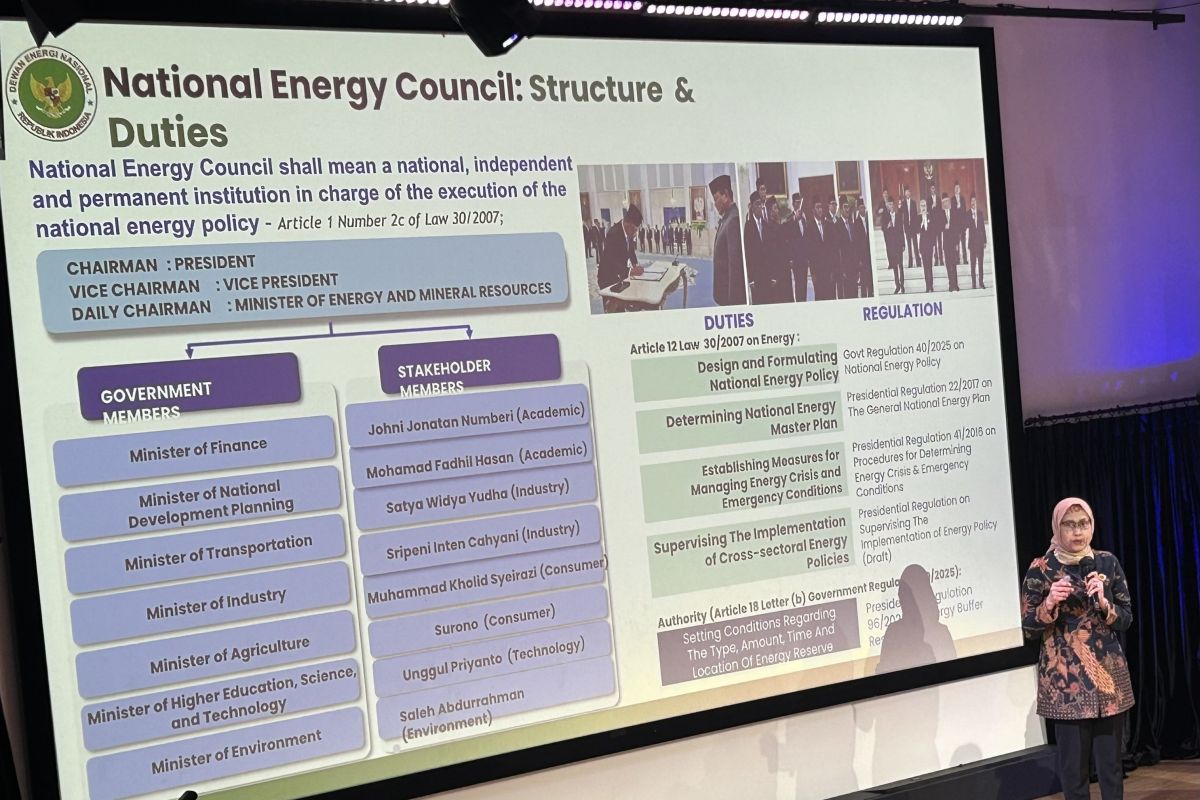
Indonesia’s National Energy Council (DEN) has affirmed that the country’s ‘free and active’ foreign policy stance will be an advantage in developing nuclear power plants (PLTN), with the first phase targeted to operate by 2032.
Speaking at a panel discussion titled ‘American Leadership in Clean Nuclear Strategy’ at @america Jakarta on Tuesday, DEN member Sripeni Inten Cahyani said the policy allows Indonesia to collaborate with multiple advanced nations on nuclear technology.
‘In the view of the National Energy Council, developing nuclear power with various technologies from advanced countries is better. For instance, we are also developing cooperation with America, with technology from America, technology from Russia, technology from China, Korea, and so on. I think that is better because we adopt a free and active foreign policy,’ she said.
Inten noted that Indonesia, through state electricity company PLN, is already cooperating with the United States on studies to prepare for nuclear power development.
Indonesia is targeting nuclear power plant capacity of 35 to 42 gigawatts by 2060 as part of its efforts to achieve net zero emissions.
Meanwhile, under the 2025–2034 Electricity Supply Business Plan (RUPTL), the government is targeting the construction of a 500-megawatt nuclear power plant to begin development in 2032 within the Sumatra and Kalimantan electricity systems.
To realise this target, DEN is considering the use of Small Modular Reactor (SMR) technology. This technology is considered to have a higher safety level and is more suited to Indonesia’s geographical conditions, particularly for remote areas.
Although the investment cost for SMRs is relatively higher, Inten assessed that the technology remains more efficient compared to oil-fired power plants, such as those using High Speed Diesel (HSD). However, she acknowledged that SMR technology is still in the development stage in various countries.
According to Inten, several SMR projects are currently in the design to early construction phases. Some projects are expected to become commercially operational by 2029 at the earliest.
Meanwhile, Indonesia tends to adopt only proven, commercially ready technologies to minimise governance and operational risks.
‘So that is one issue. The problem is that the technology is still in the development stage,’ she said.
Furthermore, geopolitical aspects are also a concern in nuclear energy development, as the technology is generally dominated by major powers such as the United States and Russia.
Despite this, Inten stressed that Indonesia will adhere to its free and active principle in determining cooperation partners. According to her, the government will select technologies that are proven reliable, meet established standards, and are supported by adequate financing schemes and implementation processes.
She added that the government must also prepare various supporting stages, from feasibility studies and preliminary project assessments to public outreach and increasing public understanding of nuclear energy as part of the preparations for developing nuclear power plants in Indonesia.
‘So, because Indonesia adheres to a free and active foreign policy, what matters is that the technology is proven, and then we can develop whichever one, as long as the criteria are met. Including ease of financing, as well as ease of and support for the processes,’ she said.