
Indonesia Targets Soybean Self-Sufficiency Within 3-4 Years, Land and Seeds Prepared
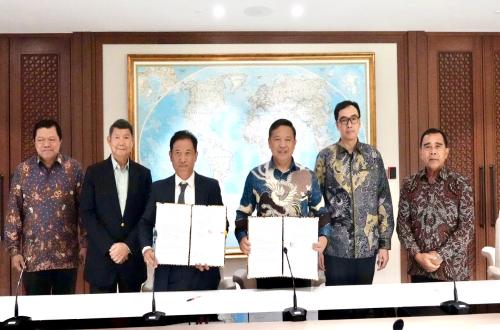
PTPN Group and PT Karya Unggulan Anak Bangsa (KUAB) are preparing for the potential development of soybean cultivation on approximately 4,800 hectares of land spread across several regions in Java and Banten. The collaboration covers everything from upstream to downstream cultivation, as well as the development of a Soybean Seed Development Centre to support seed availability for farmers.
The partnership was formalised through the signing of a Memorandum of Understanding regarding land utilisation and soybean cultivation development in Jakarta on Friday (11/0lam/2026). The signing was conducted by the President Director of PT KUAB, Ali Zum Mashar, and the Director of Assets of PTPN III (Persero), Agung Setya Imam Efendi, witnessed by the President Director of PTPN III (Persero), Denaldy Mulino Mauna, and the Special Envoy to the President of Indonesia, Hashim S Djojohadikusumo.
Hashim stated that soybean development must be accompanied by the strengthening of the seed system to ensure that farmers’ needs can be met domestically. “I believe this is very strategic for soybean food self-sufficiency,” Hashim said, according to a press release received on Sunday (13/09/2026).
Hashim hopes that Indonesia can achieve soybean self-sufficiency within three to four years. According to him, the availability of suitable land for soybeans opens opportunities for seed development that can be distributed to cooperatives and farmers in various regions.
“We should be able to achieve soybean self-sufficiency perhaps within 3–4 years. And I believe our intention is to supply and provide seeds to cooperatives or many farmers throughout Indonesia,” he added.
The President Director of PTPN III (Persero), Denaldly Mulino Mauna, stated that PTPN Group will perform coordination and facilitation functions in implementing the programme. Implementation will be carried out gradually, taking into account land readiness, productivity, business models, and programme sustainability.
“PTPN Group is ready to play its role in supporting national soybean development through measured and feasibility-based collaboration,” said Denaldy.
The potential land of approximately 4,800 hectares is located within several PTPN Group assets, including the Jalupang Plantation in Subang Regency, Pasir Badak Plantation in Sukabumi Regency, Cikumpay Plantation in Purwakarta Regency, Cibungur Plantation in Sukabumi Regency, Cisalak Baru Plantation in Lebak Regency, and the PG Jatitujuh area in Majalengka Regency.
Under this cooperation, PTPN I, PTPN IV PalmCo, and PT Sinergi Gula Nusantara (SGN) will carry out roles according to their respective land ownership and management. PTPN IV PalmCo will also support knowledge transfer, cultivation development, and the absorption of soybeans for subsequent planting needs.
Meanwhile, PT KUAB will handle cultivation implementation, the provision of technology and MIGO soybean varieties, funding, and knowledge transfer. The parties will also assess technical aspects, productivity, business models, land readiness, and sustainability before wider development is undertaken.
The construction of a Soybean Seed Development Centre is one of the primary focuses of the cooperation. The centre is expected to support the availability of high-quality seeds and serve as a development model that can be applied alongside cooperatives and farmers in other regions.
This plan is linked to the government’s agenda to develop national soybeans, including the plan to assign PTPN Group to develop soybeans up to 250,000 hectares gradually until 2029. The partnership with PT KUAB is directed towards building land readiness, development models, and the production capacity required to support this plan.
Prior to the signing of the Memorandum of Understanding, PTPN Group and PT KUAB conducted site visits and field inspections at several potential cultivation locations. These stages included discussions on land suitability, mapping of proposed areas, and the preparation of the cooperation plan.
The soybean development is also aimed at supporting the government’s agenda to strengthen national food security and independence. Strengthening seed supply, land, cultivation, and farmer capacity are among the key aspects to be assessed during the initial stage of the cooperation.
Source: jawawa.id (https://jawawa.id/newsitem/indonesia-targets-soybean-self-sufficiency-within-3-4-years-land-and-seeds-prepared-1789289806)
Originally published by Republika (https://ekonomi.republika.co.id/berita/tlabub416/ri-targetkan-swasembada-kedelai-34-tahun-lahan-dan-benih-disiapkan), translated from Indonesian