
Indonesia targets renewable energy investment from China
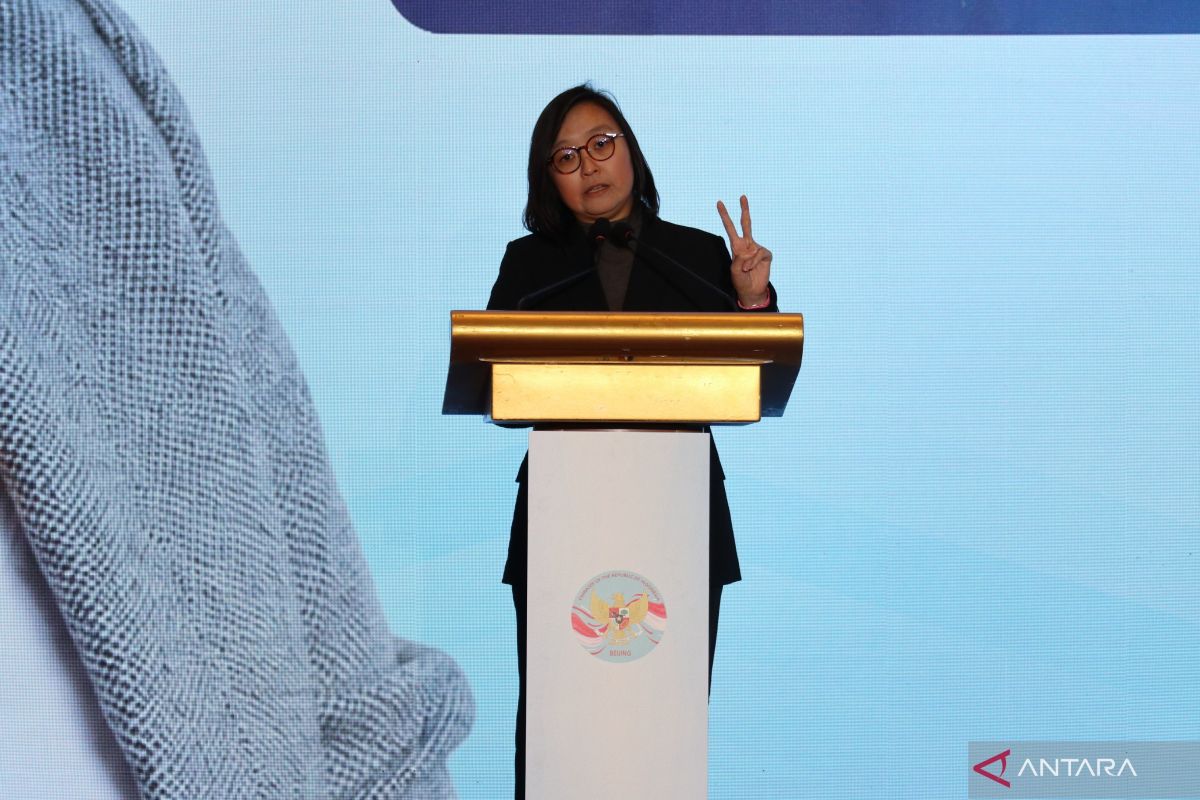
Indonesia is targeting renewable energy investment from China, which is known for its strength in renewable energy technology.
“When we talk about renewable and sustainable energy, the issue is not merely the quality of the transactions we undertake, but also how we shape the future of humanity,” Deputy Minister for Creative Economy and Deputy Head of the Creative Economy Agency Irene Umar said in Beijing on Monday.
Irene made the remarks at the Indonesia-China business forum, entitled “Mobilising China RE Investment into Indonesia”, attended by around 150 business participants from Indonesia and China.
Reports show that in 2025, China’s carbon dioxide emissions relative to gross domestic product (GDP) were down 17.7 per cent compared with 2020. Non-fossil energy sources accounted for 21.7 per cent of national energy consumption, while China’s combined installed wind and solar capacity reached 1.84 billion kilowatts. Forest reserves increased to 20.99 billion cubic metres.
By the first half of 2026, China’s total installed renewable energy capacity had reached 2.46 billion kilowatts, or 60.7 per cent of national power-generation capacity. It surpassed coal-fired power capacity for the first time at the end of July 2026.
“This forum is not only about building mutual appreciation between the two countries or conducting transactions together. It is about how the two countries can build a relationship for a better world,” Irene said.
Irene also described China as a rising creative economy. “It is not only short dramas; we are also seeing how the gaming industry is shaping the economy,” she added.
Rizaldi Indra Janu, director of the Indonesia Investment Promotion Centre (IIPC) in Beijing, said Chinese investors had played an important role in developing competitive basic industries, helping to build the workforce and regional business networks.
“From automotive cooperation to household goods, there is still considerable scope to expand cooperation into energy, agriculture, the rapidly growing digital economy, healthcare and various other key industries,” Rizaldi said.
He said the Indonesian government wanted to see more Chinese companies invest in Indonesia beyond basic industries. The government is currently encouraging investment in downstream processing and critical minerals, new-energy vehicles and renewable energy, data centres and the digital economy, healthcare industries, food security and other priority sectors.
“For example, in West Java, particularly in the Cikarang and Jababeka areas, investors can access a strong automotive, electronics, industrial and logistics ecosystem. In Batam, Riau Islands, we see opportunities in exports and manufacturing, the textile industry and mineral components,” Rizaldi said.
East Java, particularly Surabaya, and Bali offer potential in medical equipment and food-related businesses.
“For investors, the key is choosing a location that matches their business opportunities. The right location can significantly improve operational efficiency while supporting business growth,” Rizaldi added.
Rizaldi said the government was optimising incentives and regulatory readiness by maximising investment incentives while ensuring permits and compliance were handled through an integrated and transparent system.
The incentives and facilities include income tax holidays or reductions for five to 20 years, a net-income deduction of up to 30 per cent for investment, gross-income deductions of 200 or 300 per cent, streamlined licensing through the OSS RBA system, and clear, investor-friendly regulations.
Strong local partnerships are also important, built on trust with the government, state-owned enterprises and local private businesses to accelerate market access and business growth.
Such partnerships include support from local governments, cooperation with state-owned enterprises and local private partners, engagement with business associations and industrial clusters, and talent development and knowledge exchange.
According to Investment Coordinating Board (BKPM) data, realised investment from mainland China in Indonesia from 2021 to the first half of 2026 reached US$38.34 billion, with average growth of 37 per cent and 553,492 local workers employed.
Investment stood at US$3.2 billion in 2021, then US$8.2 billion in 2022, US$7.4 billion in 2023, US$8.1 billion in 2024, US$7.5 billion in 2025 and US$3.8 billion through the second quarter of 2026.
China’s five largest investment sectors were basic metals, at US$17.2 billion or 45 per cent; transport, warehousing and telecommunications, at US$5 billion or 13 per cent; chemicals and pharmaceuticals, at US$3.9 billion or 10 per cent; housing, industrial estates and offices, at US$2.6 billion or 7 per cent; and electricity, gas and water, at US$1.6 billion or 4 per cent.
By region, Sulawesi received the most investment, at US$15.47 billion or 40.4 per cent, followed by Java at US$11.92 billion or 31.1 per cent; Maluku and Papua at US$7.52 billion or 19.6 per cent; Sumatra at US$1.98 billion or 5.2 per cent; Kalimantan at US$1.32 billion or 3.5 per cent; and Bali and Nusa Tenggara at US$0.13 billion or 0.3 per cent.
The five provinces receiving the most investment from mainland China were Central Sulawesi, at US$14.16 billion or 37 per cent; North Maluku, at US$7.09 billion or 18 per cent; West Java, at US$5.39 billion or 14 per cent; Jakarta, at US$2.33 billion or 6 per cent; and Banten, at US$1.65 billion or 4 per cent.
Source: jawawa.id (https://jawawa.id/newsitem/indonesia-targets-renewable-energy-investment-from-china-1793631031)
Originally published by jatim.antaranews.com (https://jatim.antaranews.com/amp/berita/1114395/indonesia-bidik-investasi-energi-terbarukan-dari-china), translated from Indonesian