
Indonesia Targets Rehabilitation of 49,097 Hectares of Mangroves
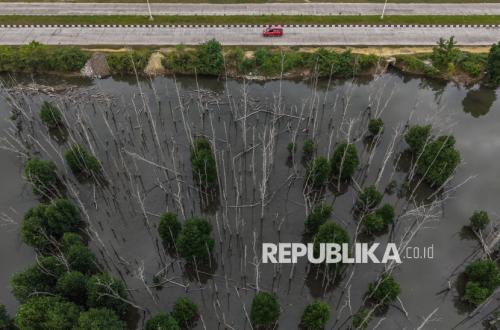
JAKARTA — The government aims to restore 3.31 million hectares of peatland and rehabilitate 49,097 hectares of mangroves by 2030. Environment Minister and Head of the Environmental Control Agency Mohammad Jumhur Hidayat is urging faster action through improved governance, collaboration across institutions and community involvement.
Jumhur said the challenges of protecting peatlands and mangroves could not be addressed simply by tackling visible impacts such as fires, smoke, floods, coastal erosion and emissions. The government needed to address the underlying problems that cause damage to these ecosystems to recur.
“If this way of thinking does not change, I fear we will keep putting out the same fire in the same place every year,” Jumhur said at the closing of the Integrated Management of Peatland Landscapes in Indonesia (IMPLI) Project on Wednesday (25 November 2026).
He said damage to peatlands and mangroves was linked to a range of governance problems, including peat drainage, falling groundwater levels, mangrove clearance for other uses, fragmented water management, inconsistent spatial planning, land disputes and economic incentives that favour land conversion.
According to Jumhur, fundamental change must begin with a new view of these two ecosystems. Peatlands and mangroves should be treated as natural capital and ecological infrastructure that helps safeguard development, just like roads and dams.
He cited experience in three provinces showing that ecosystem protection can go hand in hand with improving local livelihoods. In Riau, water management needs to be carried out across entire peat hydrological units. In Jambi, paludiculture offers communities income opportunities without requiring peatlands to be drained.
In South Sumatra, modelling has shown that peatland protection can coincide with economic gains and lower emissions. “So we are not choosing between conservation and the economy. What we need to build is an economy that adapts to the nature of its ecosystems,” Jumhur said.
According to the 2026 inventory, Indonesia has 13.36 million hectares of peatland. About 9.45 million hectares remain undamaged, while 3.91 million hectares have been degraded.
This means that around seven out of every 10 hectares of Indonesian peatland remain in good condition. Jumhur stressed that the government’s priority was to protect these areas from damage.
Of Indonesia’s approximately 3.45 million hectares of mangroves, 986,000 hectares have the potential to be restored. Around 82 per cent of the area with restoration potential consists of fish and shrimp ponds.
Mangrove restoration therefore cannot be limited to planting seedlings. The government needs to take account of the livelihoods of communities that depend on aquaculture ponds.
Productive ponds will be retained, while the management of ponds whose productivity has declined will be improved. Abandoned ponds that remain ecologically suitable will be returned to mangrove forest.
Jumhur said the government was targeting the restoration of 3.31 million hectares of peatland, with responsibilities shared among the Ministry of Environment, the Ministry of Forestry and companies. The programme is supported by 2,004 Peat-Care Independent Villages.
For mangroves, the government will work across 123 mangrove landscape units, with a rehabilitation target of 49,097 hectares by 2030. Detailed plans for peatland restoration and community economic models are being finalised with Gadjah Mada University (UGM), the World Bank and IPB University.
Jumhur emphasised that every restoration target must specify its location, activities, funding sources, responsible parties and a mechanism for measuring results. Success, he said, could not be measured merely by the number of canal blocks built or seedlings planted. The government must ensure that peatlands become wet again, fires do not recur, emissions fall and community welfare improves.
He added that the government was not starting from scratch. The Indonesia Mangroves and Peatlands Legacy (IMPLI) project has produced data on the characteristics of 48 peat hydrological units, peat ecosystem protection and management plans (RPPEGs) in five regencies, a groundwater-level monitoring system, and experience supporting communities in 13 villages.
That experience shows that peatland restoration requires more than building canal blocks. Village institutions must be strengthened, local economic activities must be viable, women must be involved, and communities’ environmental management practices must also change.
He said he hoped the knowledge, data and systems developed through the project would continue to be used after it ends. The establishment of the National Peatland and Mangrove Management Agency (BPGMN), he said, offers an opportunity to accelerate the work without starting again from scratch.
Source: jawawa.id (https://jawawa.id/newsitem/indonesia-targets-rehabilitation-of-49-097-hectares-of-mangroves-1795603999)
Originally published by Republika (https://esgnow.republika.co.id/berita/tp1v5n416/indonesia-targetkan-rehabilitasi-49097-hektare-mangrove), translated from Indonesian