
Indonesia Targets 60,000 km of Active Railway Network by 2045
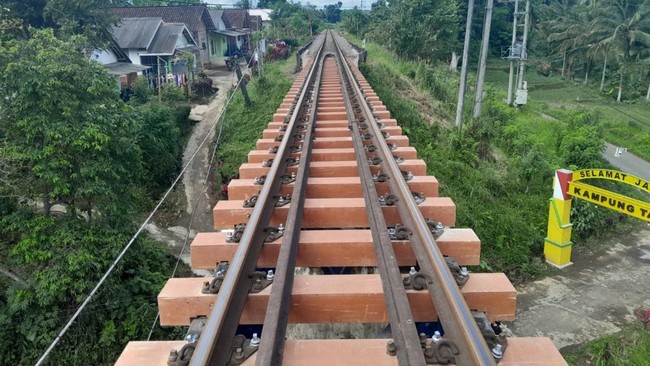
PT Kereta Api Indonesia (Persero) has announced its target to possess an active railway network of up to 60,000 kilometres (km) by 2045. This target is part of KAI’s transformation roadmap to become a world-class operator.
The President Director of PT KAI (Persero), Bobby Rasyidin, stated that the company has developed a development roadmap up to 2045, divided into five main stages. “We have designed the KAI roadmap to become a world-class operator, defined by the International Union of Railways (UIC) standards. Our roadmap from 2025 to 2045 consists of five stages,” Bobby said during a Hearing with Commission VI of the Indonesian House of Representatives (DPR RI) in Jakarta.
Currently, the length of active tracks in Indonesia is approximately 6,700 km. In the initial transformation phase lasting until 2030, KAI aims to increase the track length to over 7,000 km, alongside company revenue growth. “In the first stage from 2025 to 2030, we are focusing on establishing credibility. Currently, the track length is only 6,700 km with a company revenue of Rp35.7 trillion; by 2030, we expect the track length to exceed 7,000 km with revenue around Rp66 trillion,” he added.
However, the long-term target is far more ambitious. In subsequent stages, KAI aims for world-class capacity and operational standards, which will serve as the company’s transformation inflection point. The roadmap estimates that the national railway network requirement will reach between 37,000 km and 60,000 km by 2045.
“The next stage is to achieve world-class standards in core capabilities. By 2045, we anticipate a need for approximately 37,000 to 60,000 km of track. This means we must reactivate existing tracks in Java. Currently, active tracks in Java are less than 7,000 km, whereas during the Dutch colonial era, Java actually had 10,000 km. We are not looking to add more tracks in Java, but rather to recover what was lost,” Bobby continued.
In addition to expanding the network, KAI is working to restructure its revenue streams. Currently, approximately 96% of KAI’s revenue comes from passenger transport (farebox) and logistics, while contributions from Transit Oriented Development (TOD) account for only about 4%.
“To provide some context, 96% of our revenue comes from farebox and logistics, while only 4% comes from TOD. If we look at Japan Railways (JR), 60% comes from farebox and logistics, while 40% comes from TOD,” he explained. Consequently, KAI is strengthening its TOD business as a new growth driver. One ongoing project includes a residential area in Manggarai, South Jakarta, which is expected to be completed by 2027 and will consist of nearly 5,000 housing units.