
Indonesia Targets 2026 Ratification of IEU-CEPA to Secure Zero Tariffs for Exports to Europe
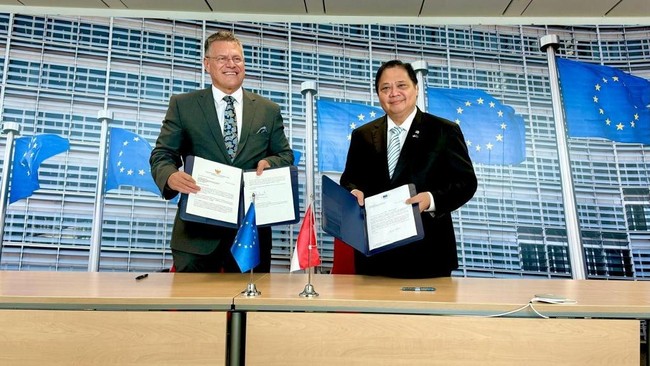
The Coordinating Minister for Economic Affairs, Airlangga Hartarto, stated that the government targets the ratification process of the Indonesia-European Union Comprehensive Economic Partnership Agreement (IEU-CEPA) to be completed this year. If the trade agreement is finalised by 2026, Airlangga noted that the comprehensive economic cooperation policy with Europe could be implemented directly in 2027.
“We have the CEPA with the EU, and the hope is that it can be ratified this year, so that it can be enforced at the beginning of next year,” he said during the Economic Update 2026 programme on CNBC Indonesia.
Airlangga explained that this economic cooperation with the European Union would allow Indonesian products to enter Europe freely, meaning without import tariff barriers. “This means that for 90% of Indonesian products, import duties will become zero, compared to the current average of 10-20%,” Airlangga added.
To accelerate the ratification process, Airlangga mentioned that representatives from the European Union are scheduled to visit Indonesia in the third quarter of 2026. “We hope that Europe can come to Indonesia; this is currently being planned for the end of the third quarter,” said Airlangga.
Previously, the German Ambassador to Indonesia, Ralf Beste, expressed optimism that the IEU-CEPA could soon enter the ratification stage and come into effect in 2027. According to Beste, support for the trade agreement, which has been negotiated for years, is quite strong in both Europe and Indonesia. Therefore, he does not foresee any major obstacles that could disrupt the ratification process.
“I am quite optimistic that the ratification process can proceed this year. Of course, it depends on the parliaments of both parties, namely the European Parliament and the Indonesian Parliament,” Beste said during a press conference at the German Embassy in Jakarta.
He added that, unlike several other trade agreements that have sparked debate in Europe, the IEU-CEPA is receiving widespread support from various political groups within the European Union. “There is a broad majority in Europe supporting a bilateral trade agreement with Indonesia. This is not a controversial agreement. I also see significant support from the Indonesian side, so there is nothing that concerns me,” he remarked.
Beste stated that if the ratification process proceeds as planned, the IEU-CEPA could take effect in 2027. The presence of this agreement is believed to be a new driver for increasing trade and investment between Indonesia and European Union countries, including Germany.
The IEU-CEPA is currently a vital instrument in strengthening economic relations between Indonesia and the European Union. Consequently, completing the ratification process is a priority so that the benefits of the agreement can be immediately felt by businesses on both sides. One of the primary benefits of implementing the IEU-CEPA will be the elimination of trade tariffs on approximately 98 per cent of tariff lines.
For Indonesia, the agreement will open wider market access to the European Union through zero-percent tariff facilities for most national export products, which is expected to enhance the competitiveness of Indonesian products in the European market and support national export growth.