
Indonesia Targets 100 GW Solar Power Capacity in Three Years, ESDM Details Strategy
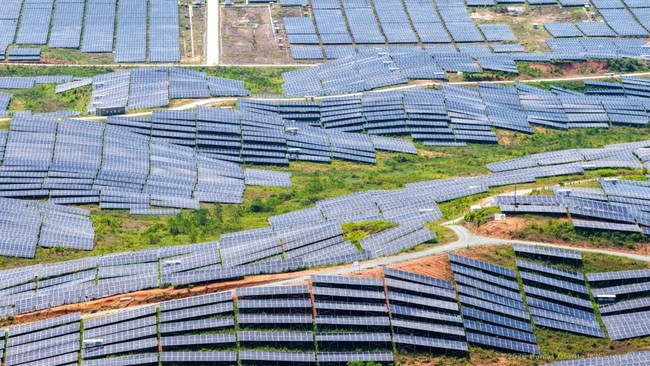
The Ministry of Energy and Mineral Resources (ESDM) has set a target to build 100 gigawatts (GW) of solar power capacity within the next three years, in line with President Prabowo Subianto’s directives. Director General of New, Renewable Energy and Energy Conservation (EBTKE) Eniya Listiani Dewi explained that the government is overhauling national electricity planning to align with this ambitious target, while synchronising grid infrastructure to absorb large-scale clean energy.
‘This is a massive issue, and with the President’s additional directive to achieve 100 GW of solar power in three years, we are rapidly adjusting all national electricity planning to meet these requirements,’ she said at the 50th IPA Convention & Exhibition (Convex) in ICE BSD, Tangerang.
The primary focus of the 100 GW solar programme is to reduce diesel generator usage, particularly in eastern Indonesia where operational costs are high. The government is prioritising rural electrification by 2029.
‘A major part of the 100 GW solar programme is reducing diesel use in eastern Indonesia. Rural electrification is our priority, and by 2029 we must ensure 100% electricity access for the public,’ Eniya said.
To realise the target, Indonesia requires substantial funding from various sources. The government projects over $100 billion (Rp 1.767 trillion) in investment needs, with the majority expected from the private sector via Independent Power Producer (IPP) schemes.
‘International collaboration and private sector involvement are essential. Private investment is projected to be substantial, but we need over $100 billion, with around 70% coming from IPPs, so the private sector will join this major initiative,’ she added.
President Prabowo Subianto has accelerated the green energy transition, including a target of 100 GW solar capacity by 2029. Prabowo stressed that the government will maximise solar electricity use over the next three years.
‘We want to move very quickly to use solar electricity. We have a plan and are determined to move as fast as possible, aiming to achieve 100 gigawatts of solar energy within three years,’ Prabowo said at the Indonesia-Japan Business Forum in Tokyo on 30 March 2026.
The accelerated solar plant development is deemed urgent due to escalating geopolitical conflicts and uncertainties, particularly in the Middle East, posing threats to national energy supply stability.
‘This is more urgent for us because the geopolitical situation in the Middle East creates strategic uncertainty for our energy security,’ Prabowo stated.
As a precaution, the government is securing supply through domestic resources. Besides solar, Indonesia has significant geothermal potential and is ramping up biofuel production, including 50% biodiesel (B50) and bioethanol.