
Indonesia Supplies 80 Percent of Malaysia's Coconut Needs, Ministry Says
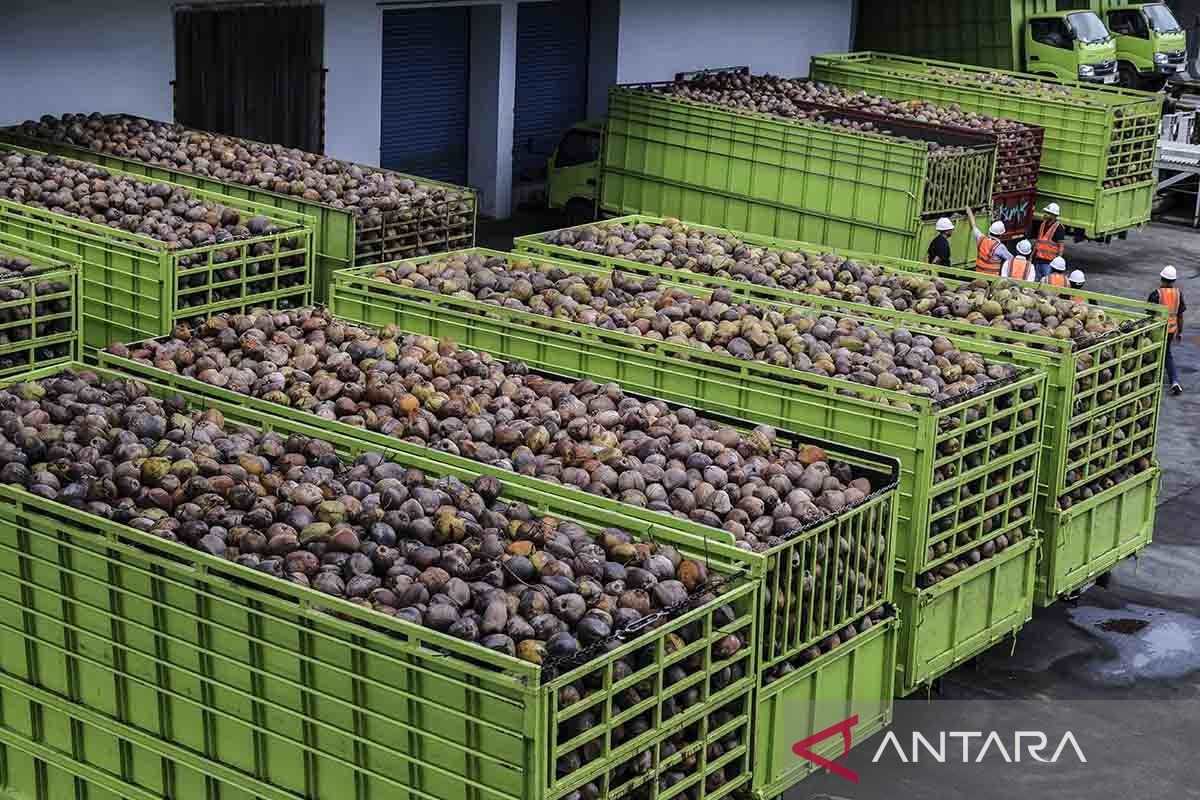
The Ministry of Agriculture has stated that Malaysia remains highly dependent on coconut supplies from Indonesia, with approximately 80 percent of the neighbouring country’s needs being met by Indonesia. Agus Rosyid, Quality Supervisor of Agricultural Products at the Ministry’s Directorate General of Plantations, said this high dependency presents an opportunity to strengthen the development of the national coconut industry, particularly through downstream processing. “Malaysia has almost 80 percent of its coconut needs supplied by Indonesia. In fact, two years ago when they experienced a raw material shortage, they came to the ministry requesting that there be no ban on coconut exports because they were worried their industrial needs would not be met,” he stated during a discussion on coconut downstreaming development in Jakarta on Wednesday.
According to him, the high regional and global market demand indicates a significant opportunity for Indonesia to increase the added value of the coconut commodity. Coconut derivative products with market prospects include coconut cream, coconut milk, coconut oil, virgin coconut oil (VCO), and various other processed products. To this end, the government is encouraging coconut exports to no longer be dominated by raw materials, but rather by value-added processed products, so that more economic benefits can be enjoyed domestically.
Based on 2023 data from the International Coconut Community (ICC) and the Ministry of Agriculture, Indonesia is the world’s second-largest coconut producer after the Philippines. National coconut production reached 2.87 million tonnes of copra equivalent, with a plantation area of approximately 3.34 million hectares, accounting for about 24 percent of global coconut production. Meanwhile, the Philippines is in first place with production of around 3.18 million tonnes of copra equivalent, or 27 percent of global production, from a land area of approximately 3.6 million hectares.
Agus noted that the majority of Indonesia’s coconut plantations are smallholder farms. Around 98 percent of coconut plantations are managed by farmers, numbering approximately 5.5 million people. Based on ICC and Ministry data, of the total national coconut plantation area, approximately 2.55 million hectares, or 76.5 percent, are mature producing plants. The potential added value of coconuts is also substantial through the utilisation of all parts of the plant, from the husk, shell, flesh, to the coconut water, with a potential added value reaching 6.55 billion US dollars.
According to ICC data, the export value of Indonesian coconut products in 2022 reached approximately 2.11 billion US dollars. However, the Ministry of Agriculture noted that the national coconut area and production are experiencing a downward trend due to several factors, such as land conversion to other commodities, pest attacks, and unstable coconut prices at the farm level. “When coconut prices remain low for a long time, farmers eventually turn to other commodities considered more promising, such as oil palm, because its price is more stable,” Agus said.
Furthermore, national coconut productivity is still not optimal. Currently, the average national coconut productivity is still around 1.1 tonnes per hectare, still below the optimal potential which can reach 3.5 to 5 tonnes per hectare. To enhance the competitiveness of this commodity, the government is preparing a coconut downstreaming programme through the development of an area covering 151,554 hectares in 2026, with a budget of approximately Rp427 billion. The programme will be spread across 28 provinces and includes the development of production areas, provision of superior seeds, productivity improvement, and supply chain strengthening. The Ministry of Agriculture is targeting this downstreaming programme to increase the added value of coconuts while strengthening Indonesia’s position in the global market.