
Indonesia Successfully Develops Drones Without Plastic or Metal Components
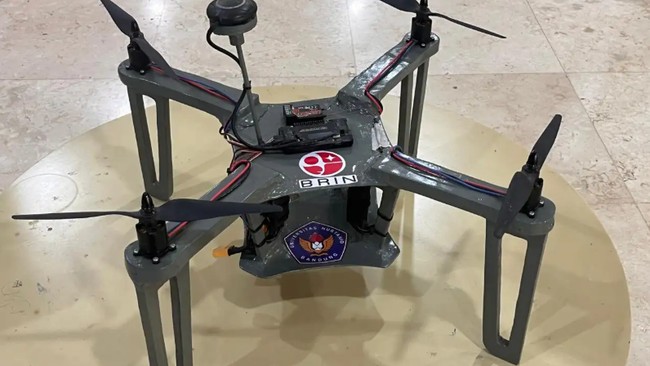
The Biomass and Bioproduct Research Centre (PRBB) of the National Research and Innovation Agency (BRIN), in collaboration with Universitas Nurtanio (UNNUR) Bandung, has developed two unmanned aerial vehicle (UAV) prototypes: a Vertical Take-Off and Landing (VTOL) UAV and a Quadcopter UAV.
Both prototypes are lightweight unmanned aerial vehicles. The UAV VTOL utilises abaca fibre and Oil Palm Empty Fruit Bunch (EFB) fibre composites, enhanced with EFB activated carbon, while the Quadcopter UAV uses epoxy material combined with abacal fibre and bamboo activated carbon.
This development was revealed by Lies Banowati, a lecturer in Aerospace Engineering and Vice Rector I at Universitas Nurtanio, during the Nanotechnology and Materials Research Organisation (ORNM) Talk and Expo 2026 held at the B.J. Habibie Science and Technology Park in Serpong.
“UNNUR is conducting collaborative research with BRIN, developing a UAV VTOL prototype with a Maximum Takeoff Weight (MTOW) of 5.5 kg, made from biomass fibres. Additionally, we are developing a Quadcopter drone with an MTOW of 3 kg,” said Lies.
According to her, one of the advantages of the UAV VTOL and quadcopter lies in their lightweight structure. Their weight is relatively lower compared to other unmanned aerial vehicles that use plastic or metal materials.
“Based on test results, abaca fibre has a relatively low density of approximately 1 gram per cm³. This value is lower than carbon fibre at 2.2 grams per cm³ and aluminium at 3.8 grams per cm³, making abaca fibre suitable for lightweight UAV structural applications,” Lies explained.
Furthermore, Lies noted that during tensile testing, the abaca fibre used in the Quadcopter demonstrated a strength of approximately 111.5 MPa. Consequently, this fibre can serve as an alternative material to replace conventional materials and can increase the Domestic Component Level (TKDN).
“We want to prioritise TKDN through the utilisation of biomass materials that are abundant in Indonesia. However, this potential has not yet been optimally utilised,” she added.
The UAV VTOL and quadcopter have various potential uses, particularly in the agricultural and plantation sectors. These vehicles can be used to map and identify pests, as well as measure soil moisture levels.
“These prototypes can be used for mapping and spraying pesticides, as well as monitoring soil moisture, which is highly beneficial for stakeholders looking to develop plantations or establish agricultural companies,” Lies explained.
She continued that the UAV VTOL and quadcopter are not limited to mapping agricultural land. They can also be utilised to distribute medicines to disaster-affected areas that are difficult to reach by conventional vehicles.
“We can design them to drop medicines and lightweight medical equipment to disaster-stricken areas. In the future, we also plan to develop them to detect the extent of the Lembang fault in Bandung,” she said.
Nidya Chitraning, a Senior Researcher at PRBB, stated that the UAV VTOL is equipped with a camera and all systems are functioning well. The UAV Fixed Wing has undergone ground testing, and the next step is flight testing at Sulaiman Airbase in Bandung, while the Quadcopter has been tested and is capable of flying well. Both the UAV VTOL and Quadcopter have a range of between 10 to 15 km, supported by lithium polymer (LiPo) batteries.
“We have conducted trials using UAV prototypes with different wingspans. With LiPo batteries, the UAV can travel approximately 10 kilometres. Meanwhile, using LiPo batteries with an operational capacity of up to one hour allows the UAV to travel more than 15 kilometres,” Nidya revealed.
Nidya explained that the development of UAVs using natural fibre-based composite materials holds great potential for Indonesia. The abundant availability of biomass can be used as raw material to produce high-value-added materials.
“The hope is that these prototypes can proceed to the downstreaming stage. Indonesia possesses abundant biomass that has the potential to be developed into materials with higher added value,” she said.
Regarding intellectual property protection, Nidya mentioned that the biomass-based UAV VTOL has been registered for a patent. Meanwhile, the UAV quadcopter obtained its patent in 2026. She hopes both technologies will continue to be developed and utilised more widely, including by the industrial sector.
“BRIN is open to collaborating with various parties. This technology is ready for further development according to specific needs,” she added.
The collaboration between UNNUR and BRIN provides a significant impact for both parties. Lies stated that besides benefiting the UNNUR students involved, the collaboration can also improve the university’s accreditation.
“Currently, UNNUR is moving towards becoming an impactful campus, where outputs are not just journals or patents, but must include prototypes ready for downstreaming. We hope to collaborate in the field of biomass with the industrial world in the future,” concluded Lies.