
Indonesia Strengthens Export Controls on Strategic Goods and Technology
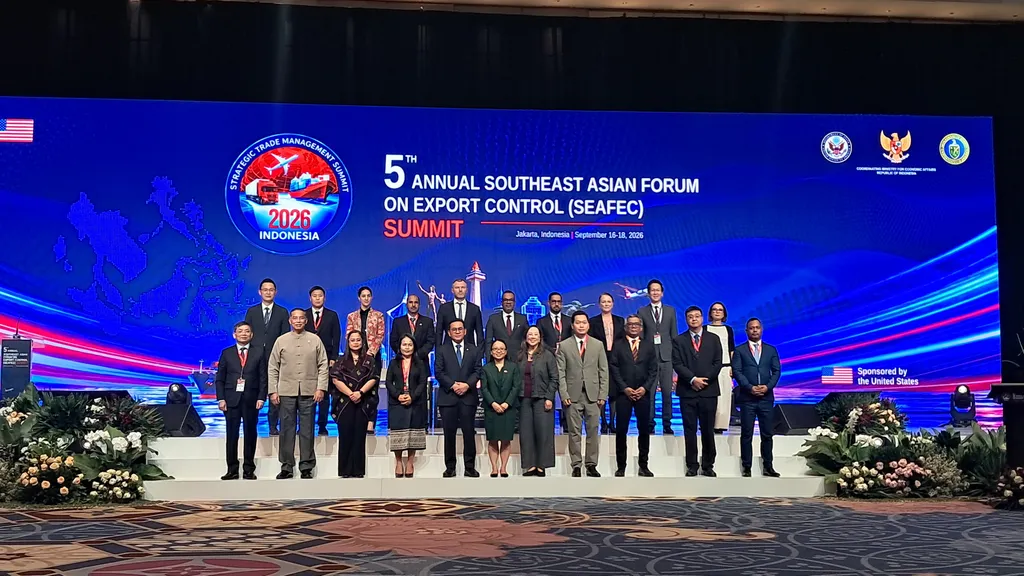
The Indonesian government is strengthening the implementation of strategic trade management (STM) with strategic nations. This aligns with government efforts to bolster technology-based industries that require access to global goods, technology, and supply chains.
Minister of Trade Budi Santoso stated that the development of STM is becoming increasingly relevant amidst rapid economic transformation and technological advancements. Furthermore, as the global economic centre of gravity shifts towards the Indo-Pacific, Indonesia must ensure its position as a regional production and investment hub is maintained.
“The rapid changes in dual-use technology, AI, semiconductor production, and critical mineral processing require us to find the right balance between market access and trade security,” said Boded during his opening remarks at the 5th Annual Southeast Asia Forum on Export Controls (SEAFEC) in Jakarta on Wednesday (16/9/2026).
SEAFEC is part of Indonesia’s Strategic Trade Management Summit (IDSTM2026), organised by the Indonesian and United States governments. The event invited approximately 300 representatives from government bodies, international organisations, academia, the private sector, think tanks, and non-governmental organisations.
Consequently, according to Budi, strengthening STM is becoming increasingly vital as Indonesia’s export structure changes and the role of strategic technology in the economy grows. He emphasised that STM should be positioned not as a trade barrier, but as a framework to strengthen trade growth.
“STM, which is our national approach to export controls, is increasingly important for Indonesia. Not as a constraint, but as a framework for trade growth,” he said.
Strengthening STM is also becoming more critical as Indonesia’s export structure evolves. The manufacturing sector now accounts for more than 82 per cent of Indonesia’s exports. From January to July 2026, Indonesia also recorded a trade surplus of US$3.7 billion.
These conditions necessitate that Indonesia strengthens its oversight system for the trade of dual-use goods and technology, while simultaneously ensuring that trade processes remain efficient.
According to Budi, the implementation of STM in Indonesia will be carried out in stages and based on risk. The government is currently coordinating across ministries and agencies to determine a national framework that can balance security, business competitiveness, and compliance for industry players.
“We anticipate a gradual and phased approach. We must provide sufficient time for businesses and institutions to adapt and build readiness,” he noted.
The Ministry of Trade has established three priorities in building the STM framework. First, clarifying inter-agency authority. Second, building a simple and transparent process so as not to add unnecessary burdens to the business world. Third, integrating STM with existing government systems.
System integration is vital as the government is also strengthening the Indonesia National Single Window (INSW) as the primary platform for trade and logistics services. The development of STM and Indonesia Single Risk Management (ISRM) is part of the agenda to strengthen governance within that system.
The government is committed to ensuring that the implementation of STM signals to the business community Indonesia’s efforts to create a secure business ecosystem for high-technology trade.
Strengthening STM is also related to Indonesia’s commitment to the agreement on reciprocal trade (ART) with the United States. This document was signed by President Prabowo Subianto and US President Donald Trump in February 2026.
The government is encouraging cooperation with the US through the exchange of knowledge, experience, and technical support. Such cooperation also supports the development of strategic sectors such as semiconductors, aerospace, and energy, including through the strengthening of industrial ecosystems, technology, and national talent capacity.
So far, Budi noted, the US is the second-largest trading partner for Indonesia. The bilateral trade value between Indonesia and the US reached US$43.9 billion in 2025.
Chargé d’Affaires of the US Mission to ASEAN, Thao Anh Tran, in her remarks, stated that export controls are necessary to prevent the diversion of sensitive technology while maintaining supply chain resilience.
According to her, the complexity of global supply chains increases the risk of trade network misuse, the diversion of investment and technology, and threats to economic security. Therefore, strengthening export control systems cannot be achieved by one country alone.
“No single country faces these challenges in isolation. These challenges require a coordinated regional response,” said Thao.
She assessed that Indonesia holds a significant position in strengthening STM in Southeast Asia as it is one of the largest economies in the region, as well as a country with a major role in global trade and port activities.
According to Thao, this position brings a responsibility for Indonesia to help drive the implementation of security standards, openness, and cooperation in strategic trade control within the region. The regional forum can be used to share best practices, align systems, and build a regional framework for export controls.