
Indonesia Strengthens ESG Standards for Sustainable Critical Mineral Downstreaming
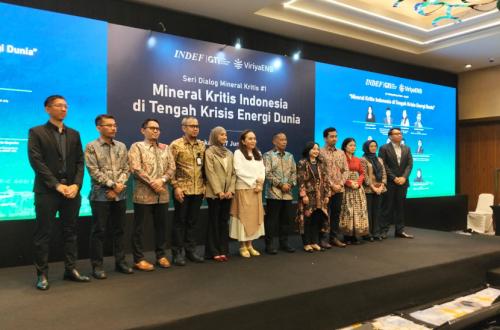
The government is strengthening the application of Environmental, Social, and Governance (ESG) principles in the management of critical minerals to ensure the national downstreaming programme runs sustainably and meets global market demands. Cecep M Yasin, Director of Mineral Business Development at the Directorate General of Minerals and Coal, Ministry of Energy and Mineral Resources (ESDM), stated that downstreaming must go beyond generating economic added value. Downstream industrial development must also be built on good governance and robust environmental protection. “Strong downstreaming must be built on good governance. We must ensure that downstream industrial development goes hand in hand with the sustainability of mineral resources,” Cecep said during a discussion on Indonesia’s Critical Minerals Amid the Global Energy Crisis held by the INDEF think tank on Wednesday (17/6/2026). Cecep explained that one of the main instruments used by the government to maintain the balance between resource exploitation and sustainability is the Work Plan and Budget (RKAB). The RKAB is no longer viewed merely as an administrative instrument but has become a strategic tool to control production, secure mineral reserves, and ensure the supply of raw materials for the national downstream industry. Through this mechanism, the government can regulate the balance between available reserves, production volumes, domestic processing capacity, and future industrial needs. He added that the Ministry of ESDM continuously coordinates with the Ministry of Industry to ensure the raw material needs of downstream industries are met without sacrificing resource sustainability. In 2026, mineral and coal policy is directed to support two major objectives simultaneously: energy security and sustainability. To achieve these goals, the government is implementing five main instruments. The first is the 25 percent Domestic Market Obligation (DMO) policy for coal, aimed at securing domestic energy supply, particularly for national power plants. “This policy serves as an important foundation for maintaining energy security and electricity price stability,” he said. The second instrument is the implementation of an annual RKAB, replacing the previous three-year mechanism. Cecep noted that annual evaluation allows for stricter oversight, enabling the government to control production more effectively according to industrial needs and reserve conditions. The third instrument is optimising state revenue through refined mineral and coal benchmark prices. Besides increasing economic benefits for the state, this policy also provides incentives for companies that conduct integrated mining operations with downstream activities. Companies with integrated processing and refining facilities may receive flexibility in their mining business permit periods, adjusted to their reserves. The fourth instrument focuses on environmental protection through the mandatory placement of reclamation and post-mining guarantees before companies obtain annual operating approval. According to Cecep, this policy is designed so that mining activities not only generate economic benefits but also leave behind environmental conditions that can be restored and utilised sustainably. “Every mining business permit holder must first place reclamation and post-mining guarantees before being granted approval to conduct activities each year,” he said.