
Indonesia-Singapore Green Power Deal Hinges on Electricity Price
Indonesia-Singapore Green Power Deal Hinges on Electricity Price
Jakarta. Indonesia and Singapore are closer than ever to launching one of Southeast Asia’s largest cross-border renewable energy projects, but a final agreement on electricity pricing remains the biggest obstacle.
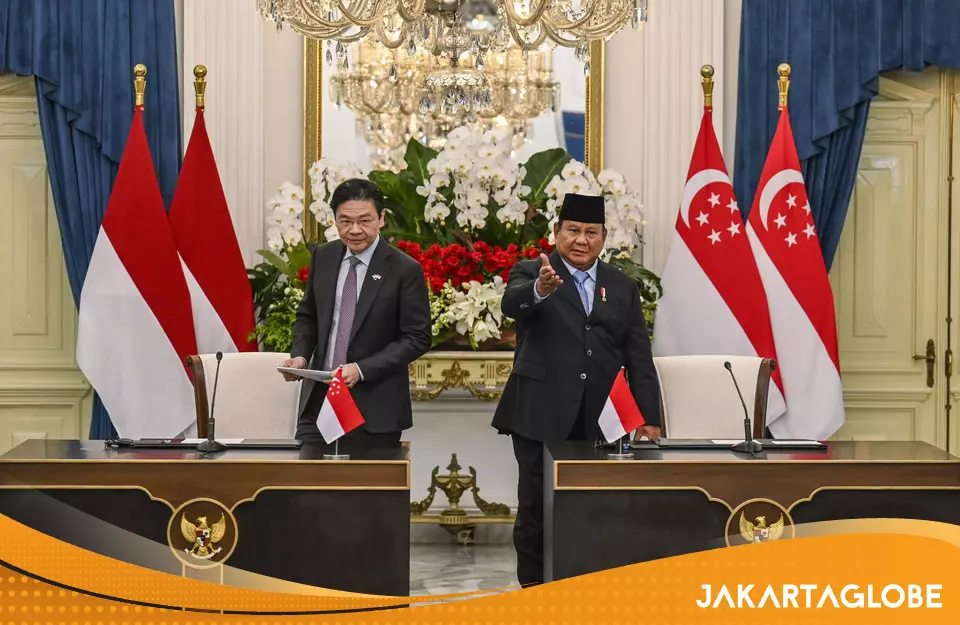
The issue resurfaced this week after Singapore Prime Minister Lawrence Wong’s visit to Jakarta, where he and President Prabowo Subianto signed a series of bilateral agreements, including cooperation on low-carbon electricity exports.
Energy Minister Bahlil Lahadalia said negotiations are now focused on finding a tariff acceptable to both countries.
“Our regulations place pricing under the government’s authority. We want an arrangement that benefits both sides. We should be able to find common ground soon, but we haven’t reached a win-win price yet,” Bahlil said.
Singapore plans to import up to 3.4 gigawatts of renewable electricity from Indonesia as part of its broader strategy to source 6 GW of low-carbon power from five neighboring countries by 2035, enough to supply about one-third of the city-state’s electricity demand. The electricity will be generated primarily from large-scale solar photovoltaic projects in Indonesia.
An October 2025 report by S&P Global estimated the project’s delivered cost at about S$300 ($232) per megawatt-hour, including transmission and backup costs. Renewable Energy Certificates (RECs), which certify electricity generated from renewable sources, are expected to play an important role in project economics.
“Green Premium”
Energy experts say pricing should reflect the additional investment required to produce and deliver renewable electricity.
Bisman Bahktiar, executive director of the Center for Energy and Mining Law (Pushep), said long-term pricing certainty would be critical to attracting investors.
“The agreement should include adjustment mechanisms to accommodate changes in production costs and market conditions,” he told the Jakarta Globe.
Fabby Tumiwa, executive director of the Institute for Essential Services Reform (IESR), said the government was right to consider the project’s “green premium” – the additional cost of producing clean electricity compared with conventional power.
“A fair price must reflect production costs, reasonable margins, and the cost of transmitting electricity to Singapore,” Fabby said in a separate interview.
He added that the project could create thousands of green jobs, particularly during construction, while maximizing economic benefits if more solar panels and battery components are manufactured domestically.
Fabby dismissed concerns that exporting renewable electricity would undermine Indonesia’s own energy transition, noting the country’s vast solar resources.
“The Energy Ministry estimates Indonesia’s solar potential at around 3,400 GW, while our research suggests it could reach 7,700 GW. Even after exports, there will still be abundant capacity for domestic demand,” he said.
Legal Obstacle
Beyond pricing, regulatory issues also remain. Current Indonesian rules allow electricity exports only through state-owned enterprises or companies appointed by the government, creating uncertainty for private developers that previously secured conditional approvals from Singapore.
Singapore has granted conditional approvals for 11 cross-border electricity projects totaling 8.35 GW, including six from Indonesia that have progressed to the conditional licensing stage.
During Wong’s visit, Prabowo appointed Danantara to oversee Indonesia’s electricity exports. The sovereign wealth fund signed agreements with Keppel Electric, Sembcorp Utilities, and Singapore Energy Interconnections covering electricity offtake and technical cooperation.
“Indonesia is fully committed to addressing the regulatory and infrastructure priorities needed to ensure the project moves forward before the end of the decade,” Danantara Chief Executive Rosan Roeslani said.
The project is part of the ASEAN Power Grid initiative, which aims to connect regional electricity markets, accelerate renewable energy development, and strengthen Southeast Asia’s long-term energy security.
In September 2024, ASEAN energy ministers agreed to develop a framework on subsea power cables and realize the ASEAN Power Grid by 2045, paving the way for member countries to facilitate subsea surveys in their waters, as well as the laying, maintenance, and protection of subsea power cables across the region.
Tags: Keywords:
Source: jawawa.id (https://jawawa.id/newsitem/indonesia-singapore-green-power-deal-hinges-on-electricity-price-1783655408)
Originally published by jakartaglobe.id (https://jakartaglobe.id/business/indonesiasingapore-green-power-deal-hinges-on-electricity-price)