
Indonesia Set to Have Largest Battery Factory, Here's Its Profile
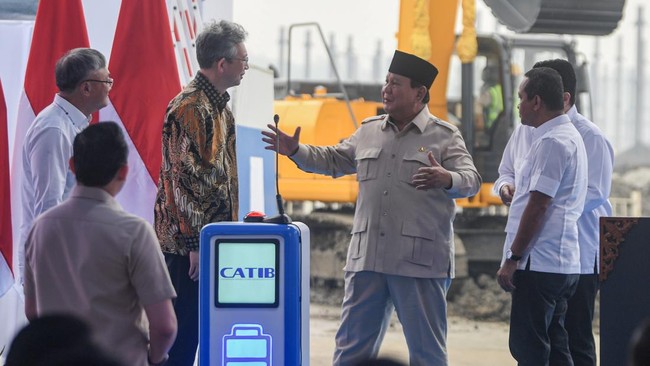
Indonesia is projected to soon have a large-scale electric vehicle battery factory in Karawang, West Java. The production facility is owned by PT Contemporary Amperex Technology Indonesia Battery (CATIB). Minister of Energy and Mineral Resources (ESDM) Bahlil Lahadalia stated that the factory’s construction is complete and it is ready for operation. The inauguration is now just waiting for a schedule adjustment from President Prabowo Subianto. “It is ready to be inaugurated. We are just waiting for the right time from the President. The factory is finished. If you want to see it, please do,” Bahlil said when met at the Ministry of Energy and Mineral Resources. He noted this battery factory will be the second large-scale facility in Indonesia, following the PT Hyundai LG Indonesia (HLI) Green Power plant in Karawang, which was inaugurated in July 2024. “So we have built two battery factories. One is LG when I was still Minister of Investment. The other is CATL now that I am Minister of ESDM. This is what is called downstreaming, where we build the entire battery ecosystem in our country,” Bahlil explained. CATIB is a joint venture between Indonesia Battery Corporation (IBC) and CBL, a subsidiary of the Chinese battery giant Contemporary Amperex Technology Co Limited (CATL). IBC President Director Aditya Farhan Arif said the first phase of the factory’s production capacity reaches 6.9 Giga Watt hour (GWh). He stated that the factory will not have difficulty finding a market once it begins operations, as the industrial concept is built on existing demand, allowing it to run immediately. “So in principle, the buyers are ready, so when it is ready for commercial operation, we will immediately produce commercially. In fact, trial production is already underway at this PT CATIB factory,” he said. He also explained that the nickel value chain from mining to battery production is a lengthy process, starting from mining activities, followed by initial processing, then battery material production, and finally battery production. CATIB is at the most downstream position in this value chain. Aditya said the company’s presence is an important part of the overall integrated nickel industrial ecosystem. “The capacity of CATIB in this first phase is 6.9 GWh and we will soon expand it to at least 15 GWh. If we convert 15 GWh into electric vehicles, it is roughly equivalent to about 250,000 electric vehicles,” he stated. Construction of the factory in Artha Industrial Hill (ALH) & Karawang New Industry City (NICC), West Java, began on 29 June 2025, with President Prabowo officiating the groundbreaking. This means that if the factory begins operations this month, it took 13 months to build. Meanwhile, Indonesia is developing an integrated EV battery factory ecosystem, touted as the largest in Southeast Asia, supported by vast nickel reserves as the main battery component. The total investment for the integrated battery project reaches US$5.9 billion, comprising six joint ventures from upstream to downstream. The upstream projects include a nickel mine by PT Sumberdaya Arindo, an RKEF smelter by PT Feni Haltim, and an HPAL smelter by PT Nickel Cobalt Halmahera. The downstream projects consist of a battery material facility in East Halmahera, the CATIB battery cell factory in Karawang, and a battery recycling project in East Halmahera.