
Indonesia Seeks to Strengthen Confidence in International Voluntary Carbon Markets
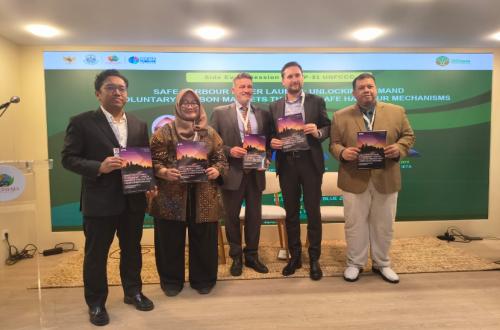
ANTALYA — The Indonesian Government supports developing a safe harbour mechanism to provide legal certainty to international buyers of carbon credits and investors. The mechanism is expected to strengthen confidence in the voluntary carbon market while supporting Indonesia’s ambition to become a global forest carbon hub.
The issue was discussed at the launch of the report Unlocking Demand in Voluntary Carbon Markets through Safe Harbour Mechanisms: A Recommendation to Governments at the Indonesia Pavilion during the 31st UN Climate Change Conference (COP31) in Antalya, Türkiye, on Saturday (14 November 2026).
The report was prepared by the International Emissions Trading Association (IETA) with support from the Coalition to Grow Carbon Markets (CGCM). The initiative aims to boost demand for carbon credits in the international voluntary carbon market, with Indonesia among the CGCM’s 14 member countries.
Safe harbour is a legal-protection approach for companies that use carbon credits in accordance with specified requirements and standards. The mechanism is intended to reduce companies’ reluctance to participate in the voluntary carbon market.
Laksmi Wijayanti, Director General of Sustainable Forest Management at the Ministry of Forestry, said market growth could not rely solely on the availability of credits. The market also needed buyer confidence, legal certainty and assurances that carbon credits genuinely represented emissions reductions and did not involve greenwashing.
Laksmi said companies currently faced legal and reputational risks when buying carbon credits and making public claims about their use. This uncertainty could deter investment, including in projects that generate high-quality carbon credits.
Ilham, Director of Forest Utilisation Business Development at the Ministry of Forestry, said Indonesia was continuing to strengthen the legal framework and governance for carbon trading. The efforts include developing a safe harbour approach, internationally standardised contracts that guarantee social safeguards, and dispute-resolution mechanisms.
“These measures can clarify the legal certainty of transactions while ensuring that the development of the carbon market remains aligned with national green economic development policies and Indonesia’s climate commitments,” Ilham said in a statement on Tuesday (24 November 2026).
Ilham stressed that legal protection through a safe harbour mechanism did not mean granting immunity. Its implementation would remain within the bounds of Indonesia’s sovereignty.
According to Ilham, the mechanism could increase international market confidence and support Indonesia’s ambition to become an International Forest Carbon Hub. Indonesia could also become a point of reference for international voluntary carbon trading.
Mark Kenber, Executive Director of the Voluntary Carbon Markets Integrity Initiative (VCMI), explained that safe harbour mechanisms were not a substitute for national regulation, but a complement to it. Companies would still have to comply with the laws and regulations of the countries in which they operate.
Safe harbour mechanisms cover two aspects: the quality of carbon credits and the accuracy of companies’ claims. In terms of quality, credits must meet recognised standards, such as the Article 6.4 mechanism under the Paris Agreement, the Integrity Council for the Voluntary Carbon Market’s (ICVCM) Core Carbon Principles, the Carbon Offsetting and Reduction Scheme for International Aviation (CORSIA), or standards set by individual governments.
The accuracy of claims, meanwhile, concerns how companies explain their use of carbon credits to the public. Companies must provide accurate information and must not imply that all emissions have been eliminated if they have in fact only been offset through the purchase of carbon credits.
Andrea Bonzzanni, IETA’s Senior Director, said safe harbour mechanisms provided certainty for companies that had met the requirements, so they would not immediately face criticism or legal action.
“This certainty and confidence are what the carbon market needs in order to continue growing,” Andrea said.
Source: jawawa.id (https://jawawa.id/newsitem/indonesia-seeks-to-strengthen-confidence-in-international-voluntary-carbon-markets-1795514068)
Originally published by Republika (https://esgnow.republika.co.id/berita/tp00lj416/indonesia-perkuat-kepercayaan-pasar-karbon-sukarela-internasional), translated from Indonesian