
Indonesia Says It Has Stemmed Natural Declines at Mature Oilfields
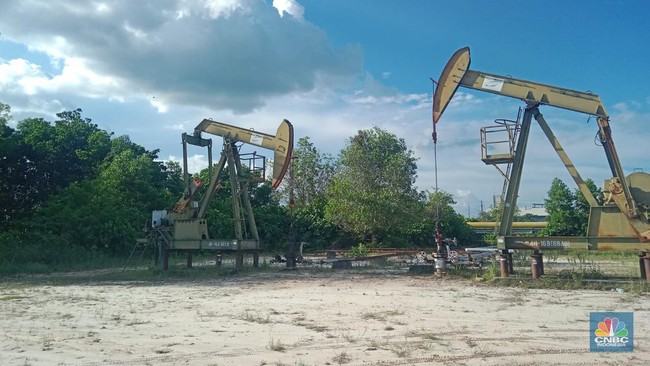
Jakarta, CNBC Indonesia – Indonesia’s upstream oil and gas sector is said to have demonstrated operational resilience in 2026, particularly in slowing the natural decline of mature fields. This was despite a number of technical challenges and wider industry volatility.
The Executive Director of the ReforMiner Institute said that although Indonesia’s upstream oil and gas sector faces natural decline rates of 15–20% a year at some mature fields, it had managed to keep production levels stable.
“National oil lifting through mid-year and the third quarter of 2026 was recorded at around 576.2 to 578.2 thousand barrels of oil per day (MBOPD). National gas deliveries over the same period were 5,208 million standard cubic feet per day (MMSCFD), reaching 94.5% of the state budget target,” Komaidi said in a report on national upstream oil and gas performance, quoted on Friday (9 October 2026).
He said relatively stable output was in part the result of drilling efficiencies, including batch drilling and dual completion at PHR Zone 4—where well GNK-114 had initial production of 5,605 barrels of oil per day—as well as the reliability of the Mahato Block (Texcal Energy), integrated optimisation of community wells through the legalisation of BKU, and the recovery of dead stock.
“2026 is a pivotal year in which major upstream oil and gas projects that had been delayed have officially moved from the planning phase to physical execution in the field,” Komaidi said.
Projects under way include:
The Abadi LNG project in the Masela Block (Inpex, Pertamina and Petronas), whose groundbreaking ceremony and initial construction officially began on 16 July 2026.
Eni’s Northern Hub in East Kalimantan and IDD project. Integration of the Indonesia Deepwater Development (IDD) project—covering the Gendalo and Gandang fields—was approved through a revised integrated Plan of Development (PoD).
The South Andaman Gas Hub development (Mubadala Energy and Harbour Energy), for which SKK Migas completed approval of the PoD to prepare gas delivery infrastructure for North Sumatra’s industrial area and the Arun refinery.
BP’s first CCUS facility at Tangguh UCC.
Challenges
Despite positive trends in lifting and progress on several national strategic upstream oil and gas projects, Komaidi said several obstacles could undermine the ability to meet production targets over the long term. Ageing production facilities and repeated unplanned shutdowns remain major barriers to sustaining output.
“Problems identified in the field show that preventive maintenance programmes at key facilities remain a weak point,” Komaidi said.
The sector’s heavy reliance on a small number of major producers is another concern. National oil and gas production is particularly vulnerable to disruptions affecting these companies. For example, output has been significantly affected by rising water cut and gas-oil ratios at ExxonMobil Cepu Ltd. (EMCL), as well as power-system disruptions at Pertamina Hulu Rokan.
“National upstream oil and gas performance continues to face many of the same problems as in previous years, including delays in environmental permits (AMDAL and UKL/UPL), permits to use forest areas (IPPKH/PPKH), issues relating to the status of sustainable food-crop farmland (LP2B/LSD), and overlapping operational land with other sectors, which obstructs investment,” Komaidi said.
He said policy support and regulatory reform were needed to address these issues. To provide legal certainty, uphold the sanctity of contracts, ensure certainty for business entities and offer competitive investment schemes, the revision of the Oil and Gas Law should be completed and passed without delay.
At a more technical level, he said a presidential instruction should set a maximum 30-day service-level agreement for integrated permit processing: for AMDAL and UKL-UPL approvals at the Environment and Forestry Ministry, IPPKH/PPKH permits at the Forestry Ministry, and the resolution of overlapping LP2B/LSD land designations at the Agrarian Affairs and Spatial Planning Ministry/National Land Agency (ATR/BPN).
“Sustaining national oil and gas production requires fiscal and investment incentives. The government should provide special incentives for mature and high-risk fields, such as more flexible production-sharing arrangements, tax allowances and accelerated depreciation for cooperation contract contractors (KKKS) managing mature fields with high water content, so that enhanced oil recovery (EOR) remains economically viable. At present, there is relatively no alternative: without incentives, production cannot be maintained,” Komaidi said.
Source: jawawa.id (https://jawawa.id/newsitem/indonesia-says-it-has-stemmed-natural-declines-at-mature-oilfields-1791525103)
Originally published by CNBC Indonesia (https://www.cnbcindonesia.com/news/20261009105825-4-774679/ri-berhasil-tahan-penurunan-alami-lapangan-minyak-tua-ini-buktinya), translated from Indonesian