
Indonesia Revises Rare Earth Export Rules to Unblock Nickel and Tin Shipments
The Indonesian government has reopened the tap on exports of strategic downstream minerals such as nickel, alumina and tin, which had been halted due to a dispute over the rare earth element (REE) content within these mineral commodities.
In line with this, the government will revise Trade Ministerial Regulation (Permendag) No. 6 of 2026, the Fourth Amendment to Trade Ministerial Regulation No. 22 of 2023 on Goods Prohibited from Export.
The government will carry out cross-ministerial and institutional coordination in revising the regulation to ensure this dispute does not recur in the future.
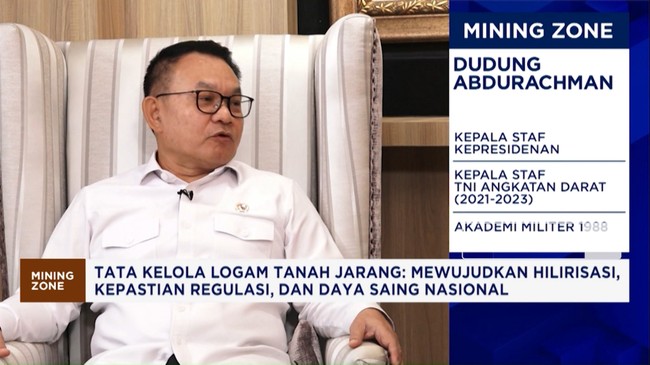
Head of the Presidential Staff Office Dudung Abdurachman said an agreement between ministries and agencies has been signed to accelerate the normalisation of mineral exports.
He said intensive coordination continues with the Ministry of Trade and the Directorate General of Minerals and Coal at the Ministry of Energy and Mineral Resources to detail the permissible limits on REE content.
“From yesterday’s communication and coordination, an agreement was finally reached, because if this were delayed for so long, the grade of each metal to be exported would effectively shrink, then operational costs too, and no less importantly, social unrest among workers, business actors and so on,” he said on the Mining Zone programme on CNBC Indonesia, quoted on Tuesday (4/8/2026).
“So we took steps yesterday, reached an agreement among all parties, then signed it whilst awaiting the regulation that we will draft from the Mineral and Coal Directorate’s proposal to the Trade Ministry, which will then be communicated and coordinated at the Coordinating Ministry for Economic Affairs. But before this is discussed, exports can already begin, so as to avoid such turmoil,” he explained.
According to him, the export halt was triggered by business actors’ concerns about law enforcement action over REE content as accompanying minerals in mineral commodities. As a result, hundreds of mineral-carrying vessels were held up at ports before the government finally provided security guarantees for shipping activities.
“That very night exports could proceed. Finally, after communication, everyone agreed and signed, so no party is disadvantaged,” Dudung said of export permits granted several days ago.
The government is currently finalising a draft of new regulations involving 15 ministries and agencies to set technical limits on REE content. The main focus of the rules is to clarify the definition of accompanying minerals to prevent multiple interpretations or law enforcement actions considered excessive in the field.
“In addition, we will also discuss how to develop the technology itself, one of which involves BRIN, then the Minerals and Coal Directorate, then the oil and gas sector and so on, so that we do not merely export raw materials, and the downstream process can be developed,” he explained.
Dudung stressed that his office will closely monitor the implementation of this agreement to prevent rogue law enforcement officials from unilaterally obstructing licensed exports. He urged business actors to report promptly any coordination problems with officers in the field during the transition period of these regulations.
“If anyone claims to act as law enforcement, they must report to us so we can protect them. We must not have law enforcement running wild without coordination,” Dudung concluded.
Previously, Coordinating Minister for Economic Affairs Airlangga Hartarto addressed the issue of mineral exports hampered by their REE content.
The government believes it will revise Trade Ministerial Regulation (Permendag) No. 6 of 2026, the Fourth Amendment to Trade Ministerial Regulation No. 22 of 2023 on Goods Prohibited from Export.
“(On) REEs, it has been discussed at the Energy and Mineral Resources Ministry and the Trade Ministry. There is no (new regulation). Just a revision of Permendag,” Airlangga said when met at his office on Monday (3/8/2026). The revision is targeted for completion within a week.
Recently, there have been complaints from mineral mining businesses such as tin, nickel and bauxite that their export activities were halted because they had to meet a new requirement: the REE content within their goods.
Airlangga acknowledged that chemically, REEs are often found bonded with mining commodities and are difficult to separate completely.
“REEs exist in chemical elements. It is natural. They cannot be separated 100 per cent. There are always accompanying others,” he explained.
The Permendag revision will be drafted based on technical recommendations issued by the Ministry of Energy and Mineral Resources.
Nevertheless, the rules being deliberated concern determining the threshold of chemical element content that will serve as a reference for surveyors and Customs in overseeing exports.
“In accordance with the limits. Yes. Permendag upon the recommendation of the Energy and Mineral Resources Ministry,” he said.
It should be noted that this Permendag was signed in Jakarta on 17 March 2026 by Trade Minister Budi Santoso and promulgated on 26 March 2026. Permendag No. 6 of 2026 came into effect on 1 April 2026.
Among the goods prohibited from export under Permendag No. 6 of 2026 are rare earth elements (REEs) comprising 17 elements contained in rare earths at less than 99% purity, namely:
Scandium below 99% purity
Yttrium below 99% purity
Lanthanum below 99% purity
Cerium below 99% purity
Praseodymium below 99% purity
Neodymium below 99% purity
Promethium below 99% purity
Samarium below 99% purity
Europium below 99% purity
Gadolinium below 99% purity
Terbium below 99% purity
Dysprosium below 99% purity
Holmium below 99% purity
Erbium below 99% purity
Thulium below 99% purity
Ytterbium below 99% purity
Lutetium below 99% purity
This provision is set out in the Mining Sector Appendix, item 257 of Permendag No. 6 of 2026.
Source: jawawa.id (https://jawawa.id/newsitem/indonesia-revises-rare-earth-export-rules-to-unblock-nickel-and-tin-shipments-1785826320)
Originally published by CNBC Indonesia (https://www.cnbcindonesia.com/news/20260804122937-4-756378/peraturan-ekspor-ltj-direvisi-keran-ekspor-nikel-cs-dibuka-lagi), translated from Indonesian