
Indonesia Reaffirms Commitment to Supporting Palestinian Education
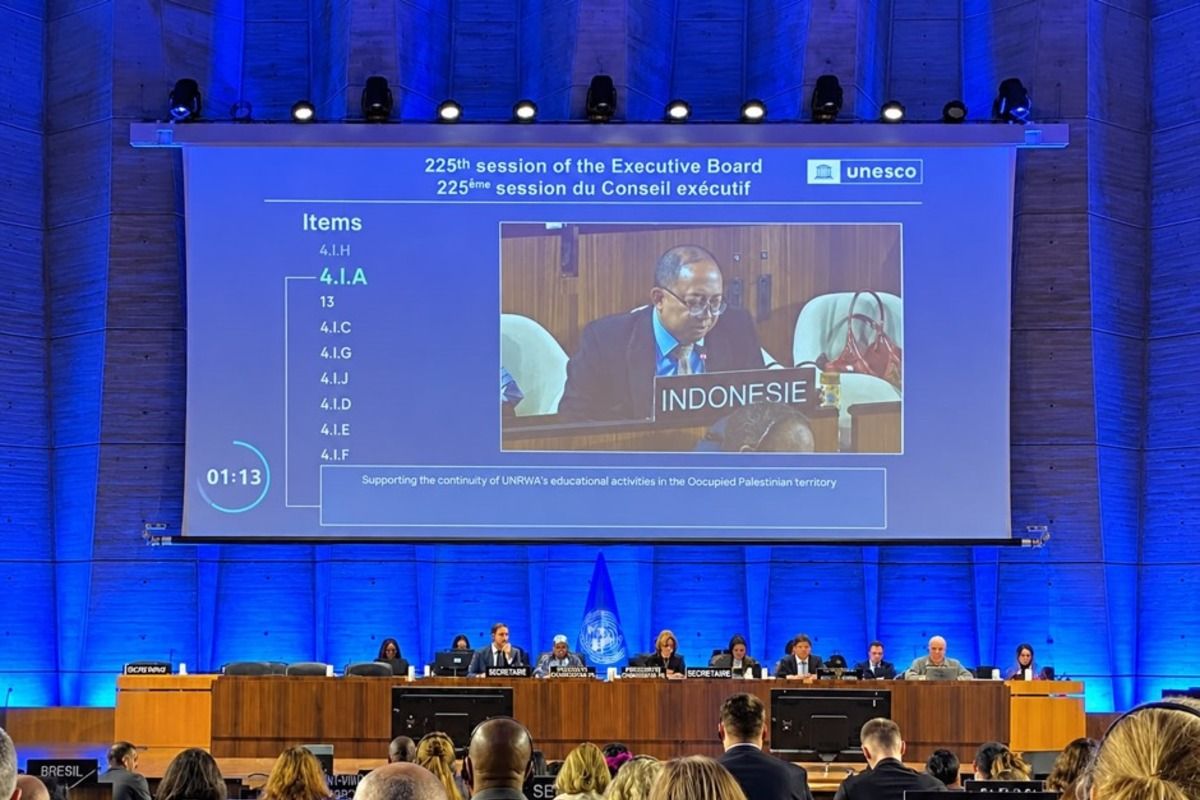
Jakarta (ANTARA) – Indonesia has reaffirmed its commitment to supporting continued education for young Palestinians affected by prolonged conflict.
On the sixth day of the 225th session of UNESCO’s Executive Board in Paris, Indonesia’s Deputy Permanent Delegate to UNESCO, IGAK Satrya Wibawa, called for stronger international cooperation to ensure that education services provided by the UN Relief and Works Agency for Palestine Refugees (UNRWA) can continue.
“For Indonesia, education is not merely a need during conflict; it is the foundation for recovery, development and Palestine’s future. Palestinian children must not lose the opportunity to learn because of prolonged conflict,” Satrya said in a written statement in Jakarta on Tuesday.
Indonesia welcomed UNESCO’s support for UNRWA’s educational activities, while expressing deep concern over the destruction of educational facilities, restrictions on movement and operational obstacles threatening Palestinian children’s right to learn.
The Palestinian education crisis has reached an alarming level. UNESCO estimates that about 745,000 students in Gaza have been without access to school education for more than two academic years since October 2023, including around 88,000 higher education students.
Meanwhile, in March 2026, UNRWA warned that about 48,000 Palestinian refugee students in the West Bank also faced the risk of disrupted education because of displacement, school closures and insecurity.
Indonesia stressed the need for adequate and sustainable funding for UNRWA, managed transparently and accountably, so the agency can continue providing education and protection for Palestinian refugee children.
“UNRWA has an irreplaceable role in ensuring Palestinian refugees have access to education. International solidarity must therefore be translated into funding support and concrete, sustained cooperation,” he said.
Indonesia is also seeking to expand Palestinians’ access to education. On 9 September, the National Zakat Agency (BAZNAS) and the Ministry of Higher Education, Science and Technology launched a master’s scholarship programme for 200 students to study at Indonesian universities, with a budget of Rp22 billion.
Jakarta is also strengthening cooperation on education reform, institutional capacity-building and the development of an inclusive education system through an Indonesia–Palestine dialogue in April 2026 involving Australia.
Indonesia’s support also includes humanitarian assistance. According to a report from the Indonesian Embassy in Cairo, by February 2026 aid channelled through Egypt amounted to around US$22.55 million (about Rp405 billion), weighing 2,580 tonnes.
In April 2026, a convoy of 24 lorries delivered a further 500 tonnes of aid, worth Rp20 billion, for 150,000 people in Gaza.
Satrya said Indonesia supported UNESCO’s efforts to expand emergency learning, teacher training, psychosocial services, inclusive education, and higher and vocational education.
In a report dated 15 October 2026, UNESCO said around 40,000 students had benefited from the Gaza Virtual Campus Network and temporary learning spaces.
The initiative shows that education can be sustained despite damaged infrastructure, although the physical recovery of schools and universities remains urgent.
Indonesia also emphasised that curriculum development and education recovery must respect Palestinian national ownership and the authority of the Palestinian Authority.
UNESCO–UNRWA cooperation should be strengthened, with the needs of Palestinian communities treated as the foremost priority.
“Preserving Palestinian education means safeguarding the hopes of a generation and strengthening the Palestinian people’s ability to build their own future. Indonesia will continue to support international efforts to ensure that the right to education does not become another casualty of conflict,” he said.