
Indonesia Pursues 50% Bioethanol Blend as Deputy Coordinating Minister Reveals Prabowo’s Key Directive
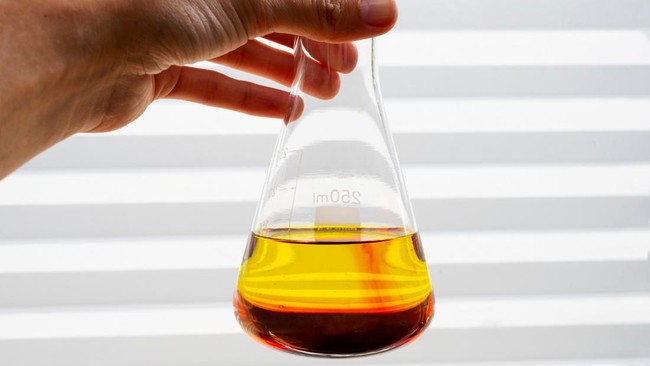
Jakarta, CNBC Indonesia – The government’s ambition to reach a 50% biofuel blend, or E50, faces several challenges. One is the availability of sugar-cane feedstock, as by-products from its processing are still needed by domestic agriculture and livestock sectors.
Deputy Coordinating Minister for Food Hanif Faisol Nurofiq said molasses, a potential feedstock for bioethanol production, is currently being absorbed by the domestic market. It is used, among other things, in agriculture and animal feed.
This means the government must carefully assess how molasses could be used to support bioethanol development without disrupting supplies to other sectors.
“Most molasses is still used in agriculture and animal feed. If that is disrupted, it will affect agricultural and livestock products,” Hanif said at his office in Jakarta on Friday (6 November 2026).
He said the government was still discussing concrete scenarios to meet bioethanol feedstock needs. The discussions involve several ministries because the issue concerns not only agricultural production but also land availability.
The government will hold a meeting with the Ministry of Agriculture, the Ministry of Energy and Mineral Resources (ESDM), the Ministry of Agrarian Affairs and Spatial Planning/National Land Agency (ATR/BPN), and the Ministry of Forestry.
“For E50 in particular, we may need to step this up with a different scenario. We are examining it with colleagues at the ESDM, ATR/BPN, Agriculture and Forestry ministries, because it concerns land use,” he said.
Sugar-cane land requirements still being assessed
Alongside the feedstock supply challenge, the government is also calculating how much land will be needed to support its bioethanol ambitions, including the development of E50.
Hanif said the Ministry of Agriculture had previously identified potential locations for sugar-cane plantations. However, the government has not finalised the land requirement, as the matter still needs to be discussed across ministries. One option under consideration is using degraded land for new sugar-cane plantations.
Hanif said Indonesia had around 9.7 million hectares of potentially degraded land. That figure still needs to be assessed and adjusted for land status, including the exclusion of areas within forest zones.
“The total is nearly 9.7 million hectares, which we are continuing to analyse. But the analysis is not straightforward; we need many sources to identify locations in reasonable detail,” he explained.
He stressed that the use of such land must comply with President Prabowo Subianto’s directive that food and energy programmes must not be developed by converting natural forests.
“The President’s instruction was firm: we must not touch natural forests. His order was clear: no more natural forest is to be converted. So we are redirecting, repositioning and relocating all plans to degraded land that already exists in our country,” Hanif said.
Hanif explained that after forest areas are excluded, around six million hectares of the approximately 9.7 million hectares of potentially degraded land could still be considered. The government is now conducting further assessments and cross-checking data against various sectoral maps.
As for the figure of up to two million hectares of sugar-cane land needed to support E50, Hanif said it still had to be verified.
“We are recalculating it, but that is the figure in the Ministry of Agriculture’s plan,” he said.
He added that verification was necessary to ensure the proposed locations were outside forest areas and suitable for sugar-cane plantations.
“Once again, we want to verify it. The maps are indicative, and we do not yet have a single integrated map. We are therefore overlaying many maps to support the E50 policy,” he said.
The government therefore still has two major tasks in pursuing E50: securing feedstock without disrupting the needs of agriculture and livestock, and preparing land for new sugar-cane plantations in line with spatial-planning and forestry rules.
Source: jawawa.id (https://jawawa.id/newsitem/indonesia-pursues-50-bioethanol-blend-as-deputy-coordinating-minister-reveals-prabowos-key-directive-1793951426)
Originally published by CNBC Indonesia (https://www.cnbcindonesia.com/news/20261106114117-4-782919/ri-kejar-bioetanol-50-wamenko-hanif-ungkap-pesan-penting-prabowo), translated from Indonesian