
Indonesia proposes deepening regional AI education cooperation within ASEAN
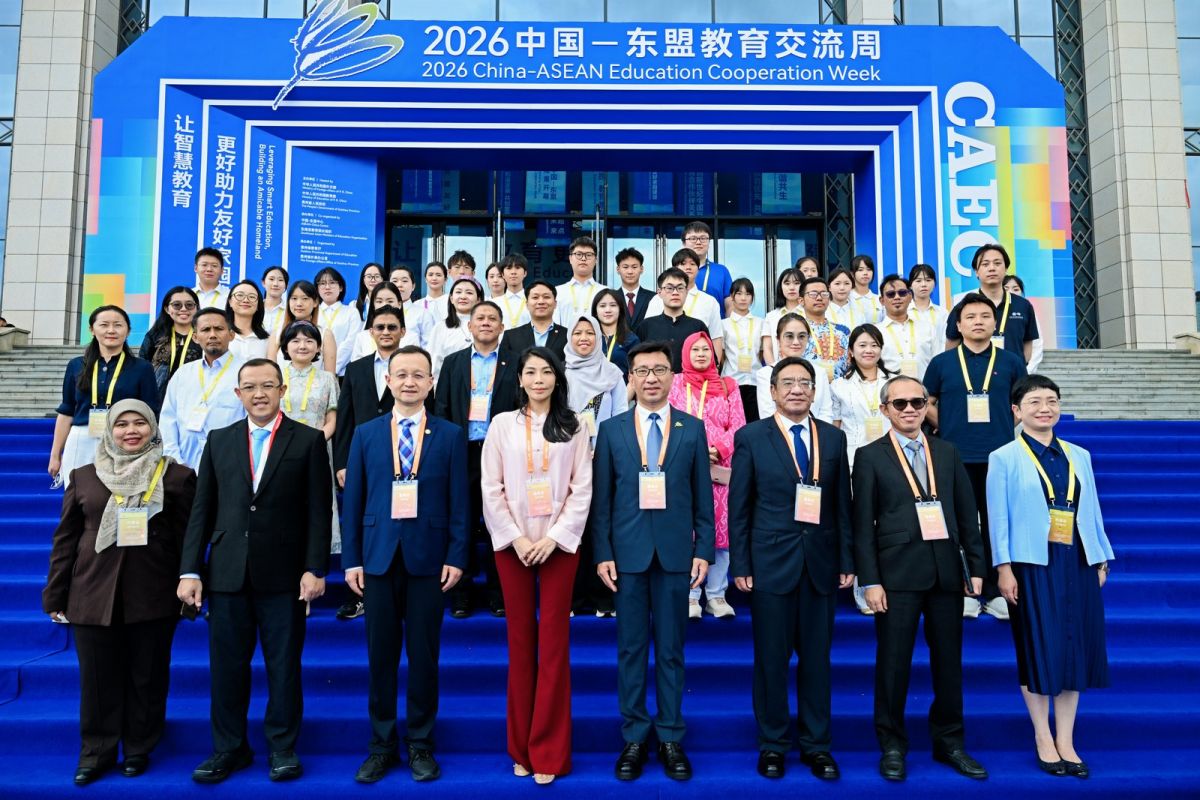
Guiyang (ANTARA) - The 2026 China-ASEAN Education Cooperation Week opened in Guiyang, Guizhou Province, southwest China, under the theme ‘Leveraging Smart Education, Building an Amicable Homeland’. More than 450 education officials, university academics, and industry representatives from China and ASEAN nations gathered to discuss how artificial intelligence (AI) can further deepen educational cooperation between China and ASEAN member states.
Badri Munir Sukoco, Secretary-General of the Republic of Indonesia’s Ministry of Higher Education, Science, and Technology, attended the event for the first time. Badri told Xinhua that China’s smart education and industrial systems for AI have become world leaders. Indonesia aims to draw lessons from China’s experience in AI curriculum reform, teacher training, and the equitable development of computing capacity across various regions through the China-ASEAN Education Cooperation Week platform.
During his first visit to Guizhou, Badri expressed great impression with the success of this inland southwest Chinese province in pursuing a unique digital industry development path, breaking the stereotype that technology industries are concentrated solely in coastal areas. “Actually, I was a little surprised. This province is far from the coastal cities that serve as technology hubs, yet the government has worked to create balance by establishing Guizhou as China’s big data hub,” Badri remarked.
Badri noted that Indonesia’s progress in developing digital education and the AI industry still lags behind China. Guizhou’s practice of developing big data advantages tailored to local conditions could serve as a model for various provinces in Indonesia. “Regarding AI, we understand that China is far more advanced than we are, so we can learn more from China and also collaborate more extensively,” said Badri. He added that while Indonesia has decentralised its system since 1990, the pace of development has not yet matched China’s.
After witnessing the launch of a large-scale AI model for Traditional Chinese Medicine (TCM) and an AI laboratory that integrates industry, universities, and research, Badri stated that China possesses a comprehensive and world-leading AI industrial chain, particularly in developing AI projects across various sectors. Badri proposed that China and Indonesia could fully realise two-way complementary cooperation through the integration of resources and technology.
“For example, AI for traditional medicine. China has traditional medicine, and of course, our country does too. We can combine them and learn from each other’s traditional medicine to maintain health. Indonesia also possesses significant rare earth elements; if paired with Chinese AI, we could create new materials more rapidly,” Badri added.
According to Badri, AI is a double-edged sword that cannot be simply rejected or pursued without careful consideration. Closer cooperation between China and ASEAN, supported by systematic higher education, is crucial to maximising the positive value of AI while suppressing its misuse, such as deepfakes, disinformation, and doxxing, which is a top priority for Indonesia’s current educational reforms.
“AI is somewhat of a paradox. It can be positive if utilised optimally, but it can also be negative. We can focus more on the positive side,” said Badri. He emphasised that teachers and students must possess the ability to adapt to changes. Understanding AI and optimising its use for society is part of the transformation process. Training is essential, not only for students but also for professors, as AI is a very new field of learning.
“Previously, we relied on textbooks, but now we can learn directly with the assistance of AI. Curricula and examination systems in higher education need to be changed. We need to learn from China regarding how they integrate AI into the curriculum,” he added.
Badri stated that several intentions for digital education cooperation between Indonesian universities and Guizhou would be achieved during the China-ASEAN Education Cooperation Week. “Collaboration can be realised if we trust each other. To build trust, we need to meet in person. This cooperation week is the perfect opportunity for us to update each other on annual developments, allowing us to accelerate and expand the scale of AI cooperation,” concluded Badri.