
Indonesia Promotes Climate Adaptation and Local Wisdom at BRICS Meeting
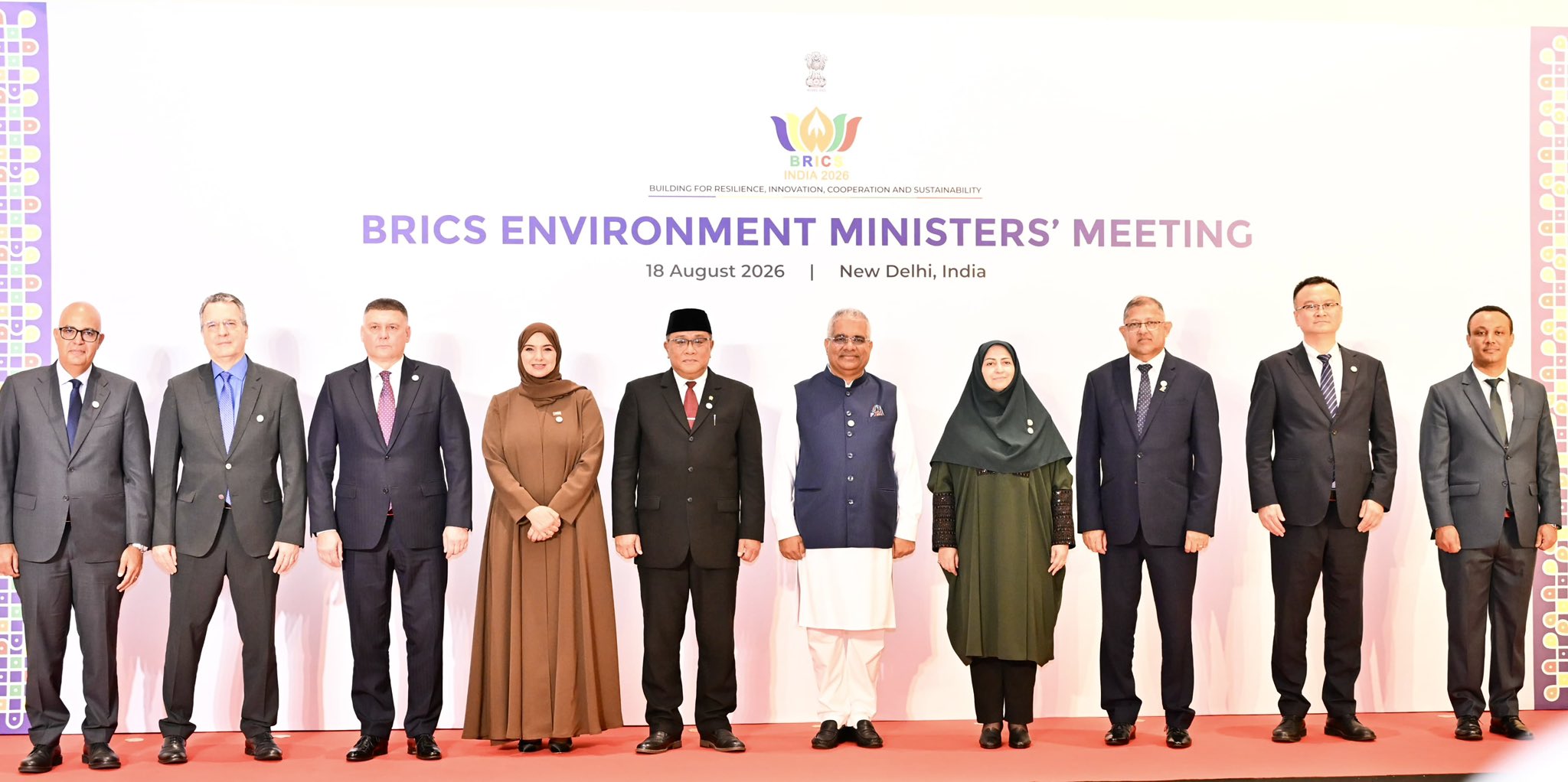
INDONESIA has stressed the importance of climate change adaptation, biodiversity protection and the use of traditional knowledge at the 12th BRICS Environment Ministers’ Meeting at Bharat Mandapam in New Delhi, India, on Tuesday (18/8) local time.
India is hosting the BRICS High-Level Meeting on Climate Change and Sustainable Development at Bharat Mandapam in New Delhi on 17–18 August.
The meeting includes the 12th BRICS Environment Ministers’ Meeting and a Senior Officials’ Meeting. The event is being held as part of India’s BRICS chairmanship in 2026 under the theme ‘Building for Resilience, Innovation, Cooperation and Sustainability’.
The meeting was attended by 10 of the 11 BRICS member states. India’s Minister of Environment, Forest and Climate Change, Bhupender Yadav, opened the proceedings, followed by a statement from Indonesia’s Environment Minister Jumhur Hidayat.
Citing an official press release published on brics2026.gov.in, Shri Bhupender Yadav, together with the heads of delegation of BRICS member states, launched four knowledge compendiums compiled by the BRICS Environment Working Group.
The four documents contain best practices, knowledge systems and various innovations developed in BRICS member states. The compilation of the compendiums is part of efforts to strengthen knowledge exchange and experience sharing among member states in addressing environmental and climate change challenges.
Meanwhile, Minister Jumhur in his presentation expressed concern over the stance of a number of developed countries with major economic power that he said were choosing to retreat from collective responsibility in tackling pollution and climate change. Yet, according to him, the economic strength of those countries still accounts for the majority of global emissions.
Jumhur said the management of natural resources, landscape formation, prevention of environmental degradation and building resilience would determine the sustainability of development.
Indonesia also underlined the importance of protecting biodiversity, both on land and at sea, as the foundation of healthy ecosystems, climate resilience and long-term sustainable growth.
Indonesia, according to Jumhur, is one of the most biodiverse countries in the world. The archipelagic nation is home to more than 300,000 known species, including 9.7 per cent of the world’s flowering plants, 14 per cent of mammals and 18.6 per cent of birds.
Indonesia’s marine ecosystems, located at the heart of the Coral Triangle, are also home to 23 per cent of the world’s mangrove forests, 16 per cent of global marine fish species and 10 per cent of the world’s coral species.
As an archipelagic country with more than 17,000 islands and more than 60 per cent of its population living in coastal areas, Indonesia faces the direct impacts of climate change. Rising sea levels, extreme weather and climate-related disasters are considered capable of disrupting livelihoods and hampering development progress.
“Therefore, for Indonesia, climate adaptation is not a peripheral agenda. It is a central pillar of sustainable development and a safeguard for our national prosperity. We have enacted the National Adaptation Plan 2026–2030 as a roadmap towards a climate-resilient Indonesia and as support for the Golden Indonesia 2045 Vision,” said Jumhur.
According to Jumhur, efforts to build climate resilience cannot rely solely on modern science and technology. The wealth of traditional community knowledge must also be part of the solution to tackling climate change.
“Communities are the first to feel the impacts of climate change and possess invaluable insights into local weather patterns and natural resource management,” said Jumhur.
At the forum, Jumhur introduced three traditional Indonesian practices considered relevant to supporting climate adaptation and resilience, namely the Subak irrigation system in Bali, Sasi Lompa in Maluku and Awig-Awig in Bali.
Subak is a water management system that combines community cooperation and spiritual practice. Sasi Lompa is a traditional system for managing fisheries sustainably. Awig-Awig is a community-based customary law system in Bali.
“These practices demonstrate that living in harmony with nature is not only a cultural heritage but also a powerful tool for climate adaptation and resilience, particularly by strengthening community-based approaches to managing water, ecosystems and natural resources in the face of climate impacts,” Jumhur concluded.
BRICS originally comprised Brazil, Russia, India, China and South Africa. Following expansion, the strategic alliance of emerging economies now also includes Egypt, Ethiopia, Indonesia, Iran, Saudi Arabia and the United Arab Emirates.
BRICS countries hold a BRICS Summit every year. The forum discusses various areas of political and socio-economic coordination, including business opportunities, economic complementarity and areas of cooperation that can be developed by member states.
Source: jawawa.id (https://jawawa.id/newsitem/indonesia-promotes-climate-adaptation-and-local-wisdom-at-brics-meeting-1787089813)
Originally published by Media Indonesia (https://mediaindonesia.com/internasional/923347/indonesia-dorong-adaptasi-iklim-dan-kearifan-lokal-dalam-pertemuan-brics), translated from Indonesian