
Indonesia Presses Ahead with 8% Growth Target by 2029, with Data Centres and Trade as Drivers
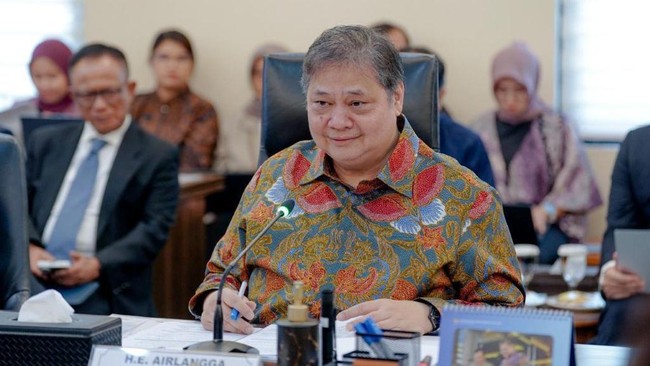
Jakarta, CNBC Indonesia — The government is preparing a range of strategies to meet its target of 8% economic growth by 2029. These include injecting stimulus to support purchasing power at the end of the year, improving the quality of human resources and developing future technology industries such as artificial intelligence (AI) and semiconductors.
Coordinating Economic Affairs Minister Airlangga Hartarto said the strategy was underpinned by solid national economic conditions. In the third quarter of 2026, Indonesia’s economy grew by 5.47% year on year, despite global economic uncertainty.
“Amid global uncertainty, Indonesia continues to grow strongly at 5.47%, and this performance exceeds that of various G20 countries,” Airlangga said in his closing remarks at the Business & Leadership Forum, held as part of the centenary celebrations of Kolese Kanisius in Jakarta on Wednesday (25 November 2026).
According to Airlangga, economic growth was supported by industrial activity, household consumption and investment. Several indicators also showed that economic activity remained in expansionary territory.
Indonesia’s manufacturing Purchasing Managers’ Index (PMI) stood at 54 in October 2026. Meanwhile, bank lending grew by 12.7%, with investment loans increasing by 19.3%.
Inflation was recorded at 3.23%, while Bank Indonesia’s benchmark interest rate stood at 6%. On the employment front, the number of people in work increased by 1.44 million to 147.99 million. The open unemployment rate also fell to 4.75%.
Airlangga urged businesses to increase productive spending and investment to maintain the momentum of economic growth.
“Looking ahead, I encourage the business community and Kanisius alumni to increase productive spending and investment,” he said.
Year-end stimulus and workforce development
To sustain household consumption at the end of 2026, the government is preparing several stimulus measures ahead of Christmas 2026 and New Year 2027.
The incentives include 100% government-borne Value Added Tax (VAT) on domestic economy-class air tickets for travel between 22 December 2026 and 10 January 2027.
The government is also offering a 30% discount on economy-class train tickets in Java and Sumatra, discounted PELNI ship tickets, and exemptions from port services charges at selected ports operated by ASDP.
In terms of social assistance, the government is continuing food aid of 10 kilograms of rice per month for 33.24 million families. It is also preparing a Wage Subsidy Assistance (BSU) payment of Rp900,000 for about 13.3 million workers for November and December 2026.
In 2027, the government will boost productivity and worker protection through a national apprenticeship programme for 150,000 participants and vocational training for 300,000 participants.
It is also preparing Job Loss Insurance (JKP) for workers affected by redundancies, as well as a government-borne Article 21 income tax incentive for employees earning up to Rp10 million per month.
Targeting AI, semiconductors and data centres
Alongside efforts to sustain consumption and improve workforce quality, the government is targeting the development of technology industries as an engine of medium-term economic growth.
Airlangga said the development of ecosystems for artificial intelligence (AI), semiconductors and data centres formed part of the strategy.
Indonesia’s data-centre capacity currently stands at around 700 megawatts (MW) and is projected to rise to 1.3 gigawatts (GW) by 2029.
The sector’s development is supported by the availability of competitively priced energy, land and water, as well as Indonesia’s large domestic market.
“AI and semiconductors will become key engines of future economic growth, supported by the readiness of energy infrastructure and Indonesia’s large domestic market,” Airlangga said.
On trade, the government is seeking to expand access to global markets through several strategic partnerships. One is the signing of the Indonesia–European Union Comprehensive Economic Partnership Agreement (IEU-CEPA) in Brussels on 21 November 2026.
The agreement is intended to remove duties on most traded tariff lines between Indonesia and the European Union.
At the regional level, all ASEAN member states have signed the Digital Economy Framework Agreement (DEFA) to strengthen regional digital economic integration. This includes cross-border payment systems, which are expected to expand market access for micro, small and medium-sized enterprises (MSMEs).
The government is also continuing Indonesia’s accession process to the Organisation for Economic Co-operation and Development (OECD), with compliance with its standards reaching around 80%.
In addition, export markets are being expanded through the conclusion of trade agreements with Canada and Peru, as well as discussions on joining the Comprehensive and Progressive Agreement for Trans-Pacific Partnership (CPTPP).
The government hopes these strategies will work together—from sustaining domestic consumption and improving workforce productivity to strengthening technology industries and expanding export markets—to promote inclusive and sustainable economic growth.
Source: jawawa.id (https://jawawa.id/newsitem/indonesia-presses-ahead-with-8-growth-target-by-2029-with-data-centres-and-trade-as-drivers-1795665049)
Originally published by CNBC Indonesia (https://www.cnbcindonesia.com/news/20261126085732-4-788581/ri-gigih-kejar-ekonomi-8-di-2029-pusat-data-perdagangan-jadi-motor), translated from Indonesian