
Indonesia Prepares CNG as LPG Replacement, Pertagas Readies Infrastructure
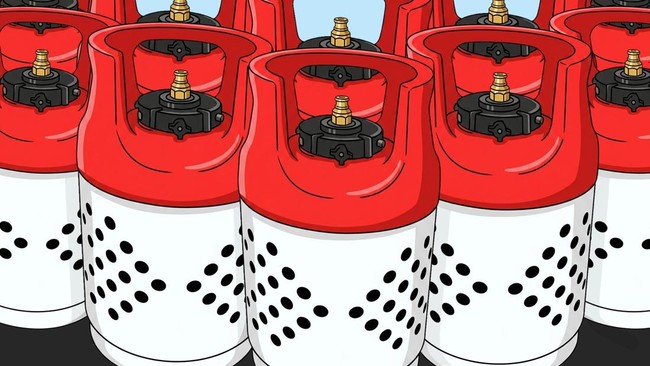
PT Pertamina Gas (Pertagas) has expressed support for the government’s plan to convert the use of 3 kilogram (kg) Liquefied Petroleum Gas (LPG) to 3 kg Compressed Natural Gas (CNG). This is being pursued through the provision of infrastructure to supply the 3 kg CNG planned by the government.
Pertagas Corporate Secretary Sulthani Adil Mangatur said the company could play a role in distributing the feedstock gas for CNG. The company is currently awaiting the government’s decision on the business mechanism to be applied in the implementation.
If the company is later given a role, it will prepare the infrastructure side.
“In principle, if we are asked to take part, we will be ready to provide support, in line with our role, for instance in the infrastructure. When we talk about CNG, conceptually the question is whether it must be channelled through certain compression stations, or whether the gas flow from the supply source must go to certain station points — that is where Pertagas’ role will be determined,” he said when met at the Tegalgede Gas Compressor Station in Cikarang, quoted on Thursday (9/7/2026).
He stressed that any future infrastructure expansion by the company will always be aligned with government programmes.
“As for the technical details, we will have to see what the oil and gas regulator decides regarding the rules and the business mechanism — we will wait to see from the government how it will be,” he concluded.
For context, the Ministry of Energy and Mineral Resources (ESDM) has introduced a project to replace 3 kg LPG with 3 kg CNG. The CNG cylinder has been named “CNG Merah Putih” (Red and White CNG) in order to harness domestic energy sources and reduce dependence on LPG, which is still dominated by imported products.
Director General of Oil and Gas at the ESDM Ministry, Laode Sulaeman, explained that the government is currently processing a dozen prototype CNG cylinders ahead of the trial phase. The target is for the 3 kg CNG cylinders to be implemented and distributed widely to the public sometime this year, 2026.
“The Minister announced the Red and White cylinder yesterday. So this July, prototypes are being made for testing. Around a dozen, perhaps about 15 cylinders. After one more stage, it can be implemented and circulated this year,” Laode said when met at the DPR building in Jakarta on Monday (29/6/2026).
Unlike conventional LPG cylinders, the CNG Merah Putih uses Type 4 cylinder technology made from composite materials. This technology is considered advantageous in terms of weight, as it is far lighter, making it easier to use at the household level.
“Let me explain once again: the cylinder material has now reached Type 4. Type 1 is all metal, Type 2 begins to have a mixture that lightens it, up to Type 3, but it is still heavy. That is why we have to make something lighter, so that mothers do not feel that the replacement is heavy,” said Laode.
For the initial phase, the government is procuring the high-tech cylinders through an import scheme from China. A series of tests will be carried out at the Oil and Gas Testing Institute (Lemigas), particularly concerning safety factors relating to the valve and the cylinder’s resistance to gas pressure.
“Currently, it is from China. We test it at Lemigas — there has to be a pressure test and so on, and the most important thing is the safety of the valve and the cylinder. In China, the cylinder and the valve come as one unit,” he continued.
The selling price of CNG Merah Putih will be set at parity with the current subsidised LPG price in order to maintain affordability for the public. Based on simulations, the use of this domestic natural gas is believed to be able to significantly reduce the energy subsidy burden.
“The price is the same. In the current simulation it is still equalised, and even so, subsidies could fall by up to 30%. If the volumes become massive, we will have bargaining power to ask them to build them here,” Laode revealed.
The implementation of 3 kg CNG will be carried out in stages, prioritising major cities on the island of Java that already have adequate gas pipeline infrastructure. The ESDM Ministry has coordinated with SKK Migas to ensure gas allocation is available to support the smooth running of the energy conversion programme.
“Yes, we are prioritising those served by pipelines first. That is why, as the Minister has said, the trials will be conducted in big cities on Java, where there are more gas pipeline routes. We have already discussed with SKK Migas that once it runs, the gas will be available,” he concluded.