
Indonesia Partners with Germany to Strengthen Research for Energy Transition
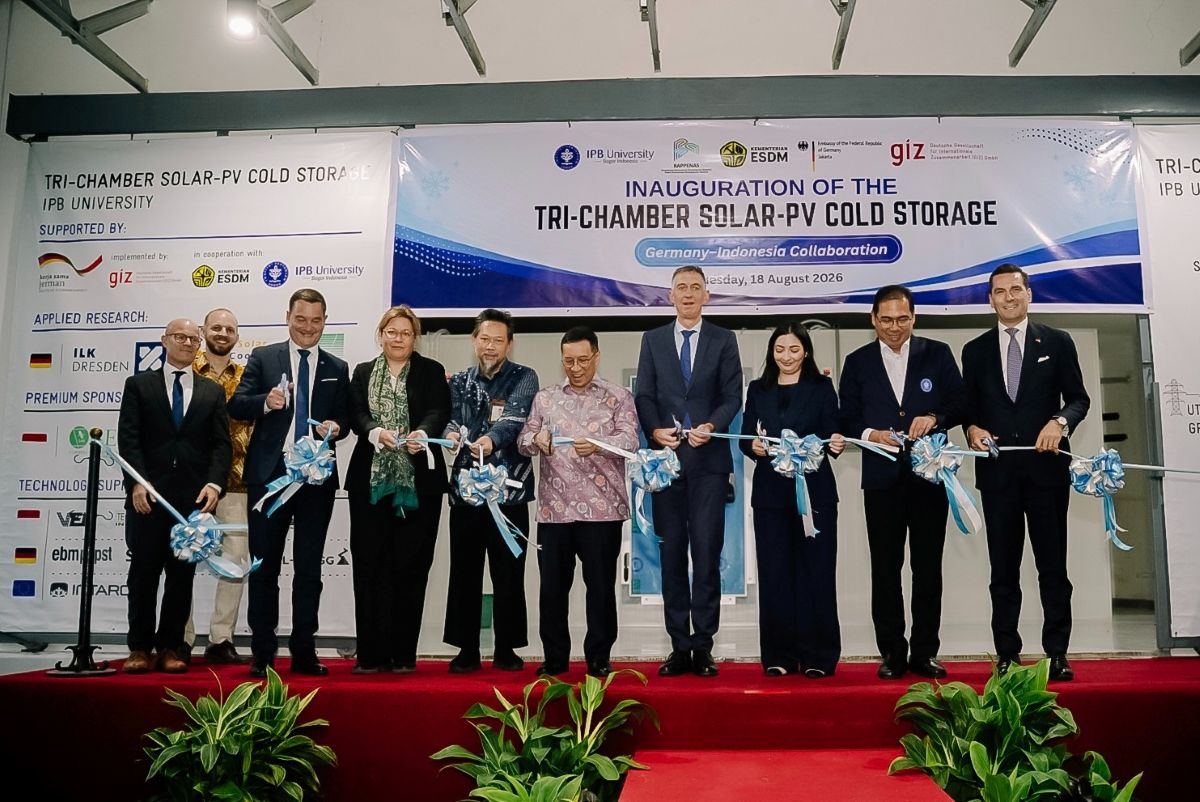
The Indonesian and German governments are strengthening cooperation to support the energy transition through a high-level event at IPB University, Bogor, on Tuesday (18/8). The event brought together government, academics, research institutions, development partners, and the private sector to discuss the role of technology, research, and investment in advancing Indonesia’s energy transition.
In his keynote address on Energy Transition and Sustainability at IPB University, Rector Alim Setiawan Slamet said higher education institutions have an important role in supporting the energy transition through research and innovation. One of the developments at IPB is an agrivoltaic system that integrates renewable energy generation with agricultural activities.
“We are committed to contributing to this transition through research and innovation,” Alim said.
According to him, the complexity of energy transition and sustainability challenges makes cross-country and cross-institutional cooperation essential. Knowledge exchange and partnership development are needed so that innovations can be applied as concrete solutions. He assessed that Germany’s experience in energy transformation provides lessons for Indonesia. According to him, the energy transition is not solely about changing energy sources, but also concerns society, industry, regions, and the future direction of economic development.
One form of Indonesia-Germany cooperation introduced at the event was a solar-powered cold storage facility at IPB University. The facility utilises solar energy to support the cooling and storage of food products, while also using natural refrigerants and energy-efficient technology to reduce environmental impact.
“We are grateful for the support of the German government through GIZ in the construction of the solar-powered cold storage,” Alim said.
The facility serves as an example of renewable energy application outside the electricity sector, particularly to support the food supply chain. Storage with maintained temperatures can help preserve product quality while reducing the risk of agricultural produce being wasted before reaching consumers.
As a pilot project, the cold storage facility also provides a space to test technology under real conditions in Indonesia. The experience is expected to provide lessons regarding technology, operation, costs, and market needs before similar solutions are developed on a broader scale. The project was developed through Indonesia-Germany technology cooperation with support from the German Federal Ministry for Economic Cooperation and Development (BMZ) and the Ministry of Energy and Mineral Resources (ESDM). Through the GIZ Indonesia and ASEAN Energy Programme, GIZ initiated and led the development of the concept involving IPB University, German applied research partners, and Indonesian and German companies.
On the same occasion, German Federal Minister for Economic Cooperation and Development Reem Alabali Radovan said German technology contributed to the development of the project. She expressed hope that energy cooperation between the two countries can continue to be expanded.
“I am proud that German technology has contributed to the success of this project,” Reem said.
According to her, Indonesia-Germany energy cooperation can provide benefits for both countries through the exchange of knowledge, technology, and the development of company networks.
“This is a win-win friendship. Both countries can benefit from each other’s knowledge and technological solutions,” she said.
Reem added that the cooperation is not only an opportunity for Indonesia to learn from Germany’s experience, but also for Germany to gain lessons from various innovations developed in Indonesia.
“This is not only for you to learn what we do in Germany, but also for us to learn from your new ideas,” she said.
She assessed that Indonesia and Germany face a number of similar challenges in the energy transition, including dependence on fossil energy and the need to accelerate the development of energy networks. Therefore, she welcomed Indonesia’s steps to strengthen its energy transition agenda, including through the plan to develop 100 gigawatts of solar power.
“Both of our countries still depend on fossil energy and both need to accelerate network development,” Reem said.
Source: jawawa.id (https://jawawa.id/newsitem/indonesia-partners-with-germany-to-strengthen-research-for-energy-transition-1787125837)
Originally published by Media Indonesia (https://mediaindonesia.com/ekonomi/923484/indonesia-gandeng-jerman-perkuat-riset-untuk-transisi-energi), translated from Indonesian