
Indonesia Overhauls Fishing Villages with Advanced Country Model
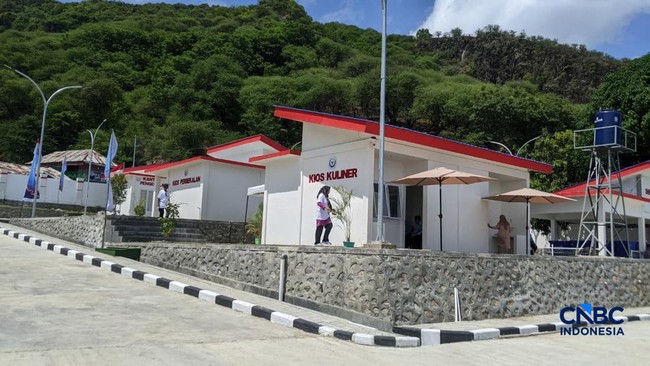
The government is not only building the Merah Putih Fishermen’s Village (KNMP) as a residential area for fishermen. Behind the project, the Ministry of Marine Affairs and Fisheries (KKP) is preparing a new business model so that fishermen’s catches can directly enter the export supply chain.
Minister of Marine Affairs and Fisheries Sakti Wahyu Trenggono said the concept was first tested in the Merah Putih Fishermen’s Village in Binyeri, Biak, Papua. As a result, the fish marketing pattern changed significantly because it was supported by cold chain facilities, logistics, and a ship repair workshop. There is also an ice factory, a boat dock, a culinary centre, a fuel station for ships, and a tourist park. This model is already widely used in developed countries such as Japan, Australia, and South Korea.
“So, from the model in Binyeri, it turned out that they are no longer selling their fish through the local markets there. There is a collector there now. Because the quality of the fish has become good, due to the ice factory we built. Then they also have logistics, making it easy for them to get supplies for going to sea,” Trenggono said during the CNBC Indonesia Economic Update 2026 on Thursday (25/6/2026).
He explained that the government also equipped the area with ship repair facilities, fuel supplies, and cold storage. Thus, the quality of the fish is maintained from the time it is caught until it is marketed. “If the ship is damaged, it is also easy to repair, there is a workshop there and so on. Then fuel for them to go to sea and everything is also easy to obtain there. So, the fish obtained is fresh. Because it is fresh, it can be directly stored in the cold storage,” he said.
Trenggono explained that the existence of these facilities means collectors are already on standby at the location, so the fishermen’s catch no longer depends on traditional markets. “The collectors are already ready there. So every time they return, as they mostly do one-day or two-day fishing trips, when they come back they bring their fish and immediately store it in the cold storage and so on. From there, it is then collected by the collectors who are already there, and then exported, for export purposes,” he said.
In the future, the government is also preparing processing facilities to increase the added value of fishery products. In addition to maintaining fish quality using slurry ice technology, each fishermen’s village will be directed to have simple processing facilities. “In the future, we hope that with the manager of this Fishermen’s Village who manages it and so on, we will install what we call a mini processing facility. Like direct vacuum packing, packaging, and so on,” said Trenggono.
He said this upstream-to-downstream integration is expected to make Indonesian fishery products of better quality while also improving product traceability. “The hope is that when it comes out, the traceability level of the fish will be better, and then the fish product will also be fresher, not like the current situation. Because what happens now is they catch fish, have difficulty getting ice, so the quality of the fish becomes poor, and so on,” he said.
The model tested in Binyeri is now being expanded nationally. Trenggono revealed that of the initial target to build 100 Merah Putih Fishermen’s Villages, 65 locations have been completed and are already being used by the community. The remaining 35 points are under construction and are expected to be completed by August at the latest. In parallel, the government is also starting to build an additional 1,269 Merah Putih Fishermen’s Villages this year, bringing the total target to 1,369 locations by the end of 2026.
He said the operation of these fishermen’s villages will be supported by specially recruited and trained human resources. Each location will have about four managers, from the manager to operational staff. Trenggono is optimistic that the development of this integrated fisheries ecosystem will not only improve the welfare of fishermen but also strengthen the coastal economy. From the 1,369 Merah Putih Fishermen’s Villages alone, the government estimates fish production could reach around 2.8 million tonnes per year, before the target of building 5,000 fishermen’s villages by 2029 is realised.