
Indonesia Orders 48 KAAN Fighter Jets: Can Turkish Technology Match the US F-35?
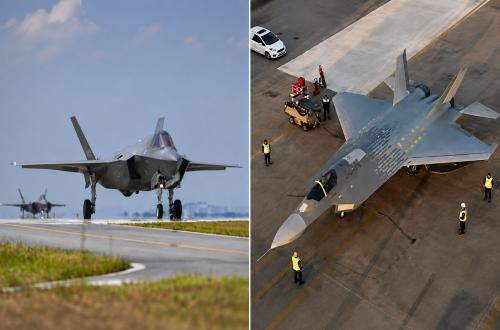
JAKARTA — Indonesia’s plan to acquire 48 Turkish-made fifth-generation KAAN fighter jets has reached an important stage, following progress in testing the aircraft’s prototype. Turkish Aerospace Industries (TAI) is targeting the first flight of the KAAN P1 prototype before the end of 2026, while the United States is strengthening the continuity of F-35 Lightning II production through a framework agreement to procure hundreds of aircraft over the coming decade.
The developments illustrate the competition in fifth-generation fighter technology between two countries whose defence industries are at different levels of maturity. Türkiye is developing KAAN towards production and operation, while the United States has operated the F-35 extensively alongside several partner countries.
A report by Hurriyet Daily News on Saturday (31 October 2026) reiterated TAI’s target of flying the P1 prototype before year-end. TAI chief executive Mehmet Demiroglu had previously announced the target on 2 October 2026, after the prototype completed system inspections and low-speed taxi tests on the runway.
KAAN’s development is now focused on completing further ground tests, including high-speed taxi tests. These steps are needed to ensure the aircraft’s systems are ready before it receives clearance for its maiden flight.
Meanwhile, the US government and Lockheed Martin announced a framework agreement on 22 October 2026 for F-35 production over a 10-year period. The plan covers at least 850 aircraft for the US military, in addition to procurement for international customers, with total production targeted at 156 aircraft a year.
The agreement still requires approval for multiyear procurement authority and funding from the US Congress before it can become a definitive procurement contract. Nevertheless, the scale of the production plan demonstrates the US defence industry’s capacity to maintain supplies of a fighter already in widespread service.
According to Lockheed Martin’s filing with the Securities and Exchange Commission (SEC), 1,387 F-35s had been delivered from the programme’s launch through to 27 September 2026. That figure illustrates the production and operational experience the KAAN programme has yet to acquire.
For Indonesia, developments in both programmes raise strategic questions about the direction of national air-force modernisation. Alongside the aircraft’s capabilities, the government must weigh technological maturity, operational readiness, delivery certainty and the industrial cooperation benefits that could come from procuring KAAN.
Indonesia signs contract for 48 KAAN fighter jets
Indonesia signed an implementation contract to procure 48 KAAN fighter aircraft from Türkiye on 26 July 2025. The signing took place during the International Defence Industry Fair (IDEF) in Istanbul and was witnessed by Defence Minister Sjafrie Sjamsoeddin.
Indonesia’s Ministry of Defence confirmed the agreement in a press release on 28 July 2025. The contract followed an intergovernmental agreement reached in Jakarta on 11 June 2025.
Turkish Aerospace described the procurement as an important milestone in developing the export market for KAAN. Indonesia is the first export customer for the fifth-generation fighter programme developed by Türkiye.
Co-operation between the two countries is not limited to the purchase of aircraft; it also includes plans to develop defence-industry capabilities. Planned activities include expanding local manufacturing capacity, training, technical support and the exchange of technological knowledge.
In its initial announcement in June 2025, TAI said the 48 aircraft were scheduled to be delivered over 120 months. However, this is a programme target that remains dependent on production progress, technological readiness and contract implementation.
Financing is a key factor in delivering the procurement. The Indonesian government must ensure that funding requirements, payment schedules and the stages of contract implementation are consistent with the national defence budget’s capacity.
On 2 April 2026, Brigadier General Rico Ricardo Sirait, head of the Defence Information Bureau at the Ministry of Defence’s secretary-general’s office, said the KAAN procurement would use foreign-loan financing. He said an initial, limited contract was still going through activation in co-ordination with the Ministry of Finance.
“For KAAN, there is already an initial contract for a limited number [of aircraft], which is currently being activated through the foreign loan (PLN) mechanism with the Ministry of Finance,” Rico said, as quoted by ANTARA. He added that procurement would be carried out in stages, taking account of budget readiness and the Indonesian National Armed Forces’ requirements.
His remarks show that signing a procurement contract and securing funding are distinct stages. The agreement to procure 48 aircraft has been announced, but implementation remains subject to government financing procedures.
The Ministry of Defence had also not provided a final procurement value in its April 2026 confirmation. Therefore, estimates circulating publicly should be distinguished from officially verified government information.
KAAN prototype prepares for new testing
KAAN is Türkiye’s national fighter-aircraft project, formerly known as TF-X. It is being developed as a multirole combat platform featuring reduced radar detectability, modern avionics, internal weapons bays and networked operational capabilities.
The programme is part of Ankara’s strategy to strengthen its defence-technology independence. Through the project, Türkiye aims to build domestic capabilities to design, manufacture and integrate advanced fighter-aircraft systems.
The initial KAAN demonstrator, designated P0, made its maiden flight on 21 February 2024. During the flight, which lasted about 13 minutes, the aircraft reached an altitude of 8,000 feet and a speed of around 230 knots.
Its second flight took place on 6 May 2024, lasting about 14 minutes and reaching an altitude of 10,000 feet. Both flights formed part of the initial assessment of KAAN’s flight characteristics and basic design capabilities.
However, the P0 demonstrator’s success does not mean that all fifth-generation combat capabilities are ready for operational use. The aircraft still requires further testing of its structure, avionics, flight controls, weapons and various supporting technologies.
The development of the P1 and P2 prototypes is therefore an important stage in the KAAN programme. Both are designed to be closer to the production configuration, incorporating refinements informed by experience with the initial demonstrator.
On 31 July 2026, TAI showed the P1 prototype conducting runway tests under its own engine power. The tests allow the development team to assess the readiness of the braking system, steering, flight controls and various supporting equipment.
Demiroglu said in early October that system inspections and low-speed taxi tests had been completed. The next tests are intended to ensure the aircraft meets safety requirements before its maiden flight.
TAI plans to build six prototypes as part of KAAN’s development. The company is also targeting initial deliveries to the Turkish Air Force from the end of 2028, although this schedule remains dependent on test results and production readiness.
The target delivery date does not mean that all the aircraft’s capabilities will have been fully validated. Avionics, weapons, electronic warfare and stealth characteristics still need to be proven in the configuration intended for operational use.
Source: jawawa.id (https://jawawa.id/newsitem/indonesia-orders-48-kaan-fighter-jets-can-turkish-technology-match-the-us-f-35-1793865138)
Originally published by Republika (https://news.republika.co.id/berita/to0c20451/ri-pesan-48-jet-kaan-mampukah-teknologi-turki-menyamai-f35-as), translated from Indonesian