
Indonesia Officially Launches 100 GW Solar Power Project with Rp1,140 Trillion Investment
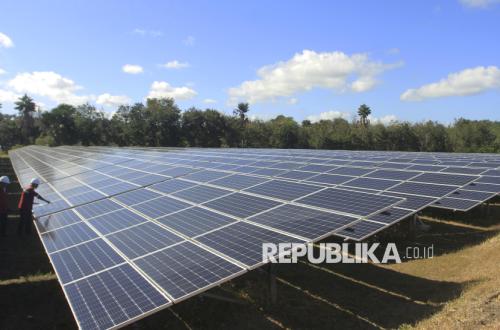
President Prabowo Subianto has officially launched Indonesia’s 100 gigawatt peak (GWp) solar power plant programme. The programme commenced with the construction of 14 solar power plants in West Java, Central Java, East Java, Bali, the Bangka Belitung Islands, and the Riau Islands, with a total capacity of 5.3 GWp.
“I, Prabowo Subianto, President of the Republic of Indonesia, hereby officially launch the 100 gigawatt peak solar power plant programme,” Prabowo said at the Launching and Groundbreaking of the 100 GWp Solar Power Programme in Bali on Tuesday (25/8/2026).
Prabowo has targeted the completion of the 100 GW solar power construction within three years. He even opened the possibility of accelerating the target to two years.
Minister of Energy and Mineral Resources Bahlil Lahadalia said the programme has an investment value of approximately US$73 billion, or more than Rp1,140 trillion. The programme is projected to create around 5.52 million jobs and save energy subsidies of up to Rp73.9 trillion per year.
Bahlil said the programme began execution just 11 days after Prabowo delivered his introductory speech on the 2027 State Budget Draft, which included instructions to accelerate the implementation of the 100 GW solar power programme.
“Today we are taking a major step towards realising what the President has always directed us to achieve, namely national energy self-sufficiency and sovereignty,” Bahlil said.
According to Bahlil, the 100 GW solar power programme is not merely a power generation project, but part of a strategy to utilise Indonesia’s energy resources while creating domestic added value.
“If Indonesia’s sun, its solar panels are made by the hard work of the Indonesian people, and its electric batteries are produced from the sweat of Indonesian workers, then this solar energy is Indonesia’s energy, the energy of Ibu Pertiwi,” he said.
Prabowo emphasised that the 100 GW solar power programme is part of efforts to make Indonesia stand on its own feet in meeting its energy needs.
“We will truly become a nation that stands on its own feet,” Prabowo said.
He even targeted Indonesia to stop importing oil and LPG in the shortest possible time. According to him, solar energy will be strengthened with geothermal, gas, and increased national oil production.
“With 100 gigawatts, with the geothermal we have, with the gas fields we have discovered, with oil lifting that must continue to rise, we must not import a single barrel of oil anymore,” he said.
Bahlil said the solar power programme is also directed at reducing dependence on diesel-fuelled power plants. Currently, there are still around 12.6 GW of power plants using diesel.
This consumption is estimated to be equivalent to oil needs of around 230,000 to 250,000 barrels per day. The conversion of diesel power plants to renewable energy is expected to reduce fuel imports while increasing domestic energy utilisation.
Specifically for Bali, the construction of 1 GW of solar power is estimated to save diesel usage of around 600,000 kilolitres. Bahlil said Bali still relies on a number of diesel power plants.
“All this time, Bali has apparently still been using diesel power plants. So, it is not surprising that we are doing this in Bali because the campaign is green energy,” Bahlil said.
In addition to reducing dependence on fossil fuels, the 100 GW solar power programme is projected to reduce emissions by around 140 million tonnes of carbon dioxide per year. The carbon economic value of this emission reduction is estimated to reach Rp6.31 trillion.
For the initial phase, the government has prepared 5.3 GWp through 14 solar power plants. Specifically for Bali, the capacity reaches 1 GW or 1,000 MW and is equipped with a battery-based energy storage system.
Bahlil explained that the electricity price from solar power plants is in the range of 5-6 US cents per kilowatt-hour, excluding batteries. Battery costs will depend on storage duration, ranging from four to 24 hours.
The programme will also target villages that have not yet received electricity access. Bahlil cited the example of a 1 MW power plant that Pertamina has built in a district in Sumatra. The plant supports electricity provision, energy storage, and community economic activities such as fisheries.
“Villages that have not had electricity so far, we will penetrate with the 100 gigawatt programme and electricity entering villages so that everyone can have electricity,” he said.
Bahlil said the construction of the 100 GW solar power programme will be carried out massively within three years. The government will prioritise the involvement of business entities through the independent power producer scheme.
If the electricity price offered is competitive, the project will be awarded to an IPP. However, if the price is not competitive or no investor is interested, the government will take over the construction through a scheme involving Danantara.
“If the price is competitive, we will give it to the IPP. If it is not competitive and no one wants it, then we will take it over to be carried out by the government through Danantara,” he said.
Bahlil emphasised that the project is the result of cross-ministerial and institutional work. The government also involves PLN, Pertamina, the military, the police, regional governments, and a number of technical ministries.
Prabowo asked all ranks to work quickly to achieve the target. He even compared the energy target to the government’s success in achieving a number of food targets ahead of schedule.
According to him, the construction of the 100 GW solar power programme is a strategic step to strengthen Indonesia’s energy resilience while facing various global dynamics.
Source: jawawa.id (https://jawawa.id/newsitem/indonesia-officially-launches-100-gw-solar-power-project-with-rp1-140-trillion-investment-1787662461)
Originally published by Republika (https://ekonomi.republika.co.id/berita/tkbqwe490/indonesia-resmi-luncurkan-proyek-plts-100-gw-investasi-capai-rp1140-triliun), translated from Indonesian