
Indonesia Offers 180 Industrial Estates to Attract Russian Investment
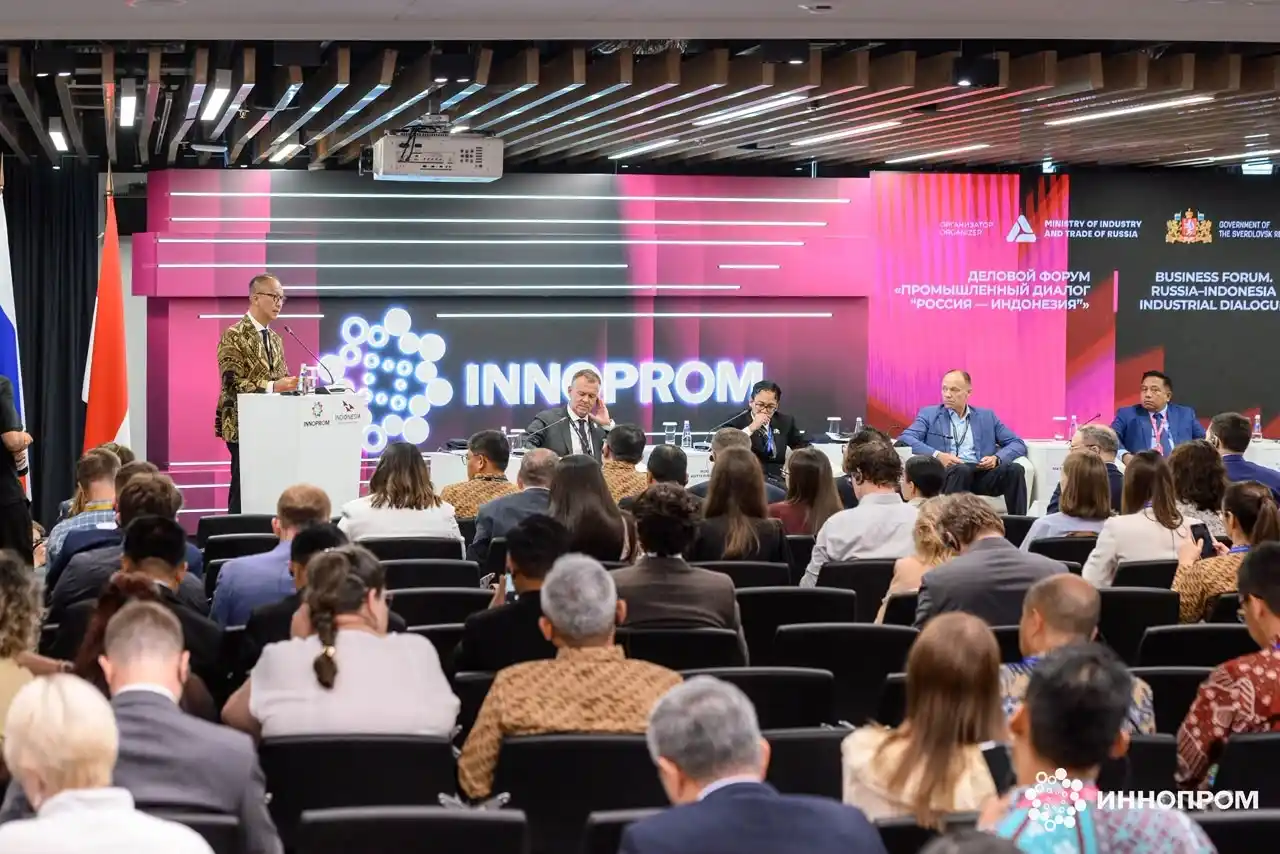
Indonesia has offered 180 industrial estates to the Russian government and business players as an entry point for the development of mutually beneficial international industrial clusters.
The offer was presented by the Ministry of Industry (Kemenperin) at INNOPROM 2026 in Yekaterinburg, Russia.
Industry Minister Agus Gumiwang said the development of industrial estates forms part of the government’s strategy to accelerate the equitable distribution of industrialisation while strengthening the competitiveness of the national manufacturing sector.
“Industrial estates play an important role in accelerating national industrial transformation — integrated ecosystems that support downstream processing, added value, job creation, and the global competitiveness of national industry,” he said in a statement cited on Sunday, 12 July 2026.
This optimism is supported by the consistently positive performance of industrial estates. Throughout 2025, industrial estates succeeded in attracting investment of Rp6,744.58 trillion, growing 9.26 per cent compared with the previous year, while absorbing around 2.35 million workers.
Tri Supondy, Director General of Industrial Resilience, Regional Development and International Access (KPAII), affirmed that regulatory harmonisation is an essential foundation for creating an increasingly conducive investment climate for industrial estates between Indonesia and Russia.
“Regulatory harmonisation between Indonesia and Russia is key to ensuring that every industrial estate investment runs efficiently, transparently and to mutual benefit for both countries. We hope this dialogue can serve as a foundation for long-term partnership, not only in investment but also in knowledge transfer and capacity development of industrial estates in both countries,” said Tri.
The discussion brought together government representatives, industrial estate associations and industrial estate managers from Indonesia and Russia to discuss investment cooperation opportunities, industrial estate development, and the formation of interconnected industrial estates (international industrial clusters).
As of the second quarter of 2026, Indonesia has 180 industrial estates housing nearly 12,000 companies or tenants. Industrial estate development is carried out through four main approaches: high-technology estates, estates based on the downstream processing of natural resources, water-efficient estates outside Java, and labour-intensive estates on Java to improve the efficiency of the national logistics system.
To strengthen investment appeal, the government also provides various fiscal and non-fiscal incentives. These facilities include risk-based business licensing, industrial estate status as National Vital Objects providing investment security certainty, the Provision of Certain Natural Gas Price (HGBT) for certain industries, an industrial machinery and equipment restructuring programme, and various tax incentives such as investment allowance, tax allowance, super tax deduction for research and vocational training activities, as well as exemption from import duties on machinery and raw materials through the masterlist scheme.
In addition, Indonesia also offers competitive wage levels in a number of industrial regions as one of the attractions for manufacturing investors.
As an example of successful industrial estate development, Kemenperin also presented the Kendal Special Economic Zone (Kendal SEZ). The zone, developed through a partnership between Jababeka & Co. and Singapore’s Sembcorp Urban Development, has become one of the fastest-growing industrial estates in Indonesia. As of 2025, Kendal SEZ has recorded cumulative investment of Rp187.05 trillion and absorbed more than 76,000 workers.
Kendal SEZ currently hosts 142 business entities from various countries, with fashion, automotive, renewable energy and electronics as the dominant sectors. The zone’s high occupancy rate has driven the development of a 1,200-hectare Ecosystem Hub that will include research and innovation centres, a sustainable industrial estate, a commercial district and integrated residential areas. The development is projected to absorb up to 250,000 workers with additional investment of around Rp370 trillion.
In addition to offering comprehensive industrial infrastructure, Kendal SEZ also opens up opportunities for collaboration in human resource development through partnerships with several vocational polytechnics and the digitalisation of industrial estate management.
The dialogue on regulatory harmonisation complemented the signing of a Memorandum of Understanding between the Indonesian Industrial Estates Association (HKI) and the Association of Clusters, Technology Parks and SEZs of Russia, conducted the previous day in Yekaterinburg. The understanding marks an initial step towards strengthening the partnership between Indonesia and Russia in industrial estate development, increased investment and the formation of competitive international industrial clusters.
13 MoUs secured for investment and industry at INNOPROM 2026
During the international industrial exhibition held on 6–9 July 2026, Kemenperin made use of various agendas, ranging from bilateral meetings and business forums to business talks and business matching.
These various Kemenperin agendas aimed to encourage industrial collaboration, accelerate technology transfer, strengthen supply chains and boost trade.
Agus Gumiwang said Indonesia’s presence as Official Partner Country of INNOPROM 2026 successfully strengthened the position of the national manufacturing industry in the Eurasian market.
“Indonesia’s participation as Partner Country at INNOPROM 2026 has strengthened the position of national industry in the Eurasian market. This is evident from the high enthusiasm of industrial players from the Eurasian market who want to cooperate with national industry, and who have even signed MoUs throughout our presence in Russia,” said Agus.
Kemenperin recorded eight bilateral meetings in the Eurasian region with the governments of Armenia, Kazakhstan, Kyrgyzstan, Azerbaijan and Tajikistan, as well as the regional governments of Chelyabinsk, Kirov and Sverdlovsk.
The series of meetings produced 13 MoUs covering cooperation in industry, trade, investment, downstream processing, industrial estate development, technology transfer and human resource development.
The agreements involved the Indonesian Ministry of Industry with the Ministry of Industry and Trade of the Russian Federation, the governments of Kyrgyzstan and Kazakhstan, and a number of regional governments in Russia.