
Indonesia Not in Crisis, Q1-2026 Economy Forecast to Grow 5.5%
Indonesia’s economic growth remains solid throughout 2025, expanding by 5.11%—still far from a crisis—amid various challenges and global economic growth, where the IMF, OECD, and World Bank project global growth at around 2.6% to 3.3%.
Indonesia’s economic growth ranks among the highest among G20 member countries. Indonesia’s resilience is supported by a strong domestic economy, bolstered by the consumption, investment, and government spending sectors, as well as strengthened by external sector stability, disciplined policies, and close institutional coordination.
The household consumption sector continues to be the main pillar of growth, contributing 54% to GDP, while the Mandiri Spending Index remains at a strong level of 360.7.
Meanwhile, in the food sector, national rice production is recorded at nearly 34.7 million tonnes, with Bulog’s rice reserve stock approaching 4.6 million tonnes—this is one of the strongest rice reserves Indonesia has ever had. In the energy sector, the Government continues to strengthen self-reliance through the implementation of the B50 programme and records an energy surplus of 4.84 million kilolitres.
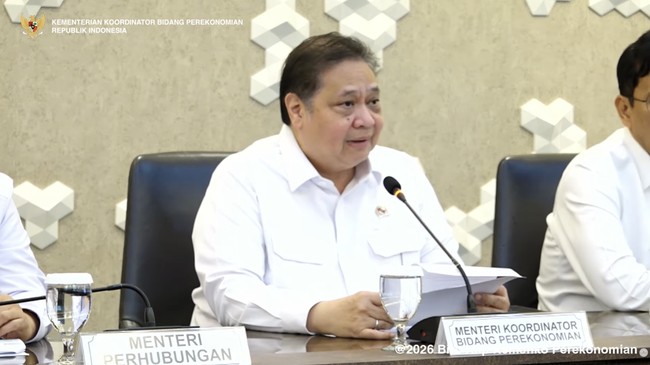
“This year’s economic growth projection is above 5.3%. And for the first quarter of this year, we are optimistic that Indonesia’s economic growth will be around 5.5%,” stated Coordinating Minister for the Economy Airlangga Hartarto at the Media Briefing: Update on Economic and Reform Measures at the Indonesian Government Communication Agency, on Monday (13/4/2026).
Airlangga also conveyed that Indonesia’s economy enters the second quarter of 2026 in a strong position. This is reflected in controlled inflation, a trade surplus that has lasted for 70 consecutive months, and high consumer confidence levels. The manufacturing sector remains in an expansion phase with an index of 50.1, while foreign exchange reserves remain strong at USD148.2 billion. Furthermore, the national banking sector remains solid with strong capital ratios and controlled credit risk.
From the external sector perspective, the rise in exports of flagship commodities such as coal, rubber, nickel, copper, and aluminium, reaching USD47 billion, provides natural hedging against pressures from the oil and gas sector. From the fiscal side, the State Budget continues to function as an economic buffer through the distribution of food assistance, transport discounts, fuel subsidies, and compensation worth around Rp11.92 trillion. In addition, the State Budget deficit remains low at 0.93% of GDP (as of March 2026).
“Then, Indonesia’s local currency transactions in 2025 increased to USD25.6 billion. This figure is double that of 2024, with countries such as Malaysia, South Korea, Thailand, Japan, and China, which have already accepted Indonesian QRIS payment transactions,” said Coordinating Minister Airlangga.
Various socio-economic indicators also show an improving trend. The poverty rate has been reduced to 8.25%, followed by a decline in the unemployment rate to 4.7%, and the Gini ratio decreasing to 0.363. In line with that, improvements in growth quality are also supported by investment realisation that significantly absorbs labour. Throughout 2025, investment realisation succeeded in absorbing around 2.71 million new workers.
In addition, Coordinating Minister Airlangga highlighted one of the programmes promoted by President Prabowo Subianto, namely downstreaming. In 2025, downstreaming investment realisation reached Rp584.1 trillion (US$36.5 billion), growing 43.3% (yoy) and contributing 30.2% to total 2025 investment realisation. The largest contribution came from the minerals and coal sector, followed by plantations and forestry, as well as oil and gas, fisheries, and maritime.
The Government also continues to strengthen ease of doing business by establishing the Task Force for Accelerating and Resolving Investment Issues (Satgas P2SP) and regulatory reform through Government Regulation Number 28 of 2025 to encourage licensing simplification through the implementation of SLA, strengthening risk-based policies, and digitalisation through OSS-RBA, while opening wider investment opportunities. In addition, Special Economic Zones (KEK) continue to show positive performance as engines of investment and growth in high value-added sectors. KEKs have developed in strategic sectors such as advanced manufacturing, mineral downstreaming, digital economy, as well as tourism and health.
From the perspective of international cooperation relations, during President Prabowo’s administration, various strategic achievements have been achieved through progress in a number of international economic and trade cooperation initiatives, including with the European Union, Canada, the Eurasian region, as well as strengthening Indonesia’s role in various global forums such as BRICS, G20, OECD, RCEP, ASEAN, and CPTPP.
Furthermore, in the discussion session, Coordinating Minister Airlangga emphasised that the Government’s energy subsidy policy remains focused on maintaining price stability and supporting economic growth. Amid fluctuations in world oil prices, the Government also prepares adequate fiscal reserves so that energy pricing policies can be evaluated periodically according to global developments. Meanwhile, in the investment sector, commitments for foreign direct investment (FDI) continue to show a positive trend, covering strategic projects, including in the energy, semiconductor, and data centre sectors.
“Indonesia has land, Indonesia has competitive energy prices, and we also have clean energy. Our water prices are also competitive. So, most US companies, or even regional companies, including China, are committed to investing in Indonesia’s data centres. Indonesia has a population of more than 280 million people. I think digital is one of the things that is still attractive to most investors, especially with AI, quantum computing, they need more data centres,” concluded Coordinating Minister Airlangga.
Source: jawawa.id (https://jawawa.id/newsitem/indonesia-not-in-crisis-q1-2026-economy-forecast-to-grow-5-5-1776145862)
Originally published by CNBC Indonesia (https://www.cnbcindonesia.com/news/20260414112555-4-726588/ri-tidak-krisis-kuartal-i-2026-ekonomi-diramal-tumbuh-55), translated from Indonesian