
Indonesia needs to leverage BRICS, OECD to boost competitiveness
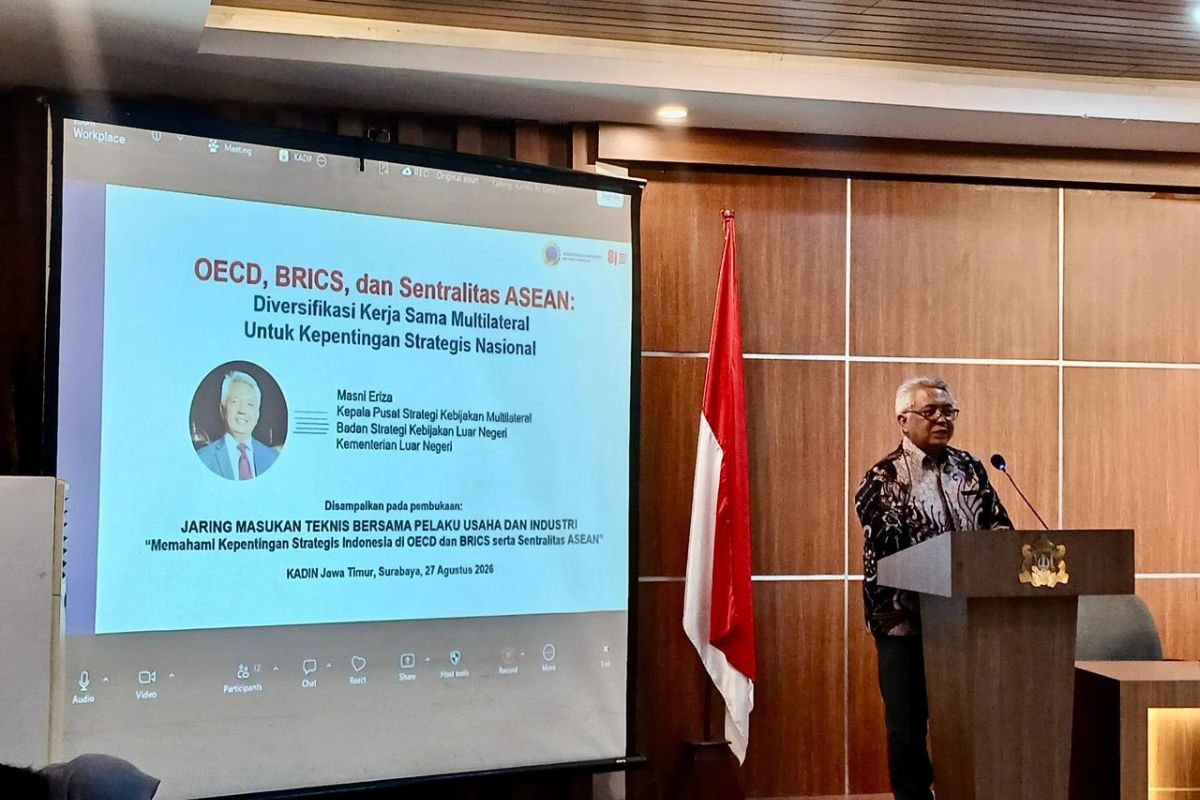
The Head of the Multilateral Policy Strategy Centre at the Foreign Ministry’s Foreign Policy Strategy Agency, Masni Eriza, has stated that domestic industry needs to leverage Indonesia’s participation in BRICS and the accession process towards the OECD to drive competitiveness.
“We must not let alignment efforts actually reduce our competitiveness and that of industry. On the contrary, adjustments must be able to strengthen the competitiveness of the national business world and industry,” she said in a statement received in Surabaya on Saturday.
Masni said the complexity of the global economy means Indonesia needs to strengthen its resilience through broad and adaptive cooperation.
Indonesia, she said, has so far positioned itself as a bridge builder capable of bringing together various global economic powers.
Moreover, the OECD is a policy forum and knowledge hub that helps countries formulate policies as well as develop standards and share best practices.
“The more diverse the options we have, the greater our room for manoeuvre to conduct a free and active foreign policy,” she said.
Currently, the OECD has 38 member countries and eight countries in the accession process, including Indonesia together with Thailand.
Of the approximately 240 OECD instruments that are part of Indonesia’s accession process, 45 instruments have been fully aligned, 181 are partially aligned and still require adjustment, while 13 instruments are not yet fully aligned.
Nevertheless, Masni said during the Technical Input Gathering with Business and Industry Players event with the East Java Chamber of Commerce and Industry (Kadin) that the accession process is not merely about aligning regulations, but ensuring that these adjustments do not sacrifice national interests and instead enhance industrial competitiveness.
According to her, Indonesia’s involvement in the OECD and BRICS provides two different strategic spaces for the national economy.
The OECD, Masni said, can be a momentum to strengthen governance, regulation, standards and the investment climate, while BRICS opens opportunities to expand markets, investment, financing, technology and supply chains.
Therefore, Masni said the government needs to ensure that various policy adjustments in the international economic integration process continue to take national interests into account.