
Indonesia Needs Strategic Oil Reserves: It's Time for the Government to Stockpile Fuel
The US-Israel-Iran war has caused fluctuations in global oil prices. Oil prices are benchmarked using the Brent and WTI (West Texas Intermediate) indices. Brent refers to oil produced in the North Sea and applies to Europe, the Middle East, and North Africa. WTI is the oil price index produced in the US and applies to the United States, Latin America, and Canada.
As of Thursday, 27 March 2026, at 06:30 a.m., WTI oil in futures trading held steady at $93.2 per barrel, down from $98.5 per barrel on Monday, 23 March 2026. Brent oil reached $106 per barrel. The average oil price has risen by 50 per cent since the US-Israel alliance attacked Iran.
On one hand, oil prices could reach a new equilibrium if International Energy Agency (IEA) member countries increase supply by releasing their strategic oil reserves to the market.
So far, 32 IEA members hold strategic reserves of 1.2 billion barrels, plus 600 million barrels of industrial stock. On 12 March 2026, they agreed to release 400 million barrels to the market to suppress oil prices. Additionally, US President Donald Trump’s decision to ease the Russian oil embargo has increased global oil supply.
The policy of increasing quotas by 12 oil-exporting countries (OPEC) will also curb oil price surges. This oil cartel contributes 40 per cent of world oil production, so quota increases have a strong dampening effect. However, a significant drop in oil prices will only occur if the war ends through peaceful negotiations or a ground attack.
On the other hand, a prolonged war will keep oil prices high. OPEC production quota increases will have minimal impact because five of its members are in the Middle East. Saudi Arabia, Iran, Iraq, Kuwait, and the United Arab Emirates cannot export oil due to Iran’s blockade in the Strait of Hormuz.
The Gulf’s contribution to world oil production reaches 29.1 per cent in 2026. This is only slightly lower than North America, which contributes 29.9 per cent. The IEA reports that 20 million barrels of crude oil and oil products pass through the Strait of Hormuz daily. The current war and Hormuz blockade are sending shockwaves through global oil market dynamics.
An expansion of the conflict to the Red Sea would skyrocket global oil prices. This area is within range of rockets and missiles from the Houthi group in Yemen, which is closely supported by Iran. The critical point is the Bab el-Mandeb Strait, which connects the Red Sea and the Gulf of Aden. Closing this strait prevents tankers from the Persian Gulf from passing through the Suez Canal and forces them to detour around the southern tip of Africa.
The longer tanker routes increase transportation costs. At the same time, maritime insurance is becoming more expensive and contributes to price increases. A Reuters report (6 March 2026) states that war risk insurance could reach $1.75 million. For a tanker valued between $200-300 million, a three per cent insurance increase would add up to $7.5 million in premiums. Before the conflict, it was only $625,000.
The Need for Indonesia’s Strategic Oil Reserves
What are the implications for Indonesia? Sooner or later, the global oil price surge will burden Indonesia. The Minister of Energy and Mineral Resources, Bahlil…, stated that Indonesia’s fuel oil (BBM) stock is sufficient for 18-21 days of consumption. Additionally, the government is diversifying crude oil imports from Africa.
Amid the Hormuz blockade, other Asian countries will also look to import oil from Africa and Latin America. This situation will drive up oil prices from these two regions due to high demand.
If the war does not stop, oil prices will continue to soar. The same applies to natural gas prices. Prices of these two energy types are highly sensitive to supply disruptions. Oil-importing countries like Indonesia are the most affected. Fuel prices may need to be raised next month.
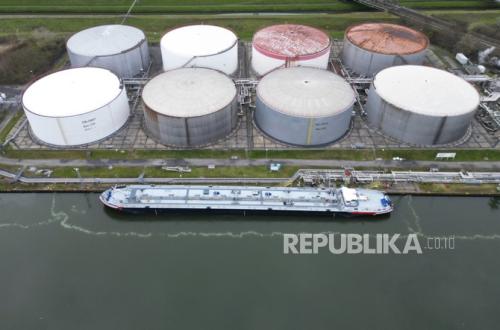
It is time for Indonesia to stockpile oil by building a Strategic Petroleum Reserve (SPR) or strategic oil reserve. Oil that is deliberately stockpiled to anticipate crises.
SPR is a quantity of oil stored by a country. The oil can be stored underground or in tanks. Ideally, the tanks are buried underground and dispersed across several regions. In case of war, these dispersed tanks are not easily destroyed by enemies.
Stored oil serves two functions. First, to keep the economy running during a global energy crisis. Second, to ensure war machines can operate when national security is threatened by military attacks. IEA member countries have strategic oil reserves for at least 90 days. This is a standard that the Indonesian government can emulate.
The US built strategic oil reserves following the 1974 oil crisis. This action was taken in response to the OPEC embargo. Underground tanks are located in the states of Louisiana and Texas. In 2020, the US had crude oil reserves of 650 million barrels (www.iea.org).
The US model was then emulated by the International Energy Agency (IEA). This organisation requires its members to build oil reserves. During supply crises, member countries release a certain amount of oil from reserves to the market. Oil prices remain relatively stable due to sufficient supply.
Nuclear weapons deter opponents from striking first. SPR deters producers and traders from raising oil prices during crises. For example, on 1 March 2022, US President Joseph Biden ordered the release of 30 million barrels of crude oil to the market. This was done to anticipate sharp oil price increases due to Russia’s invasion. The 30 IEA member countries also released an additional 30 million barrels of oil.
Why Indonesia Must Stockpile Oil
Indonesia needs to ‘stockpile’ oil in the form of strategic oil reserves. Indonesia’s Law No. 30/2007 on Energy mentions strategic reserves.
Source: jawawa.id (https://jawawa.id/newsitem/indonesia-needs-strategic-oil-reserves-its-time-for-the-government-to-stockpile-fuel-1774853519)
Originally published by Republika (https://analisis.republika.co.id/berita/tcowmb475/indonesia-butuh-cadangan-minyak-strategis-saatnya-pemerintah-menimbun-bbm), translated from Indonesian