
Indonesia Needs Rp963.23 Trillion to Build 100 GW of Solar Power
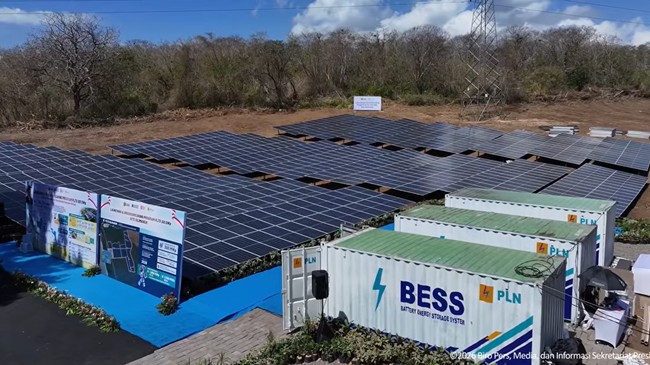
Jakarta – State electricity company PT PLN (Persero) estimates that a total investment of US$53 billion, equivalent to Rp963.23 trillion at an exchange rate of Rp18,174 per US dollar, will be needed to realise a 100-gigawatt (GW) solar power plant (PLTS) project integrated with a Battery Energy Storage System (BESS).
The investment is intended to strengthen the national electricity system, reduce operating costs and curb dependence on fossil fuels.
PLN Director of Technology, Engineering and Sustainability Edwin Nugraha Putra outlined the plan at COP31 in Antalya, Türkiye. He said implementation of the 100 GW programme followed President Prabowo Subianto’s direction to accelerate Indonesia’s clean-energy transition.
“Our president has also explained and launched the 100 GW solar power programme. By doing this, we can reduce our dependence on fuel, lower electricity costs and strengthen our electricity system,” Edwin said at a CEO Talks session at the Indonesia Pavilion at COP31 in Antalya, as quoted on Wednesday (11 November 2026).
PLN considers the US$53 billion allocation crucial to integrating large-scale solar power into the national grid. BESS technology is a key component in ensuring that intermittent solar power can be fed reliably into the electricity system, including the Java grid, which has a capacity of 35 GW.
“So, the total financing we need for the 100 GW is around US$53 billion,” he said.
To support the investment, PLN has secured US$2.94 billion in initial funding commitments from six international financial institutions: the World Bank, KfW, the Asian Development Bank (ADB), Agence Française de Développement (AFD), Finance Australia and the Japan International Cooperation Agency (JICA).
“Alongside these projects, we have also secured the mobilisation of US$2.94 billion in funding to accelerate energy,” he added.
The BESS-based 100 GW solar development is projected to help PLN improve its Environmental, Social and Governance (ESG) risk rating from high risk to low risk by 2034. The company’s ESG rating has improved from 48 in 2021 to 24 currently.
“Our ESG rating in 2021 was 48. We were in the very high-risk category, as most of our power generation came from fossil-fuel plants. We started at 48, and now we have reached 24,” he said.
The investment is also expected to improve fuel efficiency on 741 islands. Integrating BESS would allow solar power to be used throughout the day, potentially reducing fuel consumption of four million kilowatts to zero within three years.
“By doing this, we hope to be in the right emissions quartile globally. We hope that by 2030 we will enter the green zone in the second quartile worldwide in terms of emissions,” he concluded.
Source: jawawa.id (https://jawawa.id/newsitem/indonesia-needs-rp963-23-trillion-to-build-100-gw-of-solar-power-1794401440)
Originally published by CNBC Indonesia (https://www.cnbcindonesia.com/news/20261111172951-4-784374/mau-bangun-plts-100-gw-ri-butuh-biaya-rp-96323-triliun), translated from Indonesian