
Indonesia Must Not Remain Merely an AI Market: It Is Time to Master Strategic Points in the Global Technology Chain
Indonesia faces an important moment in the development of artificial intelligence (AI). Amid the race among world powers to build an AI industry, Indonesia is considered to be at risk of remaining merely a market for the various products and services based on this technology.
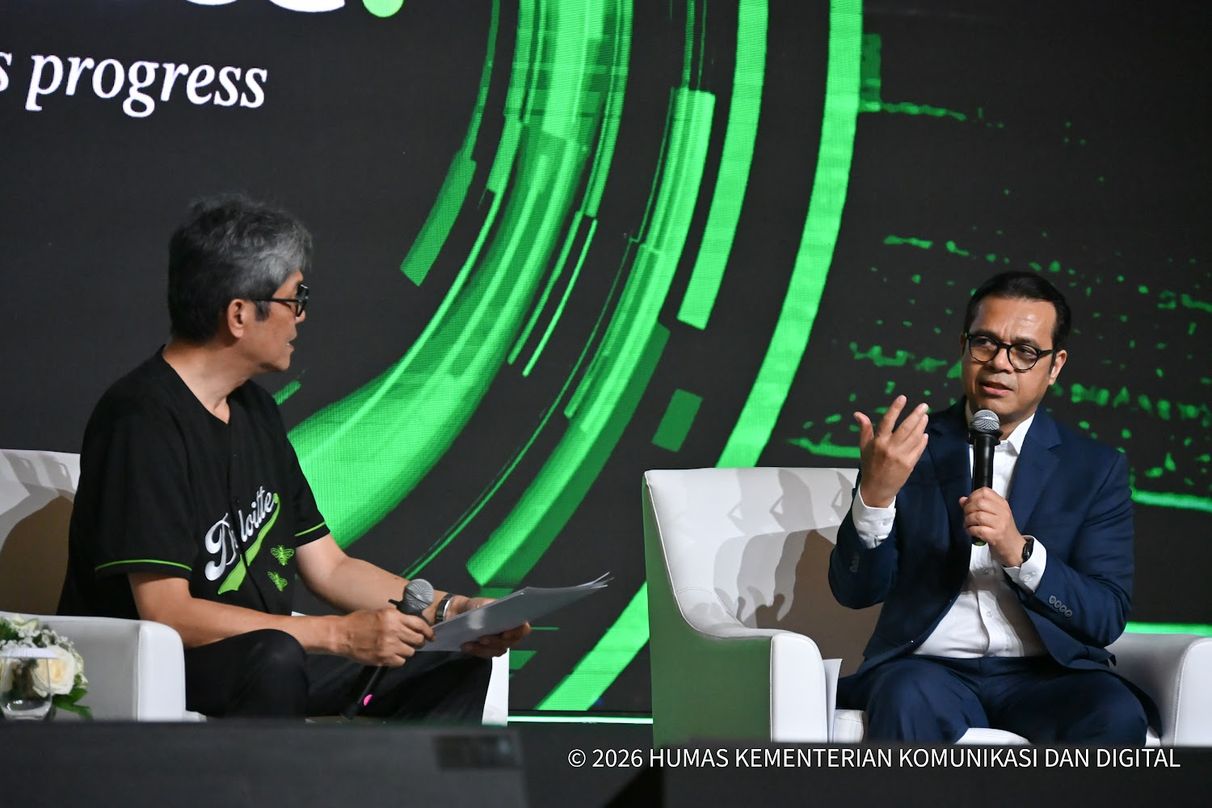
Deputy Minister of Communications and Digital (Wamenkomdigi) Nezar Patria said Indonesia needs to take a more strategic position in the global AI industry chain. This does not mean Indonesia must master every stage of the industry, but rather select certain points that offer high added value and can strengthen the nation’s bargaining power.
Nezar conveyed these views at the Deloitte Indonesia Townhall in South Jakarta on Friday (11/9/2026). The forum served as a space for government officials and the business community to discuss technological developments, digital transformation, and the challenges Indonesia faces in entering the AI era. On that occasion, Nezar emphasised the importance of building a comprehensive technology ecosystem from upstream to downstream.
“This is the time for collaboration to create an end-to-end ecosystem,” Nezar said.
The AI chain is far longer than applications
According to Nezar, discussions about the AI industry have often focused too narrowly on applications used directly by the public, such as AI-based search engines, chatbots, productivity software, and various other digital services.
Yet behind these applications lies a far more complex industrial chain. The AI ecosystem requires the availability of energy and water, data centres, computing capacity or compute power, hardware, semiconductors, technology platforms, and applications.
This means the economic value of AI is not found only in companies that produce applications. Value is also distributed along the supply chain that underpins the technology.
Indonesia, according to Nezar, has opportunities to enter several of these strategic layers.
One of the most promising is the semiconductor industry. These components are a crucial foundation for the development of modern computing technology, including the infrastructure supporting AI.
This is where Indonesia’s natural resources can become strategic capital. The issue, however, is not merely possessing mineral reserves, but how to process them into the materials required by the technology industry.
From commodities to strategic materials
Indonesia possesses various resources connected to the semiconductor industry supply chain, including nickel, silica sand, tin, copper, and gold.
Nezar assessed that these resources present opportunities, but do not automatically make Indonesia a key player in the global technology industry.
“Semiconductors require so many materials, including critical minerals. We have plenty in Indonesia that can contribute to semiconductor manufacturing,” he said.
He cited silica sand as an example. Based on data Nezar presented, referring to figures from the Ministry of Energy and Mineral Resources, Indonesia holds approximately 7.8 billion tonnes of silica sand. The challenge, however, lies in processing capacity.
“Our silica sand reserves total 7.8 billion tonnes according to Ministry of Energy and Mineral Resources data. But nobody is processing it into the silicone wafers needed to make semiconductors,” he said.
The statement illustrates a classic problem in Indonesian industrial development: mineral wealth does not necessarily generate high added value if processing and technology remain in other countries.
For this reason, the downstreaming agenda needs to be broadened. It is not enough to process commodities into intermediate products; the effort must also be directed towards materials and components that form part of the future technology industry.
Securing choke points
Nezar used the term ‘choke point’ to describe strategic points within a production chain.
In a geopolitical context, choke points are often associated with key trade routes. In the technology industry, however, the term refers to particular parts of the supply chain that are critically important, scarce, and difficult to replace.
Countries or companies able to master such points hold a stronger bargaining position, because others need the products, materials, technology, or capacity they control.
“In this industry, whoever controls scarce goods will control the choke point. A choke point is not like controlling the Strait of Hormuz or the Strait of Malacca; rather, in the production process there are narrow points controlled only by certain countries,” Nezar explained.
For Indonesia, this strategy could be a more realistic alternative than attempting to build the entire semiconductor industry chain from scratch.
Nezar acknowledged that Indonesia may need a long time to match a country like Taiwan in the semiconductor industry. Nevertheless, Indonesia can still capture parts of the chain that hold strategic significance for industries in countries such as Taiwan and South Korea.
“Perhaps we will not enter like Taiwan, because that would take a very long time. But at the very least we can secure several of the materials needed by industries based in Taiwan or South Korea. Those materials are in our hands,” he said.
Towards a complete AI ecosystem
This idea aligns with a broader direction in building Indonesia’s AI ecosystem. The government has previously stressed the importance of building full-stack AI capabilities, from basic infrastructure, electricity and water, GPUs and chips, platforms, through to applications.
The Ministry of Communications and Digital also views the development of sovereign AI as part of efforts to strengthen national technological self-reliance. This approach does not mean Indonesia must close itself off entirely from global technology, but rather that it should possess sufficient capacity and infrastructure to avoid complete dependence on particular countries or companies in strategic aspects of AI.
Within this context, critical mineral resources, computing infrastructure, data centres, digital talent, research, and the ability to build AI models form parts of a single, interconnected ecosystem.
Indonesia holds advantages in several of these components. The challenge is connecting these scattered strengths into an integrated value chain.
The Deloitte Indonesia Townhall and challenges for the business community
The discussions at the Deloitte Indonesia Townhall are relevant because AI transformation is not solely a government agenda. The business community is one of the main actors that will determine how quickly the technological opportunity translates into investment, innovation, productivity, and jobs.
Forums such as the townhall also bring policy perspectives together with industry needs. For companies, the development of AI is not merely about adopting new software, but concerns changes to business models, talent needs, data security, digital infrastructure, operational efficiency, and long-term investment strategy.
Nezar’s presence at the forum demonstrated the government’s encouragement of closer dialogue with the private sector to build a national digital ecosystem. His central message was that AI development requires cross-sector collaboration, not government policy alone.
Such collaboration is increasingly important because the AI chain spans multiple industries. The energy industry supplies electricity, the infrastructure sector builds data centres, the mining industry supplies minerals, manufacturing produces components, technology companies develop platforms and applications, while universities and research institutions prepare knowledge and talent.
Talent as a determining factor
Beyond natural resources and infrastructure, human capability remains one of the determining factors.
Indonesia needs talent that is not only able to use AI, but understands the technology behind it. These needs span data science, machine learning, chip design, cloud computing, cybersecurity, robotics, and hardware development.
Nezar has previously emphasised that Indonesia has digital talent capable of competing globally. The challenge is providing that talent with access to adequate computing infrastructure and technical knowledge.
Accordingly, the national AI strategy cannot rely solely on investment from foreign technology companies. Indonesia needs to build domestic capacity so that its people and national companies can help create technology, rather than merely consume it.
From market to player
The growth of AI will open up enormous economic opportunities, but the benefits will not automatically accrue to countries that remain only consumers.
If Indonesia merely uses applications and infrastructure built by other countries, most of the added value will remain abroad. Conversely, if Indonesia can master particular parts of the supply chain—from strategic materials, components, data centres, computing, talent, through to applications—the greater its chances of creating economic value at home.
Nezar’s remarks at the Deloitte Indonesia Townhall therefore carry a message broader than a mere AI industry strategy. It is a call for Indonesia to view AI as part of the agenda of industrialisation and technological sovereignty.
Indonesia does not have to become the next Taiwan overnight. Nor does it have to master the entire AI industry chain. More important is finding realistic strategic points to secure, building the processing capacity for them, and connecting them to the needs of global industry.
If natural resources, digital infrastructure, talent, research, industry, and policy can be brought together in an integrated ecosystem, Indonesia has the opportunity to move from being merely an AI market to becoming one of the players in the global AI value chain.
Amid intensifying technological competition intertwined with geopolitics, the ability to master such strategic points is ultimately not just a matter of economic gain. It can also form part of Indonesia’s effort to strengthen its bargaining power in determining its position in the future technology industry.
Source: jawawa.id (https://jawawa.id/newsitem/indonesia-must-not-remain-merely-an-ai-market-it-is-time-to-master-strategic-points-in-the-global-technology-1789491022)
Originally published by vibizmedia.com (https://www.vibizmedia.com/index.php/2026/09/15/indonesia-tak-boleh-hanya-jadi-pasar-ai-saatnya-kuasai-titik-strategis-rantai-teknologi-global/), translated from Indonesian