
Indonesia Moves Towards Circular Economy to Address Battery Production Challenges
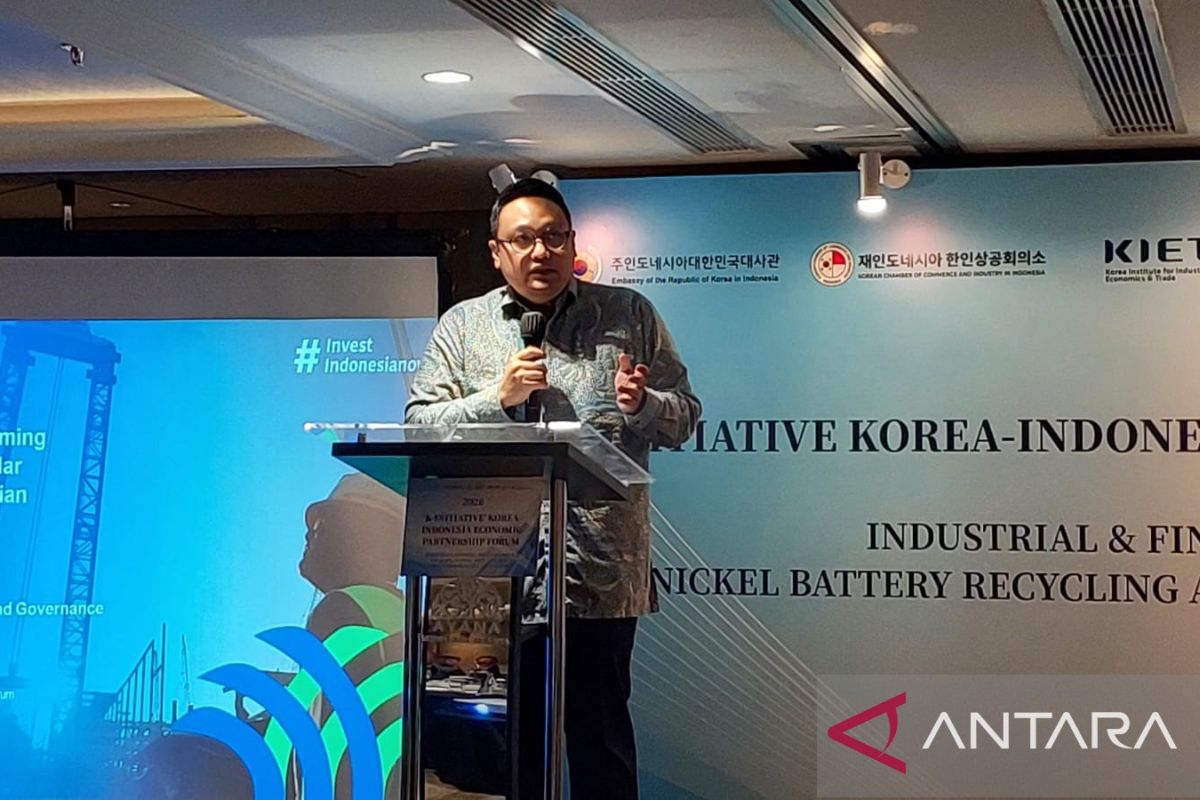
Indonesia is moving towards a circular economy to address the challenges arising from electric vehicle battery production, according to a senior official. Ahmad Faisal Suralaga, Director of Downstreaming Strategy and Governance at the Ministry of Investment and Downstreaming/BKPM, stated that globally, the provision of EV batteries faces several challenges, including mineral availability, the need for carbon decomposition, and attention to sustainable resources. “With these three challenges, I believe that to achieve sustainability, the Indonesian government is now providing a policy that we will not only stop at extracting resources for battery production but will also move towards recycling,” Ahmad Faisal said at the Korea-Indonesia Economic Partnership Forum in Jakarta on Wednesday.
The current global transition towards renewable energy and electrification is proceeding very rapidly. Batteries have become a critical component in industrial competition, energy security, and sustainable development. Simultaneously, the increase in battery production and usage brings new challenges related to resource efficiency, waste management, and environmental well-being. Ahmad Faisal noted that the Indonesian government now has comprehensive regulations for companies that support the battery recycling process, which will also be connected with applicable international regulations.
He stated that a battery recycling approach could strengthen Indonesia’s position in the electric vehicle battery supply chain and enable the country to become integrated in battery production, from battery materials to the manufacturing of battery cells and battery packs. To support this initiative, Indonesia is also transforming from a country that exports raw materials abroad into one that generates added value through a downstreaming approach. Ahmad Faisal added that Indonesia is also reforming business policies to reduce business risk challenges and running an integrated system to make it easier for investors to invest in Indonesia through a single door.
“We are also considering several international regulations, for example the EU Battery Passport has been fulfilled in several countries. Perhaps in the future we can discuss how Indonesia can be inline with international regulations,” he said. He emphasised that the government cannot work alone to build the electric vehicle battery ecosystem, including protecting the natural resources of battery raw materials available in Indonesia, such as nickel. Ahmad Faisal invited South Korean investors to participate by bringing technology that supports the circular economy to invest in Indonesia and complete the supply chain from nickel extraction to battery recycling technology facilities.
Source: jawawa.id (https://jawawa.id/newsitem/indonesia-moves-towards-circular-economy-to-address-battery-production-challenges-1782284057)
Originally published by Antara (Indonesian) (https://www.antaranews.com/berita/5620824/indonesia-bergerak-ke-ekonomi-sirkular-hadapi-masalah-produksi-baterai), translated from Indonesian