
Indonesia Mandates Biometric SIM Card Registration, Sees Sharp Drop in New Numbers
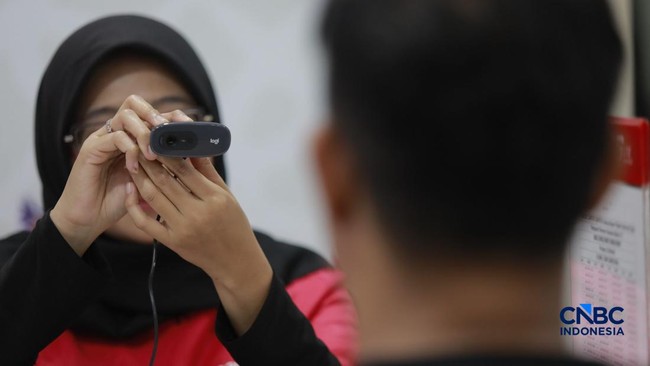
Jakarta, CNBC Indonesia – The government implemented biometric registration for SIM cards starting 1 July 2026.
Minister of Communication and Digital Affairs (Menkomdigi) Meutya Hafid said the hope is that this registration system will make the digital ecosystem, including mobile network operators, far healthier.
“We also hope that, at the end of it all, there will be a genuinely healthier digital ecosystem. Mobile network operator companies that are healthier, with better record-keeping of both customers and finances going forward,” said Meutya at the Joint Commitment Declaration on the Full Implementation of Biometric Data-Based Registration at FX Sudirman, Jakarta, on Thursday (23/7/2026).
She went on to say that this policy closes the loophole of registration using the NIK (national identity number) and family card number (NoKK), which previously had the potential for misuse.
“Because we firmly believe in the figures behind these mobile numbers — back when we first entered office, if I’m not mistaken, as many as one million new numbers could be activated in a single day. Without biometric registration, using NIKs that were not necessarily the person’s own,” she said.
According to her, that figure has now fallen to around 250,000 to 280,000 new numbers per day. The government believes this reduction will curb the anonymity that could potentially be exploited for digital crime.
Meutya said that around 10 million new subscribers have so far completed registration using biometric data. Through this process, the government can verify that subscribers are using their own NIK and detect whether a single NIK has been used by another number.
“Because with biometrics, it can immediately be seen whether that NIK has been used by another number or not,” she explained.
The government is targeting an additional 10 million biometrically verified subscriber records within the next month. This target covers not only new subscribers, but also existing subscribers who have yet to complete biometric registration.
“So if those wanting to reach the 10 million include existing subscribers who have not yet done biometric registration, we welcome that too. What matters is that we check again next month — within the next month, another 10 million records will be biometric,” said Meutya.
Loopholes were briefly found
At the same event, Director General of Digital Ecosystem at the Ministry of Communication and Digital Affairs, Edwin Hidayat Abdullah, said the implementation of biometric registration faced a number of loopholes in its early days.
The ministry conducted a three-week evaluation, going directly to several major cities as well as second- and third-tier cities. The monitoring covered Jakarta, Depok, Bogor, Tangerang, Bekasi, Surabaya, Sidoarjo, Lamongan, Gresik, Yogyakarta, Solo, Klaten, Bantul, Sleman and Wonosari.
Edwin said that on the second day of the full implementation of biometric registration, the registration system via SMS 444 could still be used. At that time, not a single mobile operator had succeeded in fully eliminating registration using NIK and NoKK.
“On the second day, I was forced to send a ‘love letter’ to three mobile operators saying that this was no longer negotiable and asking them to close all loopholes immediately,” said Edwin.
After that, mobile operators began closing the old registration loopholes in stages. Telkomsel shut down registration access via SMS, although loopholes were still found on several other channels. The same happened with other operators.
Edwin said the ministry continued to push operators to fix their systems until, on the fifteenth day, all mobile operators were declared 100% compliant with the rules. Then, on the seventeenth day, no more registrations using the old method were found.
“On the seventeenth day, there was no longer a single registration using the old method — everything was fully biometric, thank God,” he said.
Going forward, the ministry will also monitor numbers that show unusual patterns. Numbers suspected of being activated solely for sale may be deregistered.
“Numbers showing signs of irregularities — lying dormant and so on — may well be numbers that were activated only to be sold on. Those must be unregistered,” he asserted.
Source: jawawa.id (https://jawawa.id/newsitem/indonesia-mandates-biometric-sim-card-registration-sees-sharp-drop-in-new-numbers-1784807537)
Originally published by CNBC Indonesia (https://www.cnbcindonesia.com/tech/20260723174655-37-753365/registrasi-sim-card-baru-tanpa-nik-dan-nokk-hasilnya-tak-terduga), translated from Indonesian