
Indonesia Launches Prototype mRNA Dengue Vaccine
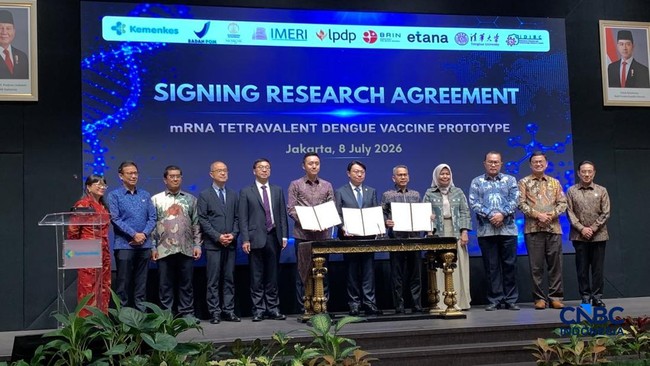
Indonesia has officially launched a prototype for a dengue fever (DHF) vaccine based on messenger RNA (mRNA) technology. The development of this vaccine is the result of a collaboration between the Ministry of Health, the University of Indonesia (UI), Tsinghua University, and PT Etana Biotechnologies Indonesia, with funding support from the Indonesia Endowment Fund for Education (LPDP).
Minister of Health Budi Gunadi Sadikin stated that the development of this vaccine is part of the government’s efforts to strengthen the independence of the national vaccine industry and reduce reliance on imported products. “If this succeeds, it will be one of the new vaccines produced in Indonesia. This will also be the 16th antigen using the latest technology, namely mRNA,” said Budi during the launch of the mRNA dengue vaccine prototype at the Adhyatma Building, Ministry of Health, Jakarta, on Wednesday (8/7/2026).
Budi noted that Indonesia currently uses 15 antigens for its national vaccination programme. However, only four antigens have been truly capable of being developed from the research stage through to domestic production. The remainder are limited to the formulation or assembly process using raw materials from abroad. In addition to pursuing the capability to produce all antigens independently, the government also aims to master two vaccine technology platforms that Indonesia does not yet possess: viral vector and mRNA technology.
“My target is simple. Before the end of President Prabowo’s administration, we want Indonesia’s vaccine research and production capabilities to be much stronger,” said Budi. He revealed that the government currently spends approximately US400 − 500million, oraroundRp6.8 − 8.5trillion(atanexchangerateofRp17, 000/US), every year to purchase vaccines from abroad. Consequently, the development of domestic vaccines is seen as having both health and economic benefits.
The Lead Researcher for the mRNA dengue vaccine development from the University of Indonesia, Prof. Dra. Beti Ernawati Dewi, Ph.D., stated that the vaccine prototype is still in the pre-clinical stage. Nevertheless, initial results show an antibody response to the four serotypes of the dengue virus circulating in Indonesia that is superior to currently available commercial vaccines. “From the pre-clinical trials we conducted, the antibody titres to neutralise dengue virus serotypes 1, 2, 3, and 4 of the Indonesian strains are much better than the commercial vaccines already available in Indonesia,” she said. The research team aims to begin the early human clinical trial stage in Indonesia within the next six months.
Meanwhile, Vice President of Tsinghua University Prof. Wu Huaqiang stated that this cooperation is part of strengthening Indonesia-China research collaboration in the development of mRNA-based dengue vaccines. “The trilateral agreement signed will strengthen the long-term cooperation between our two countries,” he said. He noted that the cooperation has three main focuses: helping Indonesia build mRNA vaccine research capacity, strengthening local biotechnology talent through academic partnerships, and developing a collaborative model to face future infectious disease threats.
Vice Minister of Higher Education, Science, and Technology Stella Christie explained that this research collaboration actually began in 2023, well before her appointment as Vice Minister. At that time, she brought together researchers from the University of Indonesia with Professor Zhang Linqi from Tsinghua University after seeing the alignment between Indonesia’s needs and the university’s expertise. Stella stated that the success of this research demonstrates an ideal collaboration model between universities, industry, government, and funding agencies. “We did not start with the signing of an MoU, but with genuine research collaboration first,” she said. She added that the government is now changing the research funding scheme, with approximately 50% of the national research budget being focused on strategic funding according to national priorities, including the development of vaccines and medical devices.
The Head of the Indonesian Food and Drug Authority (BPOM), Taruna Ikrar, said that his agency was intentionally involved from the early stages of the research process to ensure that vaccine development would not be hindered when entering the registration stage. “Do not think of BPOM as merely a rubber stamp. If you only come at the end, many products will ultimately be rejected because they did not meet standards from the start,” said Taruna. He mentioned that if successful, the vaccine has the potential to become the world’s first mRNA-based dengue vaccine.
Funding for the mRNA dengue vaccine research comes from LPDP and PT Etтана Biotechnologies Indonesia. The Director of Research Facilitation at the Indonesia Endowment Fund for Education (LPDP), Ayom Widipaminto, stated that LPDP is allocating Rp7 billion, while PT Etana is providing Rp9 billion, bringing the total research funding to Rp16 billion for the development of the prototype through to the execution of early clinical trials. “The programme is now entering its second year and will continue into the third year,” he said. LPDP also revealed that the research endowment fund has now reached approximately Rp14 trillion. Of this amount, about Rp1 trillion can be utilised annually to support national strategic research, including the development of vaccines and medical devices. “We are ready to fund the development of vaccines as well as the medical devices needed by Indonesia,” said Ayon.