
Indonesia Invites Russia to Invest in Downstream Processing
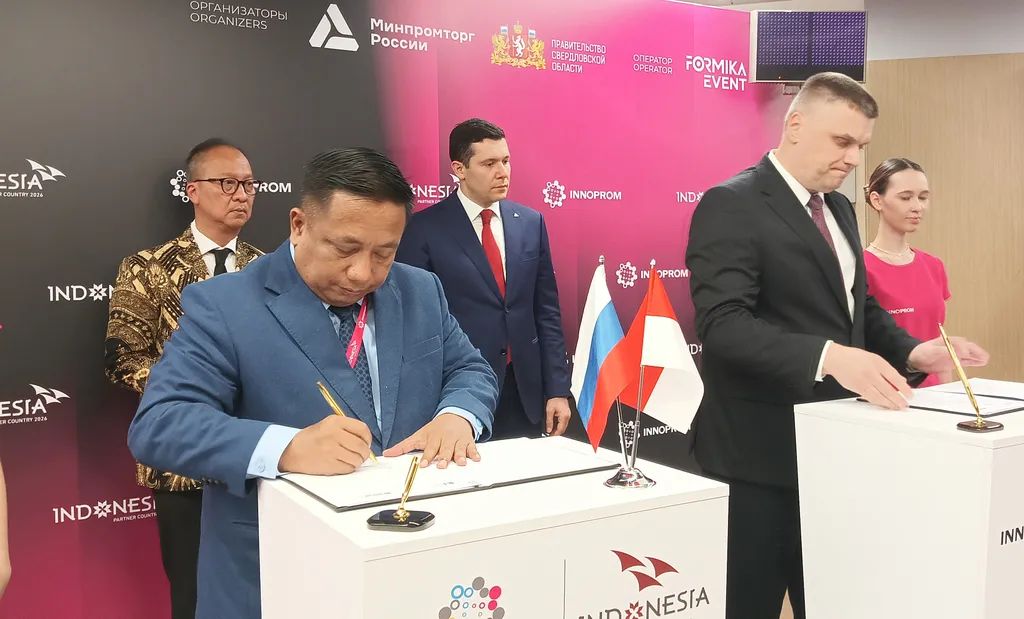
The Indonesian government is inviting Russia to expand economic relations from trade towards investment partnerships and value-added industrial development. Through cooperation in the mineral, manufacturing, and energy sectors, Indonesia is offering investment opportunities based on downstream processing. This is part of a strategy to strengthen industrial competitiveness towards the target of becoming a top five global economy by 2045.
Minister of Industry Agus Gumiwang Kartasasmita stated that the partnership model is the most important aspect of RI-Russia economic relations. The government wants Indonesia to be part of the global production chain, not just an export destination market. “Indonesia is not a country that only relies on commodities and seeks buyers. Indonesia is an industrial country looking for partners. We are present not just as a market to sell products, but as a partner to build together,” he said during a dialogue held on the sidelines of the Innoprom 2026 international industrial exhibition in Ekaterinburg, Russia.
Indonesia’s presence at the exhibition resulted in six signed cooperation agreements, some of which are continuations of previous deals from December 2025. “The real success will later be measured by the smelters built, the joint ventures signed, and the ships and trade flows moving regularly between the two countries,” Agus said.
According to Agus, RI-Russia economic relations are showing a positive trend. Bilateral trade value in 2025 reached 4.8 billion US dollars, an increase of 5.4 percent compared to the previous year. Meanwhile, Indonesian exports to Russia grew 7.5 percent to 1.8 billion US dollars. Indonesia exports various manufactured products and commodities such as rubber, coffee, footwear, electronics, and chemicals, while Russia supplies fertilisers, steel, cereals, and aerospace products. This complementary trade structure is seen as a foundation for higher value-added industrial cooperation.
Indonesia is currently focused on building domestic processing industries through its natural resource downstreaming policy. This step opens significant opportunities for foreign investors, particularly in the development of electric vehicle battery supply chains. Indonesia possesses the world’s largest nickel reserves, along with abundant reserves of bauxite, tin, and copper. Agus noted that while Indonesia was still exporting raw ore a decade ago, the government has now built various processing facilities, from smelters and refineries to battery raw material industries. “For industries facing limited access to battery and steel supply chains, this is no longer just a plan. The industry is already operating. We invite investment in the next stages, from smelters and refining to precursors and battery materials,” he said.
Beyond the mineral sector, the government is also offering cooperation in the development of the automotive, electronics, machinery, energy, petrochemical, and shipyard industries through joint venture schemes in industrial estates equipped with various incentives. In the energy sector, Russia is considered to have technological advantages in oil, gas, and petrochemical processing, while Indonesia offers raw material availability and a large domestic market. Cooperation in the shipping sector is entering the implementation phase through the signing of an agreement between the industrial associations of both countries and the Russian shipbuilding company AK Bars.
The government is also encouraging two-way investment. Indonesian manufacturing companies are urged to invest in Russia, particularly in the halal food, cosmetics, and pharmaceutical sectors, using Russia and the Eurasian Economic Union as a gateway to the Central Asian market. Conversely, Indonesia offers Russian investors access to the ASEAN market with a population of over 700 million people.
To support trade and investment transactions, the government is strengthening the role of the Indonesian Export Financing Institution (LPEI) through trade financing, guarantees, and export insurance facilities. The government is also encouraging the use of local currencies and BRICS payment mechanisms to facilitate business transactions between the two countries.
Russian Minister of Industry and Trade Anton Alikhanov emphasised that both countries maintain a constructive and trusting dialogue at all levels. The Strategic Partnership Declaration adopted last June is an important marker of the transition of relations to a new level. Russian Prime Minister Mikhail Mishustin specifically welcomed the Indonesian delegation led by Minister of Industry Agus Gumiwang Kartasasmita, stating, “We are committed to deepening our bilateral relations. In the last five years, bilateral trade has more than doubled. Our countries have good prospects for expanding cooperation in various sectors.” He added that Russian companies are ready to offer competitive solutions to Indonesia and other partners in industrial construction, modernisation of energy facilities, and railway and maritime infrastructure development.
The Indonesian Industrial Estates Association (HKI) is targeting strategic partnerships with Russian investors wishing to invest in Indonesia. This commitment was demonstrated through the signing of a memorandum of understanding with the Association of Clusters, Technology Parks and Special Economic Zones of Russia.