
Indonesia in Energy Subsidy Reform Emergency, Economist Explains Why
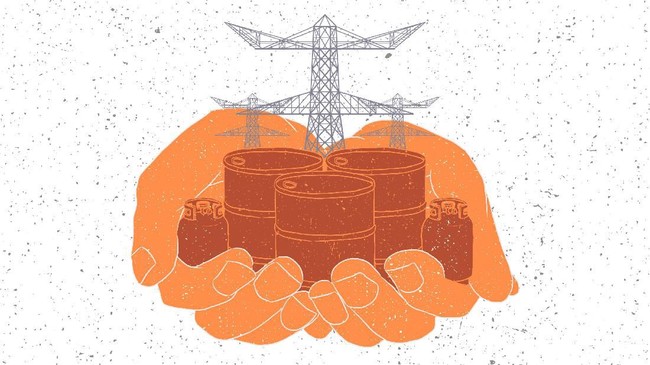
Global geopolitical uncertainty and energy price spikes have the potential to further burden the state budget (APBN). This situation is seen as a momentum for the government to reform the energy subsidy and compensation scheme. As of the end of June 2026, realised energy subsidies and compensation had reached around Rp233 trillion. This figure is expected to rise further by the end of the year and could put greater pressure on the fiscal position in 2027.
Imaduddin Abdullah, Director of International Collaboration at the Institute for Development of Economics and Finance (INDEF), said the large risk to Indonesia’s energy subsidies is inseparable from dependence on several external factors, especially global energy prices and the rupiah exchange rate. According to him, there are three main variables that determine the size of energy subsidies: global energy market prices, the rupiah exchange rate, and domestic energy consumption levels.
“We all know that global energy prices have increased, especially after the crisis in the Strait of Hormuz,” he said in CNBC Indonesia’s Energy Corner programme, quoted on Friday (28/8/2026). At the same time, the depreciation of the rupiah against the US dollar has also made energy procurement costs more expensive. This condition ultimately increases the budget requirement for energy subsidies and compensation.
“According to the government’s own calculations, by the end of the year subsidies and compensation will increase to Rp526 trillion,” he said. Thus, there is a potential increase of almost Rp200 trillion compared with the initial APBN allocation of around Rp338 trillion.
At the same event, Ahmad Zuhdi Dwi Kusuma, Principal at the Energy Shift Institute, assessed that the world has undergone changes, including in the global energy market. According to him, coal prices, which previously were in the range of US$60-70 per tonne, have now remained above US$100 per tonne for about three to four years. This condition shows that energy price patterns are no longer the same as before.
He added that fuel prices have often been viewed as linked to cyclical oil price movements. However, the repeated changes show that this condition can no longer be seen merely as a cycle, but has become a structural problem that Indonesia should be able to predict better.
“The problem is that we see the subsidy and compensation system in Indonesia is attached not to people, not to the public, but attached to commodities. So when there is turmoil in the commodities themselves, in the end the fiscal space that had been estimated through the APBN and so on becomes more volatile and, in the end, cannot be covered by subsidies, so it shifts to compensation,” he said.
On the other hand, in practice energy compensation, especially in the electricity sector, is often enjoyed by groups of people who are not actually the intended recipients of subsidies. “And when people who are not entitled to receive subsidies get them, then the question arises of where justice lies,” he added.
The government of President Prabowo Subianto is preparing a budget for subsidised fuel oil (BBM) of certain types in the 2027 Draft State Budget (RAPBN) that is higher than the estimated realisation in the 2026 State Budget (APBN). Based on the Financial Note and the 2027 RAPBN document, the budget for subsidised fuels of certain types, such as Pertalite and Solar, reaches Rp28.7 trillion. This figure is up about 8.71% compared with the estimated 2026 realisation of Rp26.4 trillion.
“In addition, to improve the efficiency of subsidy spending, the distribution of subsidised fuel is carried out with consumer registration,” as quoted from the Financial Note and 2027 RAPBN document. The increase in the fuel subsidy budget goes hand in hand with an increase in overall energy subsidies, which also include 3-kilogram LPG cylinder subsidies and electricity subsidies. The draft energy subsidy budget for 2027 reaches Rp272.94 trillion, an increase of 20.1% compared with the estimated 2026 realisation of Rp227.25 trillion.