
Indonesia Implements Ecological Mangrove Rehabilitation to Restore Coastal Ecosystems
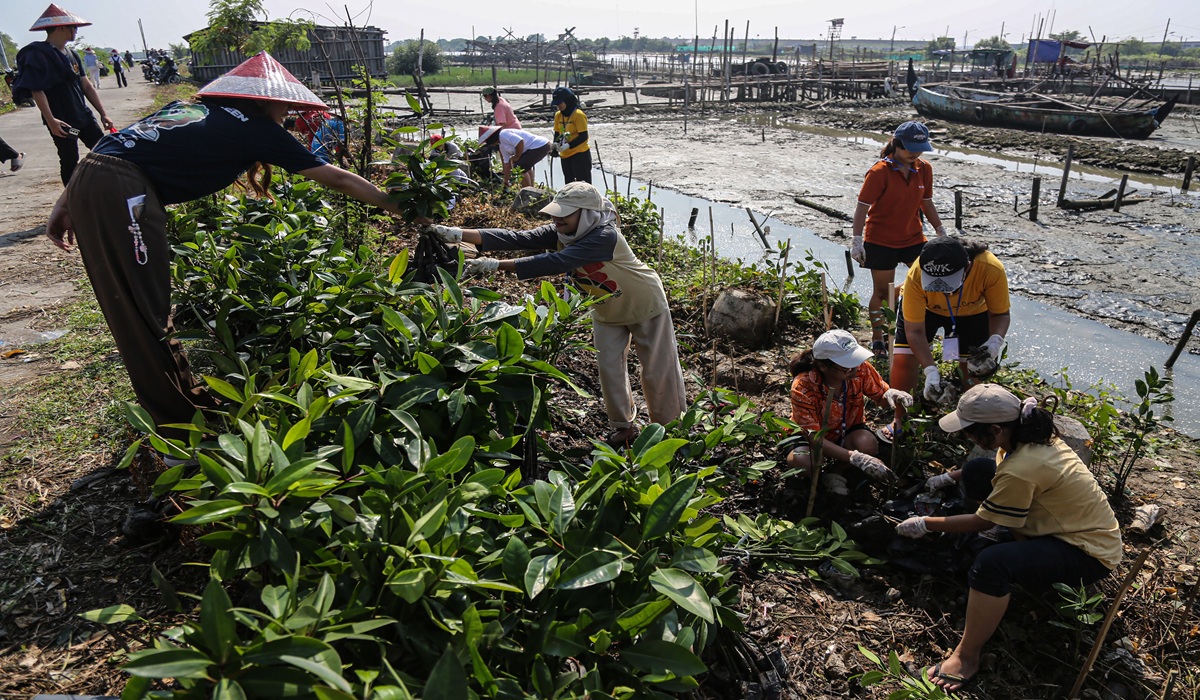
Indonesia plays a crucial role in maintaining global ecological balance, holding nearly 20% of the world’s mangrove ecosystems, equivalent to 54% of Asia’s total mangrove area. However, a major challenge looms over the sustainability of this green asset due to significant degradation over recent decades. According to Global Mangrove Alliance data (2021), Indonesia lost approximately 1.3 million hectares of mangrove between 1980 and 2025, a figure equal to 31% of the national total. In response, the Indonesian Government, through the 2025 National Mangrove Map (SK No. 3438 of 2025), recorded the current mangrove area at 3.45 million hectares.
The Director of Mangrove Rehabilitation at the Ministry of Forestry, Nikolas Nugroho Surjobasuindro, affirmed the government’s commitment to restoring degraded ecosystems. He stated that rehabilitation is not merely planting, but a protection and management effort encompassing various funding schemes. “This effort aims to restore ecosystem functions while creating business opportunities to ensure the welfare of coastal communities. When ecosystem quality improves, fishermen will feel the direct benefits through increased capture fisheries productivity and strengthened food security,” Nikolas said.
Although restoration efforts are ongoing, conventional planting methods are considered to have limitations. The Coastal and Delta Programme Coordinator of Wetlands International Indonesia, Aji Nuralam Dwisutono, revealed that the success rate of direct mangrove planting is only between 10 and 20 per cent. As a solution, the Ecological Mangrove Rehabilitation (EMR) method was introduced. Unlike manual planting, EMR emphasises improving environmental conditions, especially the hydrological and topographical systems. “The main intervention of EMR is to restore the habitat to suit the natural needs of mangroves. With good hydrology, mangrove fruit or propagules can grow naturally without the need for direct planting,” Aji explained during a workshop held in Bogor City on Tuesday (30/6/2026). The EMR method has been implemented by various civil society organisations such as Yayasan Lahan Basah (YLBA), Blue Forests, and YKAN across Java, Kalimantan, Sumatra, Sulawesi, and West Nusa Tenggara.
To strengthen government efforts, Wetlands International Indonesia together with the Global Green Growth Institute (GGGI) launched the NASCLIM (Nature-based Solutions for Climate-smart Livelihoods in Mangrove Landscapes) programme and the Return of the Mangroves (RTM) initiative. This programme is focused on two strategic areas in Kalimantan. The collaboration combines field implementation with community capacity building, aiming to ensure that mangrove rehabilitation is not only ecologically effective but also widely replicable to support climate-smart livelihoods.