
Indonesia Has New Labour Law, Here is the Response from Labour Union Leaders
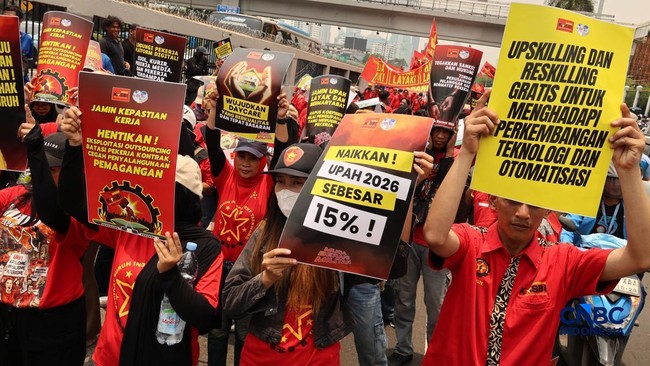
Jakarta, CNBC Indonesia - The All-Indonesia Trade Union Association (ASPIR::RASI) has expressed gratitude and appreciation for the ratification of the Labour Protection Bill into the Labour Protection Law during the Indonesian House of Representatives (DPR RI) Plenary Session on Tuesday (6/10/2026). The President of ASPIRASI, Mirah Sumirat, described the ratification of this Law as a significant momentum and a victory in the long struggle of Indonesian labourers.
“Alhamdulillah. Today we are grateful because the long struggle of the labour class has finally resulted in a Labour Protection Law. This is not merely a change in the name of the law, but a vital step because labour now has its own dedicated legislation,” she stated in a written statement on Wednesday (7/10/2026).
According to Mirah, one of the most critical aspects of this ratification is that labour is no longer merely placed as one of the clusters within the Job Creation Omnibus Law, but now possesses its own regulation specifically designed to regulate and provide protection for workers.
“Labour must not merely be a cluster inserted into a law that regulates so many other sectors. Indonesian workers need a law that specifically provides protection for their rights, job security, and welfare.”
ASPIRASI noted several substantive advancements presented during the ratification process that align with the struggles of trade unions, including those alongside the Great Coalition of Indonesian Labour Struggles (KBPBI).
First, regarding outsourcing. ASPIRASI appreciates the principle that what is outsourced is the work, not the worker, and the existence of limitations on the types of work that can be conducted through outsourcing mechanisms. More importantly, workers employed by companies using subcontracting methods are directed towards obtaining certain status as permanent employees within those companies.
“This is a principle we have long fought for. Do not outsource the workers. Workers must have a clear employment relationship and status certainty. Outsourcing should not be used as an instrument to create cheap and uncertain labour,” she said.
Second, the strengthening of labour supervision through the Labour Oversight Committee. ASPIRASI considers supervision to be one of the weak points in the Indonesian labour system. The limited number of inspectors, budget, and supervisory capacity have previously caused many violations of labour norms to remain inadequately addressed.
“No matter how good a law is, it will be meaningless if supervision is weak. Therefore, the formation of the Labour Oversight Committee must truly become a strong, independent, and effective supervisory instrument,” she noted.
Third, the provision of severance fund reserves. ASPIRASI welcomes the introduction of the idea regarding severance fund reserves as an instrument to ensure that workers’ rights remain available in the event of layoffs (PHK). ASPIRASI is still awaiting and will study the technical mechanisms in the final text of the Law and its implementing regulations.
“In principle, we support this. Workers’ severance rights must not merely be a promise when a layoff occurs. There must be a mechanism that ensures such funds are truly available,” she explained.
Fourth, worker training funds sourced from the State Budget (APBN). ASPIRASI also appreciates the government’s obligation to allocate a budget for the training and competency development of workers. This is deemed increasingly important amidst the accelerated digital transformation, automation, the use of artificial intelligence (AI), and changes in the structure of the working world.
“Workers should not be asked to adapt to AI, digitalisation, and automation only to have the cost of competency enhancement borne by the workers themselves. The State must be present,” she said.
Fifth, the limitation of Fixed-Term Employment Contracts (PKWT) and the certainty of worker status. ASPIRASI noted changes regarding the duration of PKWT, which previously could be long-term, to being more limited, with a contract period of two years and extension mechanisms as regulated by the Law. According to ASPIRASI, the main principle is that employment contracts must not become a trap of indefinite uncertainty.
“Contract workers must have certainty regarding their future. Someone should not work for years in the same company while constantly living under contract status,” she said.
Sixth, apprenticeships must not serve as a cover to replace workers. ASPIRASI supports apprenticeships that are truly intended for education, learning, and competency enhancement, with clear objectives and time limits. However, ASPIRASI strongly rejects the use of apprentice status for job seekers who are actually performing regular company work.
“Apprenticeship is a learning process, not a new way to obtain cheap labour. There should be no workers performing full duties but labelled as apprentices to avoid company obligations,” she stated.
Despite welcoming the ratification of the Labour Protection Law, Mirah emphasised that ASPIRASI will not stop at the euphoria of ratification. ASPIRASI is still awaiting the official copy of the final text of the Law to conduct a clause-by-clause study. This is crucial because several provisions in the Law will still require implementing regulations.
“We are grateful today, but we will not lose our critical stance. In fact, after the Law is passed, the next struggle begins. We will read every clause and monitor all its derivative regulations,” she concluded.
ASPIRASI reminded the Government not to allow implementing regulations to become a gateway to weakening the substance of worker protection that has been fought for in the Law.
Source: jawawa.id (https://jawawa.id/newsitem/indonesia-has-new-labour-law-here-is-the-response-from-labour-union-leaders-1791348784)
Originally published by CNBC Indonesia (https://www.cnbcindonesia.com/news/20261007102937-4-774000/ri-punya-undang-undang-baru-ketenagakerjaan-ini-respons-bos-buruh), translated from Indonesian