
Indonesia Has Major Assets to Become a Magnet for Global Oil and Gas Investment
TANGERANG – The upstream oil and gas (migas) industry is expected to remain a strategic sector amid global energy transition trends. Natural gas is projected to become the primary alternative energy source to support electricity needs and the development of artificial intelligence-based technology in the future.
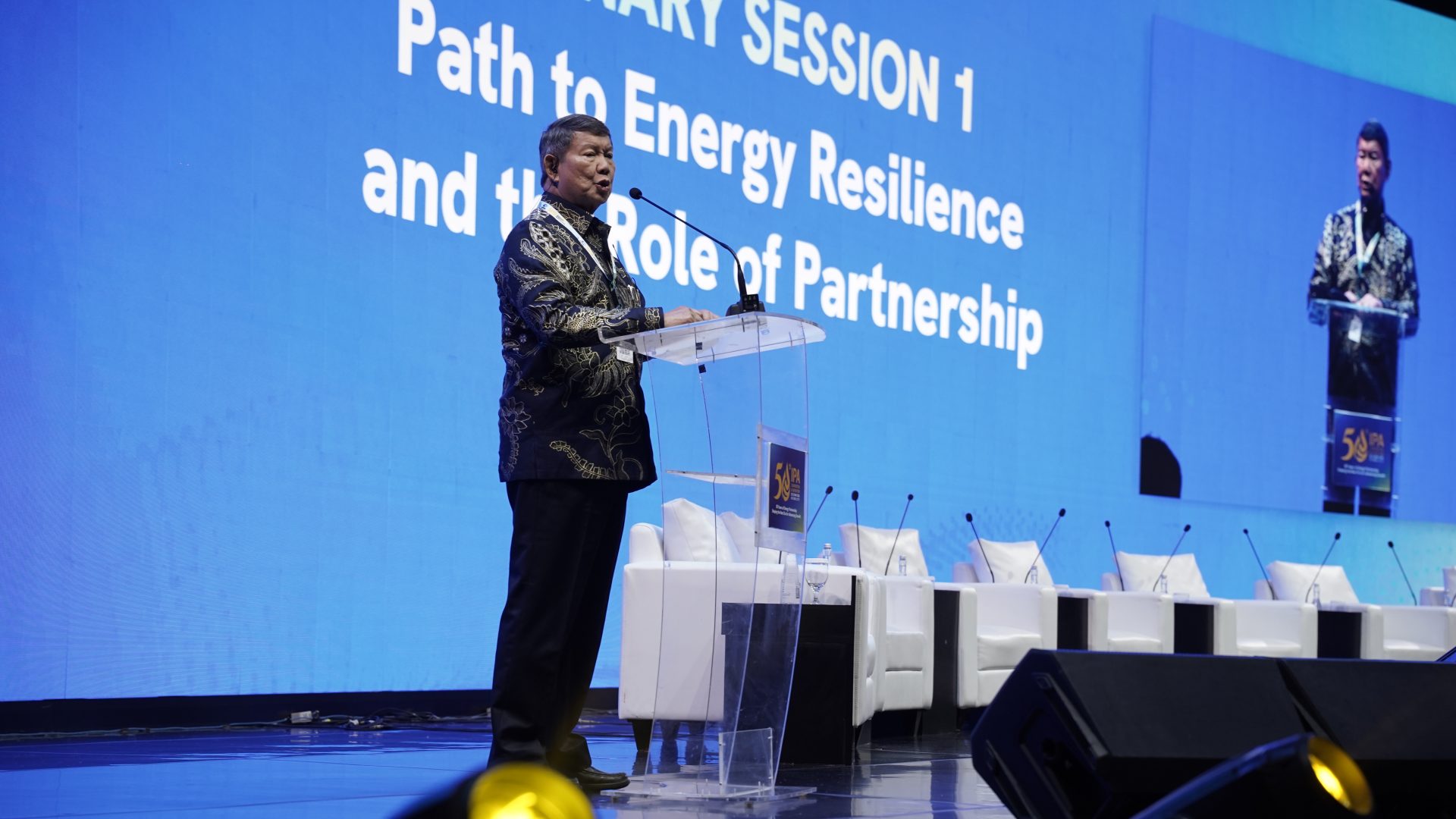
Hashim Djojohadikusumo, Member of the Board of Commissioners of the Indonesia Petroleum Association (IPA), highlighted that Indonesia’s energy needs will continue to increase and Indonesia is positioned to have advantages due to its domestic energy sources.
He assessed that natural gas will play an important role in the energy transition era alongside targets for economic growth, which are also driven by increased electricity demand. “Therefore, I am optimistic that the energy sector will be highly relied upon, especially natural gas, especially natural gas,” Hashim said during the Plenary Session: Path to Energy Resilience & The Role of Partnership at IPA Convex 2026, at ICE SBD, Wednesday (20 May).
He explained that the shift towards electric vehicles will alter national energy consumption patterns. Fuel consumption is estimated to decline gradually, but electricity demand is instead projected to increase significantly, making natural gas an important energy source for power generation.
Nevertheless, Hashim stressed that energy transition does not mean reducing the importance of the upstream oil and gas sector. On the contrary, national energy needs are predicted to surge due to economic growth and the digital revolution. He estimated that Indonesia’s energy consumption will increase dramatically over the next five years.
“Companies such as Amazon, Microsoft, Apple, and others view Indonesia as a primary location for data centre investment, and this is what will be the reason why energy usage will spike dramatically,” Hashim said.
He reminded that upstream oil and gas investment will only flow in if the government can maintain legal certainty, political stability, and a competitive fiscal scheme. “Investors need legal certainty, they need stability,” he stressed.
Meanwhile, Kathy Wu, President of IPA, revealed that the investment requirements outlined by Hashim are indeed among the considerations for major companies such as BP when investing. Especially in the current era, management is more selective in investing because it must ensure genuine return on investment guarantees.
She said that competition for capital allocation within both BP and IPA member companies is fierce and increasingly difficult.
“For this reason, projects in Indonesia must be truly competitive, both in terms of return on investment levels, risk, certainty of implementation, and certainty of results calculated on paper that can genuinely be realised,” Kathy said.
Wade Floyd, Vice President of IPA, assessed that Indonesia has a long history with upstream oil and gas industry players. This history has been built through good relationships that have been maintained until now. According to him, this long history was built on the basis of partnership and collaboration.
“In my view, that is one of the reasons for Indonesia’s success today. The role of international investors is to bring unique capabilities such as technology, large-scale project integration, execution capability, and world-class human resources to support Indonesia’s growth,” Wade said.
Ronald Gunawan, Vice President of IPA, stated that Indonesia actually has advantages to become a major player in the global oil and gas business, ranging from good return on investment levels, the presence of stability, and the fiscal scheme is also very good. The only remaining task is to shorten project execution timelines. “Indonesia already has all the important elements. If execution could be faster, I am confident Indonesia will become a top-tier investment destination,” Ronald stressed.
Meanwhile, Awang Lazuardi, President Director of PHE, stated that there is still much room to improve ease of doing business, particularly in the upstream oil and gas sector. From a licensing perspective, all stakeholders must build a shared understanding that energy resilience is not just an oil and gas industry issue. “But a national issue,” Awang said.
Djoko Siswanto, Head of the Special Work Unit for the Implementation of Upstream Oil and Gas Activities (SKK Migas), affirmed that the government is fully committed to creating a safe, comfortable, and flexible investment climate. One of the initiated strategies is to align frequencies across ministries, which is widely recognised as a major challenge for upstream oil and gas projects.
This comfort and flexibility relate to the duration of project completion because as projects drag on, the economics of these projects deteriorate and ultimately the project cannot be executed because it does not meet the economic requirements. “Once an investment decision is made, it must be implemented immediately. If there are problems, let us sit down together and resolve them one by one. The key is project acceleration. I believe there is no problem that cannot be resolved,” Djoko explained.
The Ministry of Energy and Mineral Resources recognises that to increase investment enthusiasm, business convenience must be continuously improved and the biggest challenge frequently faced by industry practitioners in the field is bureaucratic coordination, particularly regarding licensing and land use.
Laode Sulaeman, Director General of Oil and Gas at the Ministry of Energy and Mineral Resources, affirmed that the government consistently conducts inter-ministerial coordination to untangle the bureaucratic complications often complained about by business practitioners. “Regulation in the oil and gas sector is already sufficiently clear so that legal certainty remains maintained,” Laode said.