
Indonesia Has a Gas Alternative to LPG: What About Its Safety Aspects?
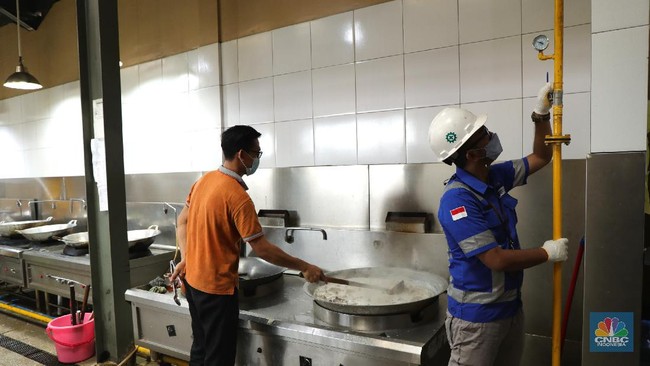
The government is currently examining the development of 3-kilogram Compressed Natural Gas (CNG) as an alternative replacement for subsidised Liquefied Petroleum Gas (LPG). At present, the government is still delving into various aspects, particularly those related to the safety of CNG usage.
The Director General of Oil and Gas (Dirjen Migas) at the Ministry of Energy and Mineral Resources (ESDM), Laode Sulaeman, stated that the study involves multiple ministries.
“As announced by the Minister, we are now analysing various aspects. One of the important aspects is the safety aspect,” said Laode at the Ministry of ESDM on Wednesday (13/5/2026).
According to him, the study is not only conducted by the Ministry of ESDM but also involves the Ministry of Industry, the Ministry of Manpower, and the National Standardisation Agency (BSN), which is authorised to issue technical standards.
“The safety aspect is not only from the Ministry of ESDM, but also from the Ministry of Industry, the Ministry of Manpower, and BSN, which issues the standards. We are consolidating all of this so that we can handle this aspect,” he said.
As is known, the government is opening the option of using 3-kilogram CNG as a substitute for subsidised LPG to reduce dependence on LPG imports while utilising domestic natural gas.
Previously, the Minister of Energy and Mineral Resources (ESDM), Bahlil Lahadalia, assured that the government will continue to provide energy subsidies to the public if they use CNG as an alternative replacement for LPG.
According to Bahlil, this policy aligns with the President’s directive that the national energy programme should remain supportive of the people who need it.
“The President’s directive, whether CNG or LPG, will always prioritise helping the people who truly need our assistance. In this way, I assure you that subsidies must still be provided for the people,” said Bahlil after the inauguration at the Ministry of ESDM on Wednesday (6/5/2026).
In addition, Bahlil said the government is also working to ensure that the selling price of CNG in the future can be equivalent to the price of 3-kg LPG currently used by the public.
Understanding and Specifications of CNG
Referring to the definition in Presidential Regulation No. 64 of 2012 on the Provision, Distribution, and Pricing of Gas Fuel for Road Transportation, CNG is gas sourced from natural gas with methane (C1) components.
The gas is compressed and stored in special pressure cylinders to make it easier to transport, store, and use as vehicle fuel.
According to the official website of PT PGN (PGAS), natural gas itself consists of a mixture of elements such as hydrocarbons comprising methane (C1), ethane (C2), propane (C3), and butane (C4). CNG itself consists of 95% methane content.
Given the diversity of natural gas elements, their processing and utilisation also vary. Natural gas can be processed into LPG, Liquefied Natural Gas (LNG), including into CNG.
Understanding CNG is often accompanied by an understanding of LPG and Liquefied Natural Gas (LNG). However, it should be noted that CNG, LPG, and LNG are three different things.
The main difference between CNG, LPG, and LNG lies in their physical state and storage pressure. CNG is stored in gaseous form at high pressure, while LPG is in liquid form at moderate pressure and temperature. LNG, on the other hand, is transported in liquid form at very low temperatures.