
Indonesia Flooded with Imported Sugar, Sugarcane Farmers Suffer, Prabowo Government Takes Action
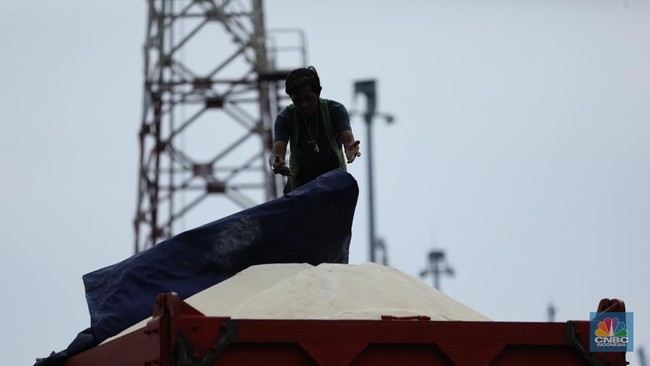
Jakarta, CNBC Indonesia – Agriculture Minister Amran Sulaiman has said his ministry is ready to meet the accelerated sugar self-sufficiency target instructed by President Prabowo Subianto, which must be achieved within two years.
Sugar self-sufficiency can no longer be delayed. Therefore, all measures — from enforcing mandatory plantation obligations, sugarcane replanting, to cracking down on illegal refining — will be implemented simultaneously and immediately.
“This is not merely a target on paper. Farmers have suffered long enough; now is the time for the state to step in and prove that the promise of self-sufficiency is real,” Amran said in a statement on Wednesday (29 July 2026).
On President Prabowo Subianto’s instruction, he continued, the government will carry out a major overhaul of national sugar governance through an accelerated sugarcane replanting programme, known as ratoon removal.
The programme targets 100,000 hectares this year and 150,000 hectares next year. It is described as a strategic step to boost productivity and strengthen national sugar independence.
“This step is extremely urgent given that around 85 percent of the national sugarcane crop is old and no longer productive. It therefore needs to be replanted immediately with superior varieties and more modern cultivation methods,” Amran said.
Refined sugar factories required to own their own sugarcane plantations
Amran also highlighted uncontrolled refined sugar imports that are flooding the domestic consumption market.
He said the situation has directly hit the performance of PT Perkebunan Nusantara, with losses of around Rp600 billion because PTPN’s sugar, which should have sold well in the market, has been squeezed out by leaked refined sugar.
“At the farmer level, the impact is visible in the plummeting price of molasses (sugarcane treacle). From around Rp1,900 to around Rp1,000 per litre in March 2026, nearly half the previous price,” he explained.
“Sugarcane farmers in East Java even threatened a mass strike because tens of thousands of tonnes of harvested sugar piled up in warehouses with no market uptake, whilst awaiting the disbursement of Rp1.5 trillion from Danantara to buy farmers’ sugar, which had been delayed for up to eight harvest periods,” he continued.
He estimated total losses from unsold farmers’ sugar at 1.6 million tonnes, with estimated economic losses for farmers ranging from Rp4 to Rp7 trillion.
“What is happening on the ground, let’s be frank about it, is a flood of refined sugar. If it were leakage, it would only be a trickle. This is a flood and sugarcane farmers are suffering extraordinary losses,” he asserted.
“This problem of unsold harvests has triggered a series of protests by sugarcane farmers recently. In Blora, Central Java, thousands of farmers grouped under the Indonesian Smallholder Sugarcane Farmers Association took to the streets twice, in April and June 2026. In the second action, farmers even dumped their sugarcane harvest in front of the factory as a form of protest,” Amran said.
Consequently, he said, the government is requiring refined sugar factories, which until now have relied solely on imported raw sugar, to build their own sugarcane plantations.
“All private companies operating in the sugar industry are obliged to build their own plantations. The same applies to importers. There will be no more tolerance for those who rely solely on imports without contributing to developing plantations domestically,” Amran said.
“Refined sugar importers must build sugarcane plantations. They cannot continue to depend on imported raw materials whilst domestic sugarcane farmers struggle to sell their harvest,” he stressed.
Amran said the requirement for the sugar processing industry to own sugarcane plantations is not a new rule.
“This mandatory plantation requirement has existed since 2014 under the Plantation Law. Now we are making sure all business players actually comply with it,” he said.
Under Article 43 of Law No. 39/2014 on Plantations, he explained, every plantation-based processing unit using imported raw materials must build its own plantation no later than three years after its processing facility begins operations.
“So this is not a rule that suddenly appeared. A ministerial regulation governing this obligation has existed since 2013, and it was reinforced by law a year later. The problem is that this rule has not been enforced firmly for years,” Amran said.
Source: jawawa.id (https://jawawa.id/newsitem/indonesia-flooded-with-imported-sugar-sugarcane-farmers-suffer-prabowo-government-takes-action-1785325965)
Originally published by CNBC Indonesia (https://www.cnbcindonesia.com/news/20260729143742-4-754790/ri-banjir-gula-impor-petani-tebu-merana-pemerintah-prabowo-bertindak), translated from Indonesian