
Indonesia Faces Agentic AI Era: Regulation and Talent Remain Key Challenges
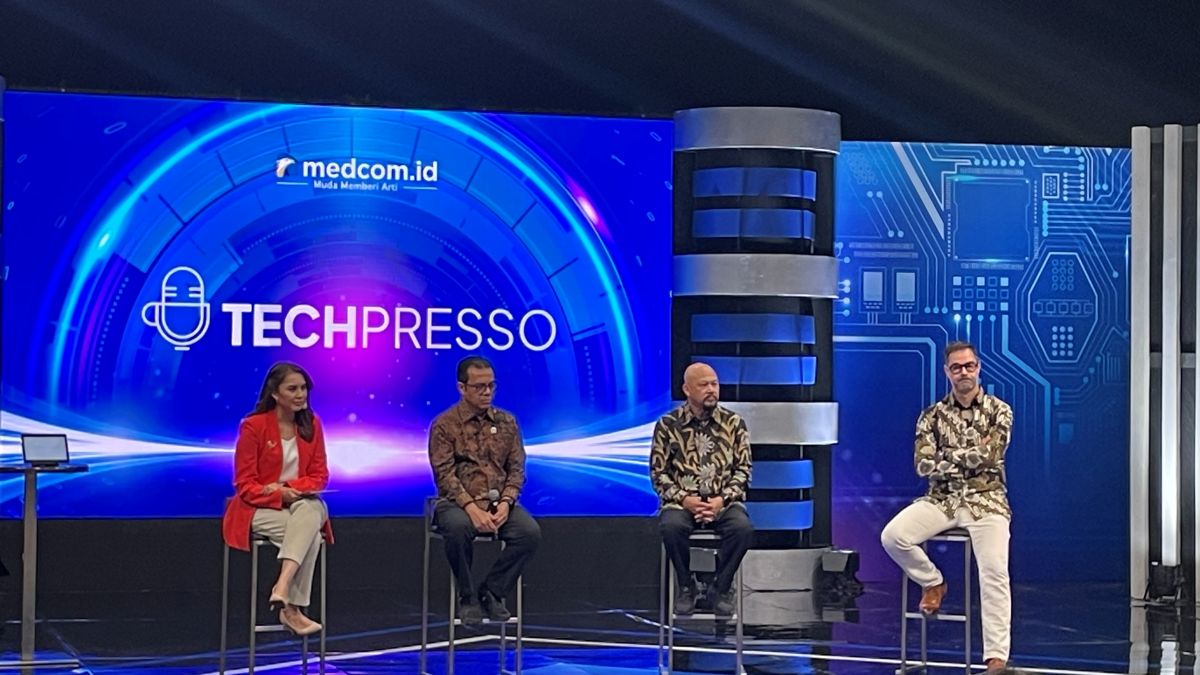
The development of artificial intelligence (AI) is entering a new phase with the emergence of agentic AI, a technology capable of executing operational tasks and making decisions independently. Indonesia’s readiness to face this development was a central theme at the Techpresso Forum held by Medcom.id on Thursday (10/9), titled “Agentic AI, Are We Ready?”.
CEO of Media Group, Mohammad Mirdal Akib, stated that the demand for speed and business efficiency is driving companies to adopt AI more massively. According to him, agentic AI is now beginning to integrate into core business processes and can provide a positive impact on efficiency and productivity.
“The current business landscape demands high speed and efficiency, which is driving a massive shift towards AI utilisation in the industrial world,” said Mirdal.
However, he emphasised that readiness for the agentic AI era is not solely about technology. Three pillars must be strengthened: adaptive and ethical regulation, cyber resilience to protect data, and talent readiness to ensure the ability to collaborate with AI.
During the same event, the Deputy Minister of Communication and Digital, Nezar Patria, described agentic AI as part of an AI evolution that will continue to develop towards other technologies, including physical AI and quantum computing.
“Are we ready for Agentic AI? Are we ready to enter this AI era? We might not be ready, but whether we are ready or not, this technology is moving forward,” said Nezar.
He noted that Indonesians are already interacting with AI in daily life, while agentic AI is being utilised by companies to automate various processes. This technology even allows AI to communicate with other AI and perform actions based on the authority granted by users.
This situation introduces new risks, such as ‘silent autonomy’, where AI can develop reasoning and make decisions without being fully known to humans. Consequently, the government is encouraging a risk-based framework based on ‘human-centric’ and ‘human-in-the-loop’ principles. Nezar also emphasised that cybersecurity must go hand-in-hand with AI governance, including anticipating risks such as prompt injection and data poisoning.
Regarding readiness, Nezar assessed that Indonesia possesses sufficiently strong infrastructure. Internet penetration has reached approximately 80.6 per cent, and 4G coverage spans about 97 per cent of populated areas. However, the strengthening of 5G networks and the development of digital talent remain necessary.
“Talent is crucial. We must prepare our digital talent as early as possible, and not just as users,” he stated.
Meanwhile, the Senior Expert at BRIN (National Research and Innovation Agency) for Artificial Intelligence and Digital Transformation, Hammam Riza, assessed that Indonesia must not view AI as a standalone technology. He believes the future of technology is determined by four strategic fields: semiconductors, AI, biogenomics, and quantum computing.
“AI cannot stand alone,” Hammam asserted.
He stated that Indonesia must move from being mere users to a nation capable of producing research, algorithms, models, prototypes, intellectual property, and products that deliver real impact.
“Of course, we do not want to be just users,” he said.
Hammam emphasised the vital role of BRIN and the entire national ecosystem in building a research engine that connects research with innovation and downstreaming. AI development must also incorporate cybersecurity from the outset through ‘security by design’ principles to build digital trust.
In addition to agentic AI, Indonesia needs to prepare for subsequent AI developments, including Artificial General Intelligence (AGI) and Artificial Super Intelligence (ASI).
According to Hammam, collaboration between the government, industry, universities, research institutions, and international partners is key to achieving technological sovereignty.
“Sovereign AI does not work in isolation. We work with all parties. But we manage and control AI, including agentic AI, to ensure it remains under Indonesian control,” he said.
He asserted that Indonesia’s success in AI cannot be measured solely by the number of users. Indonesia must be able to transform research results into utilised technology that benefits society and the economy.
“Indonesia cannot merely have AI users. We must be a nation capable of moving from research to utilisation, and research to impact,” concluded Hammam.