
Indonesia Emas or Indonesia Teler?
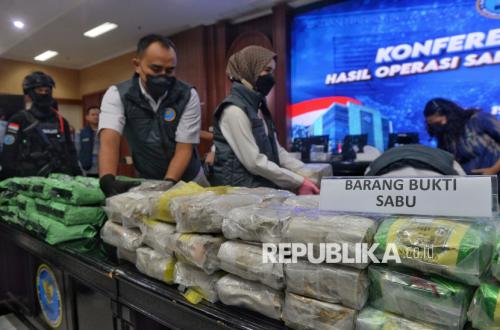
Every 26 June, the world commemorates International Anti-Narcotics Day. As in previous years, ceremonial seminars are held, warning banners are unfurled, social media campaigns are enlivened, and calls for a war on drugs echo across the nation. Yet amidst this commotion, why does narcotics become increasingly adept at finding its way into the heart of society? Why do we condemn the dangers of narcotics every year, while at the same time, its distribution networks grow ever more tentacular and never cease recruiting new victims?
This nation is placing great hope in the demographic bonus to achieve the vision of a Golden Indonesia 2045. Our public sphere is currently saturated with narratives of human resource development, accelerated industrial downstreaming, digital transformation, and enhanced global competitiveness. We are grandly building toll roads, ports, dams, and various other physical infrastructures. However, behind all this, a destructive threat is waging a guerrilla war from within. A threat that does not work by toppling tall buildings, destroying highways, or damaging long-span bridges. It creeps silently but devastates human beings by impairing the function of the intellect, weakening character, and slowly gnawing at the marrow of the nation’s future. That threat is narcotics.
Indonesia is currently enjoying the dawn of a demographic bonus, which many experts call a golden opportunity that may only come once in a nation’s history. Yet, it is at this point that the paradox of development finds its most bitter form. While the state is busy preparing a superior generation to lead Indonesia in the future, drug syndicates are working without regard for the academic calendar to seize that same generation. Empirical data shows a worrying trend. The prevalence rate of drug abuse in 2023 was 1.73 percent, or around 3.33 million people, and has now crept up to 2.11 percent, equivalent to 4.15 million people in 2025. Even more horrifying, hundreds of thousands of them are teenagers, with the 15 to 24 age group being the most vulnerable segment. This fact confirms one thing: narcotics are not attacking our past, but are actively sabotaging Indonesia’s future. When we talk about the Golden Indonesia roadmap, drug lords see it as a market expansion opportunity. When the state designs human resource quality, dark syndicates are designing network expansion. Thus, narcotics can no longer be reduced to a mere criminal issue; it has mutated into a civilisational threat.
In the realm of law, many understand the prohibition of narcotics solely because of their intoxicating nature. This perspective is not wrong, but it is too narrow. In the tradition of ushul fiqh, scholars have outlined that the entire fabric of Islamic law is designed for one noble purpose: to maintain human welfare, known as Maqashid asy-Syari’ah, which includes the protection of five fundamental pillars: religion, life, intellect, lineage, and property. Narcotics brutally destroy all five of these sacred pillars simultaneously, with the epicentre of the damage striking directly at the most fundamental aspect: the human intellect. The intellect that God bestowed so that humans can think, learn, innovate, and distinguish between truth and falsehood. Therefore, Islam places sacred importance on fortifying the function of the intellect. A rule of ushul fiqh states, ‘Al-hukmu yaduru ma’a ’illatihi wujudan wa ’adaman’, meaning the law revolves around its legal reason, both in its presence and absence. If khamr is forbidden because of its consciousness-damaging effects, then all modern chemical substances that have similar or more destructive power automatically fall under the same law. Islam prohibits narcotics not merely because of their physical entity, but because the Sharia has an ideological interest in protecting the intellect as the foundation of civilisation. Without a healthy intellect, knowledge will wither; without knowledge, productivity will be paralysed; and without productivity, the dream of national progress will only end as a stale political slogan.
The map of the modern economy teaches that a country’s glory is no longer determined by the abundance of natural resources contained in its earth. Many developed countries are poor in natural resources, yet they control the world because they have invested in robust, creative, and educated human capital. Conversely, even a country abundant in oil and minerals will remain trapped as a spectator if the quality of its people is low. It is at this level that the true destructive power of narcotics lies. It does not merely undermine biological health, but structurally impoverishes a nation’s human capital. Narcotics erode cognitive capacity for learning, kill the work ethic, demolish mental health, and destroy the smallest family institutions. How many future scientists, technocrats, doctors, entrepreneurs, scholars, and national leaders have been lost from the radar of history because they fell into the black hole of narcotics? The greatest loss for a nation is not when it loses its foreign exchange reserves, but when it loses its people.
Why, after decades of war, have we not yet won the battle against narcotics? The answer is simple: because we are too busy fighting downstream while forgetting to build fortifications upstream. The state is busy hunting dealers, seizing tonnes of evidence, and rehabilitating addicts, but is often negligent in building the ideological and spiritual immunity of the nation. We are too focused on the physical rehabilitation of victims, but forget the spiritual and intellectual rehabilitation of the generation. We are too busy calculating the material losses from narcotics, but rarely calculate the loss of the nation’s intellect and character. In the language of maqashid, we are too focused on the aspect of hifzh al-mal and hifzh an-nafs, but are negligent about hifzh al-’aql, which is the very core of the narcotics attack. In fact, without a healthy intellect, the protection of the other four pillars will be meaningless. A person whose intellect is damaged will not be able to maintain their religion, will not be able to protect their own soul, will not be able to guard their lineage, and will not be able to manage their property.
Therefore, the war against narcotics must be repositioned as a war of civilisation, not just a war of law. The approach cannot be merely penal, but must be holistic. The upstream side must be strengthened through education that builds awareness of the sacredness of the intellect, through families that instil spiritual values, and through communities that provide space for positive expression for the younger generation. The downstream side must remain firm, but not merely punitive. The rehabilitation process must touch the spiritual and intellectual dimensions, not just the physical. The nation must realise that every single young person who falls into the trap of narcotics is a loss of one future leader, one innovator, and one pillar of civilisation. The demographic bonus that we are so proud of can turn into a demographic disaster if the generation that is supposed to be the engine of progress is instead ravaged by narcotics. The choice is clear: Indonesia Emas or Indonesia Teler? The answer lies in how seriously we protect the intellect of the nation’s children today.