
Indonesia Continues to Quietly Import Spades from China and Pakistan, but at Much Lower Volumes
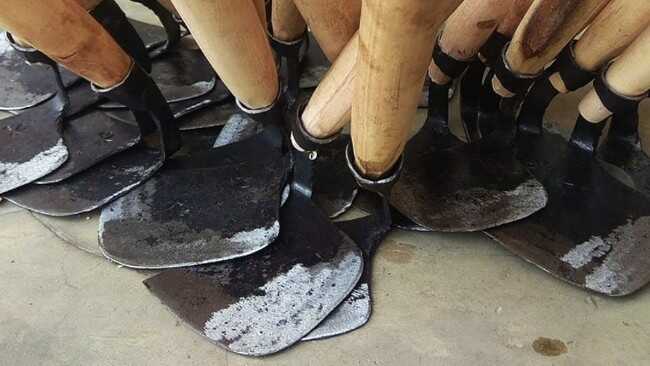
The issue of spade imports became a contentious debate during President Joko Widodo’s administration. Between 2019 and the early 2020s, the government viewed purchases of simple agricultural tools from abroad as difficult to justify. Spades became a frequent example because they are synonymous with Indonesia’s domestic small-scale industries. Trade data from that period recorded substantial transactions, with import volumes reaching hundreds of tonnes over several years, prompting criticism of government procurement practices and the readiness of local industries.
Recent developments show a markedly different situation. Data from the Central Bureau of Statistics (BPS) indicates that imports of agricultural hand tools still occur, but on a significantly smaller scale. Trade values now range from thousands to tens of thousands of dollars annually—far below levels seen at the beginning of the decade.
The change is particularly evident in the flat spade category (HS 82011000). According to BPS, in 2021 the import value was recorded at US$63,102 with a volume of approximately 59 tonnes. A year later this fell to US$10,432 with a volume of 3.45 tonnes. Subsequent movements continued to decline. In 2023, the recorded value was US$8,862 with a volume of approximately 1.7 tonnes. In 2024 the figure was US$9,515 with a volume of less than one tonne. By 2025, the import value stood at just US$3,911 with a volume of approximately 59 kilogrammes. Trade that was once measured in tens of tonnes is now on a kilogramme scale.
Trade Ministry data showing spade sources in 2025 indicates supplies are scattered across several countries. Supplies come from Pakistan, China, Belgium, Germany, and Romania. The small import values demonstrate that transactions are occurring in very limited quantities.
For cangkul (hoe) HS 82013010, the trade scale is far smaller. Imports in 2022 were recorded at US$254 with a volume of approximately 38 kilogrammes. The following year this fell to just US$64 with a volume of 2 kilogrammes. In 2024 the figure was US$53 with the same volume. By 2025 the import value rose to approximately US$321 with a volume of approximately 27 kilogrammes. These figures demonstrate that hoe imports are occurring at quantities far smaller than at the beginning of the decade.
Another category, HS 82013090, which includes mattocks and picks, still records higher values compared to ordinary hoes. In 2021 its value reached US$92,435 with a volume of approximately 120 tonnes. In 2022 this fell to US$27,103 with a volume of approximately 23 tonnes. In 2023 the recorded value was US$5,944 with a volume of approximately 1 tonne. In 2024 this rose to US$23,866 with a volume of approximately 2.5 tonnes. By 2025 the import value was recorded at US$28,906 with a volume of approximately 609 kilogrammes. Sources for this category in 2025 come from several countries, including Japan, Germany, Singapore, the United States, and Australia. The pattern of origin differs from spades, which predominantly come from simple tool-producing nations.
At the beginning of the decade, import volumes of agricultural hand tools were on a scale of tens to hundreds of tonnes. Now, transactions occur in small quantities. Imports persist, but their position is far lower than during the period when the spade issue was widely debated.